What a panchang is
The word panchang means “five limbs”. A traditional panchang describes each day through five elements: tithi (the lunar day), vara (the weekday), nakshatra (the Moon’s lunar mansion), yoga and karana. Over centuries, families, priests and astrologers have used the panchang to choose days for ceremonies, fasts and new beginnings, and to know which festival or observance falls when.
OIOA’s panchang focuses on the elements most people check every day: the tithi, the nakshatra, the paksha (the bright or dark half of the lunar month), the lunar month itself and, when it occurs, Adhik maas. Alongside these, the Home screen shows Choghadiya, Hora, Rahu Kaal, Abhijit muhurat, sunrise and sunset, and Panchak while it is running.
What you see in OIOA
When your community is set to Hindu or Jain, the Home screen opens with a Today card. It brings the day’s panchang together in one place, and its live sliders let you move through the day to see which timings apply at any moment, not just right now.
- Tithi: the current lunar day, with its paksha. A tithi does not line up with the calendar day, so it can begin and end at any time. Read more on the tithi page.
- Nakshatra: which of the 27 nakshatras the Moon is passing through.
- Paksha: Shukla paksha (waxing, from new moon to full moon) or Krishna paksha (waning, from full moon to new moon).
- Lunar month: the name of the current month in the lunar calendar.
- Adhik maas: when an extra lunar month is running, OIOA marks it so you know why familiar observances may seem to move.
- Sunrise and sunset: for your exact location, because many panchang elements are judged at sunrise.
How OIOA calculates the panchang
A panchang is astronomy. The tithi depends on the angle between the Moon and the Sun, the nakshatra on the Moon’s position among the stars, and sunrise on your latitude, longitude and the date. OIOA computes all of these on your phone, using your location (or a city you pick) and the date. There is no daily dependence on a server, which is why the panchang still works when you are offline.
Text version of this diagram
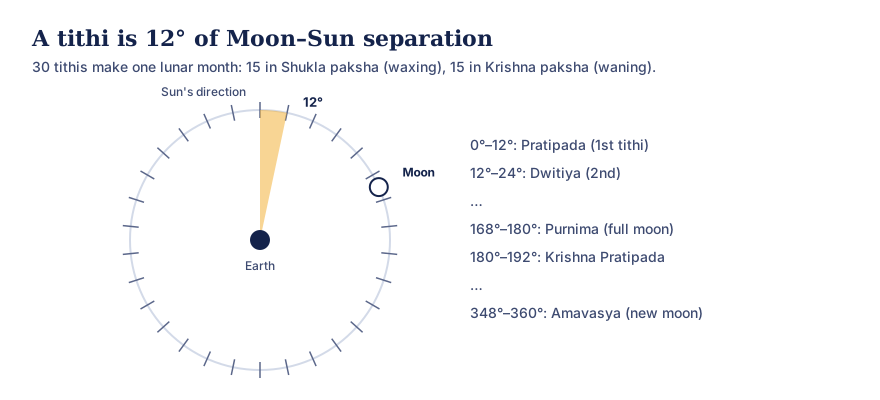
A tithi is the time it takes for the angle between the Moon and the Sun, as seen from Earth, to grow by 12 degrees. 360 degrees divided by 12 gives 30 tithis in a lunar month. 0–12° is Pratipada, 168–180° ends at Purnima (full moon), and 348–360° ends at Amavasya (new moon).
Because these are real astronomical quantities, the panchang for Kolkata and the panchang for Ahmedabad can differ on the same day, especially for sunrise-based elements. India runs on one clock, Indian Standard Time, but the Sun does not rise at the same moment everywhere.
Text version of this diagram
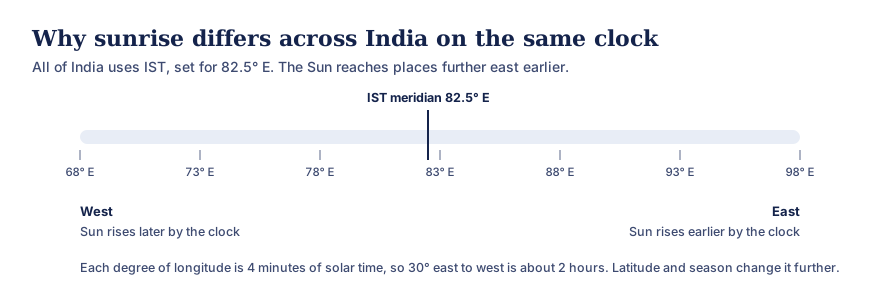
All of India uses Indian Standard Time, which is based on the 82.5° E meridian. Each degree of longitude equals four minutes of solar time, so places in the far east of India see sunrise by the clock up to about an hour earlier than IST’s reference meridian, and places in the far west up to about an hour later. Latitude and the season change sunrise times further.
Why your printed panchang might differ
You may sometimes see a small difference between OIOA and a printed panchang, a jantri or a temple calendar. There are several honest reasons for this, and none means one source is “wrong”:
- Location. A printed panchang is usually calculated for one city. If you live elsewhere, sunrise and therefore the tithi at sunrise can differ.
- Month system. Some regions name months the Amanta way, ending at new moon, and others the Purnimanta way, ending at full moon. The Krishna paksha can carry a different month name depending on which you follow.
- Astronomical method. Traditional panchangs follow different schools of calculation. Small differences in method can shift the end time of a tithi or nakshatra by minutes.
- Local custom. For festivals, many communities follow a rule such as the tithi prevailing at sunrise, and families or temples may make their own decision.
If a festival or observance matters to you, please follow your family’s or community’s authority. OIOA is a guide, and the disclaimer explains this in full. If you think OIOA has got something wrong, tell us what we missed with your location, the date and your source.
Adhik maas in the panchang
Lunar months are about 29.5 days long, a little shorter than solar months. Roughly every 32 to 33 months, a lunar month passes without the Sun moving into a new zodiac sign. That month is counted as an extra month, Adhik maas, so the lunar calendar stays in step with the seasons. Observances that would normally fall in that month usually move to the regular month that follows. OIOA shows Adhik maas when it is running. For the full explanation, see Adhik maas explained.
Using the panchang day to day
People use the panchang in many ways, and OIOA tries to make each of them easy:
- Planning a fast or an observance that falls on a particular tithi, such as Ekadashi or Purnima. Set a reminder so you don’t miss it.
- Choosing a time for a puja, a journey or the start of something new, using the Choghadiya or Hora running at that moment, and avoiding Rahu Kaal if that is your practice.
- Understanding a family member’s birth details, such as their birth nakshatra, alongside the family feature.
- Simply knowing the day: which paksha you are in, how far the month has run, and when the next full or new moon is due.
The panchang in your language
The panchang is available in English and in Gujarati, Hindi, Marathi, Bengali, Tamil, Telugu, Kannada, Malayalam, Odia, Assamese, Punjabi, Arabic and Urdu. The EN ⇄ local-language toggle switches the whole page, so you can read tithi and nakshatra names in the script you grew up with. See multi-language.
For the Jain Home screen
Choose Jain as your community and you get everything in this panchang, plus the 28 Jain nakshatras, daily Navkarshi times and calendars for Shwetamber, Digamber, Khartargachh, Sthanakwasi and other traditions.
Learn more
Common questions
Is the panchang the same as a kundli?
No. The panchang describes the day: its tithi, nakshatra and other elements, for everyone in a place. A kundli (birth chart) describes the sky at a person’s birth.
Can I see the panchang for another city?
OIOA calculates for your current location or a city you choose, so you can set the city you’re interested in.