The Shaka era
Shaka Samvat (Saka era) counts years from 78 CE. It has long been used with the Hindu panchang, especially in South India and Maharashtra, and in astronomical texts. In traditional use, its years run with the lunar months of the panchang, with the new year at Chaitra Shukla Pratipada, celebrated as Ugadi in Karnataka, Andhra Pradesh and Telangana and as Gudi Padwa in Maharashtra.
Converting years
- From the Shaka new year onwards: Shaka = CE − 78
- Before it in that Common Era year: Shaka = CE − 79
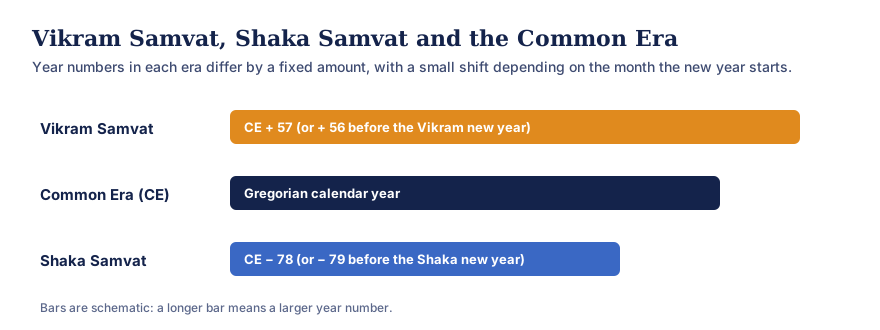
Text version of this diagram
- Vikram Samvat year = Common Era year + 57, or + 56 for the part of the year before the Vikram new year.
- Shaka Samvat year = Common Era year − 78, or − 79 for the part of the year before the Shaka new year.
The Indian national calendar
In 1957, on the recommendation of the Calendar Reform Committee, the Government of India adopted a reformed national calendar based on the Shaka era. It is a solar calendar, unlike the traditional lunar reckoning:
- The year begins on 1 Chaitra, which is 22 March in a normal year and 21 March in a Gregorian leap year.
- Chaitra has 30 days (31 in a leap year), the next five months have 31 days each, and the last six have 30 days.
- Leap years coincide with Gregorian leap years.
The national calendar is used alongside the Gregorian calendar in the Gazette of India, government communications and All India Radio broadcasts. Its months share names with the lunar months but don’t coincide with them.
| National month | Begins on (normal year) |
|---|---|
| Chaitra | 22 March |
| Vaishakha | 21 April |
| Jyeshtha | 22 May |
| Ashadha | 22 June |
| Shravana | 23 July |
| Bhadra | 23 August |
| Ashvina | 23 September |
| Kartika | 23 October |
| Agrahayana | 22 November |
| Pausha | 22 December |
| Magha | 21 January |
| Phalguna | 20 February |
Traditional and national Shaka
Because the same era name is used for two systems, it helps to be clear which is meant:
- Traditional Shaka: lunar months of the panchang, new year at Chaitra Shukla Pratipada, used for religious observance.
- National Shaka: fixed solar months, new year on 22 March, used for official dating.
What OIOA computes
OIOA’s Hindu and Jain Home screens show the lunar panchang used with the traditional Shaka era: tithi, paksha, lunar month and Adhik maas, calculated on your phone for your location. For the national calendar date, the table above converts directly from the Gregorian date.
For how the traditional and national new years are celebrated, see Vikram, Shaka and Gujarati New Year. The sister era in the north and west is Vikram Samvat, and the solar months behind regional calendars are explained in Sankranti and solar months.