A lunar calendar
The Hijri calendar counts years from the Hijrah, the migration of the Prophet Muhammad (peace be upon him) from Makkah to Madinah in 622 CE. It is purely lunar: twelve months of 29 or 30 days each, making a year of about 354 or 355 days. Unlike lunisolar calendars, it never adds an extra month, so it is not tied to the seasons.
Text version of this diagram
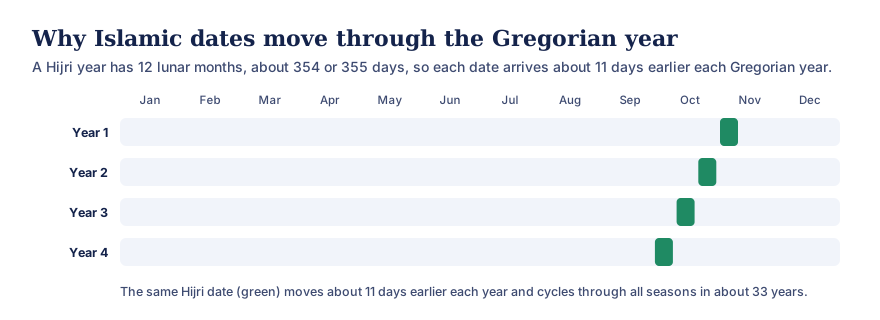
A Hijri year has 12 lunar months and lasts about 354 or 355 days, around 11 days shorter than a Gregorian year. So a given Hijri date falls about 11 days earlier each Gregorian year and passes through every season in about 33 years.
As a result, each Hijri date arrives about 11 days earlier each Gregorian year, and Ramadan, for example, moves through summer, monsoon and winter over a cycle of about 33 years.
The months
- Muharram
- Safar
- Rabi’ al-Awwal
- Rabi’ al-Thani (Rabi’ al-Akhir)
- Jumada al-Ula
- Jumada al-Thaniyah (Jumada al-Akhirah)
- Rajab
- Sha’ban
- Ramadan
- Shawwal
- Dhu al-Qa’dah
- Dhu al-Hijjah
The day begins at sunset, so the evening before a date already belongs to it.
How a month begins
There are three broad approaches:
- Moon sighting. The month begins when the new crescent is seen after sunset. Many communities in India begin months, especially Ramadan, Shawwal and Dhu al-Hijjah, by local sighting, announced by a Hilal (moon-sighting) committee or local scholars. Sighting depends on weather and location, so the start can differ by a day between places.
- Calculated calendars. Some calendars are worked out in advance by astronomical criteria. The Umm al-Qura calendar of Saudi Arabia is the best known; it is used for civil purposes there.
- Tabular calendars. Some traditions use a fixed arithmetic cycle of 29- and 30-day months. Dawoodi Bohra communities follow a tabular calendar, often called Misri after its Fatimid Egyptian origin.
Shia communities have their own conventions for determining the start of months.
What OIOA computes
On the Islamic Home screen, OIOA calculates on your phone the Islamic calendar with the option you choose: Shia, Bohra (Dawoodi, Misri) or Makkah (Umm al-Qura), alongside prayer times, Jumma and the Qibla.
For months that your community begins by sighting the moon, OIOA’s date is a guide: please follow your local announcement for Ramadan, Eid and other occasions.