Named days, not numbered days
In most calendars, a date is a number: the 6th, the 21st. In the Zoroastrian calendar used by Parsis, each day of the month has a name, the Roj, dedicated to one of the divine beings of the Zoroastrian faith: Ahura Mazda himself, the six Amesha Spentas (the “Bounteous Immortals”) and the Yazatas (beings worthy of worship). Each month, the Mah, likewise has a name.
So a Parsi date is written as, for example, Roj Khordad, Mah Farvardin, the 6th day of the 1st month. Many families keep birthdays, anniversaries and remembrance days by Roj and Mah, and the Roj also guides which prayers are particularly recited that day.
The 30 Roj
| # | Roj | # | Roj | # | Roj |
|---|---|---|---|---|---|
| 1 | Hormazd | 11 | Khorshed | 21 | Ram |
| 2 | Bahman | 12 | Mohor | 22 | Govad |
| 3 | Ardibehesht | 13 | Tir | 23 | Dae-pa-Din |
| 4 | Shehrevar | 14 | Gosh | 24 | Din |
| 5 | Aspandad | 15 | Dae-pa-Meher | 25 | Ashishvangh |
| 6 | Khordad | 16 | Meher | 26 | Ashtad |
| 7 | Amardad | 17 | Srosh | 27 | Asman |
| 8 | Dae-pa-Adar | 18 | Rashne | 28 | Zamyad |
| 9 | Adar | 19 | Fravardin | 29 | Mahraspand |
| 10 | Avan | 20 | Behram | 30 | Aneran |
Spellings vary between communities and books: Spendarmad for Aspandad, Mah for Mohor, Ashtad or Ashtaad, and so on.
Roj 1 is dedicated to Hormazd (Ahura Mazda). Roj 2 to 7 are the six Amesha Spentas. Roj 8, 15 and 23, the three Dae days, are also dedicated to the Creator, so the month falls into four weeks of 7 or 8 days, each beginning with a day dedicated to Ahura Mazda.
The 12 Mah
- Farvardin
- Ardibehesht
- Khordad
- Tir
- Amardad
- Shehrevar
- Meher
- Avan
- Adar
- Dae
- Bahman
- Aspandarmad (Spendarmad)
Each month has exactly 30 days.
The five Gatha days
After the twelfth month come five extra days, the Gatha days (also Gathas or Panjeh), named after the five Gathas, the hymns of Zarathushtra:
- Ahunavad
- Ushtavad
- Spentomad
- Vohukhshathra
- Vahishtoisht
12 × 30 + 5 = 365 days. The Gatha days, together with the last five days of Aspandarmad, form the ten days of the Muktad, when the fravashis, the guardian spirits of the departed, are remembered with prayers and flowers. The last Gahambar, Hamaspathmaidyem, falls on the Gatha days.
When the Roj meets the Mah
Twelve of the Roj names are also month names. When the day’s name matches the month’s name, the day is celebrated as a jashan or parab. For example:
- Farvardin Roj, Farvardin Mah: Farvardinagan, honouring the fravashis.
- Ardibehesht Roj, Ardibehesht Mah: honouring Asha, truth and righteousness, and fire.
- Tir Roj, Tir Mah: Tirangan.
- Meher Roj, Meher Mah: Meherangan.
- Avan Roj, Avan Mah: the Avan (Ardvisur) parab, honouring the waters; families visit the sea, rivers and wells.
- Adar Roj, Adar Mah: the Adar parab, honouring fire; many visit fire temples and agiaries.
In the month of Dae, four days share the month’s dedication: Hormazd Roj and the three Dae-pa days.
Other important days
- Navroz: Roj Hormazd, Mah Farvardin, the new year.
- Khordad Sal: Roj Khordad, Mah Farvardin, celebrated as the birthday of Zarathushtra.
- Zarthost no Diso: Roj Khorshed, Mah Dae, the anniversary of Zarathushtra’s passing.
- Jamshedi Navroz: 21 March, the spring equinox, celebrated by many Parsis whatever their calendar.
Which Gregorian day is it?
That depends on your calendar: Shahenshahi, Kadmi or Fasli. The same Roj and Mah can fall on very different Gregorian dates in each. See Shahenshahi, Kadmi and Fasli.
Text version of this diagram
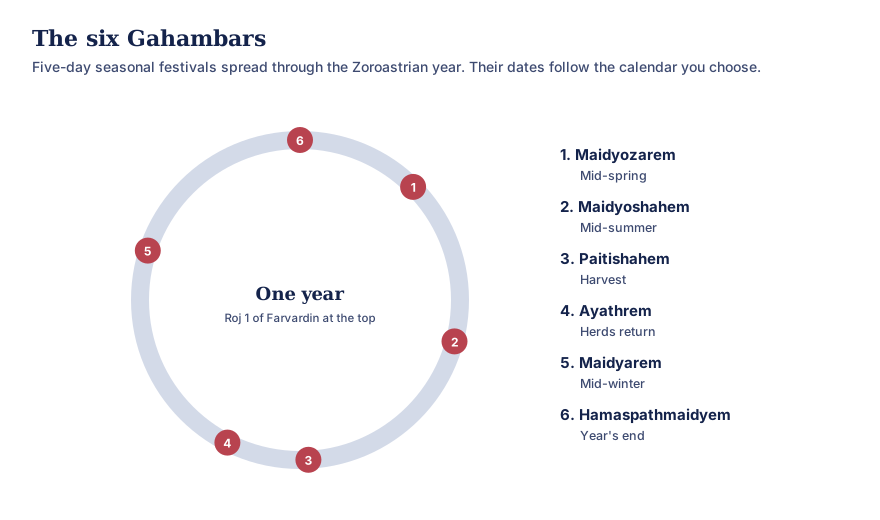
The six Gahambars, each five days long, in order through the year: Maidyozarem (mid-spring), Maidyoshahem (mid-summer), Paitishahem (harvest), Ayathrem (herds return), Maidyarem (mid-winter) and Hamaspathmaidyem (the last days of the year, the Gatha days).
In OIOA
The Parsi Home screen shows today’s Roj and Mah in the calendar you choose, with the Gahambars, all calculated on your phone. Set reminders for a family Roj birthday or a jashan. If a name is spelled differently in your family’s tradition, please tell us.
Common questions
What Roj is it today?
That depends on whether you follow the Shahenshahi, Kadmi or Fasli calendar. The Parsi Home screen in OIOA shows today’s Roj and Mah in the calendar you choose.
Why are days named rather than numbered?
In Zoroastrian tradition each day is placed under the protection of a divine being. Naming the day invokes that being, and the Roj guides which prayers are particularly recited. Numbered dates are a later convenience.
What is a ‘Roj birthday’?
Many Parsi families celebrate a birthday on the Roj and Mah of birth, in their calendar, as well as on the Gregorian date. Because the Parsi calendar is 365 days without leap days in Shahenshahi and Kadmi, the Roj birthday moves slowly against the Gregorian birthday.
Are the month names the same as the Iranian calendar’s months?
The modern Iranian (Solar Hijri) calendar uses the same ancient month names, Farvardin, Ordibehesht, Khordad and so on, but its months have different lengths and its year is fixed to the spring equinox. It’s a different calendar from the Parsi calendars, though they share a heritage.
How do I write a Parsi date?
Commonly as Roj [name], Mah [name], [year] Y.Z., where Y.Z. stands for the Yazdegardi era, counted from the accession of the last Sasanian king, Yazdegard III, in 632 CE.
Key terms
- Roj: a named day of the month.
- Mah: a named month.
- Amesha Spentas: the six Bounteous Immortals of Zoroastrian belief.
- Yazatas: divine beings worthy of worship.
- Gatha days: the five days at the end of the year.
- Jashan / parab: a celebration, notably when Roj and Mah share a name.
- Y.Z.: Yazdegardi era, used to number years.
Learning the names
For children, and for anyone new to the calendar, the 30 Roj can seem a lot to learn. Many families learn them through daily prayer, since each Roj has its associated prayers, and through the jashans that come round when Roj and Mah meet. Seeing today’s Roj on the Home screen every morning is a simple way to keep the names familiar.