Festivals of the seasons and of creation
The Gahambars (also spelled Gahanbars; in Avestan, Yairya) are six festivals spread through the Zoroastrian year, each lasting five days. They are thought to be among the oldest seasonal festivals still celebrated, rooted in the pastoral and agricultural life of ancient Iran.
In Zoroastrian tradition, each Gahambar also honours one stage of creation, in the order in which Ahura Mazda brought the world into being:
- the sky
- water
- the earth
- plants
- animals
- humankind
So each Gahambar is at once a celebration of a season and a thanksgiving for one part of the created world.
Text version of this diagram
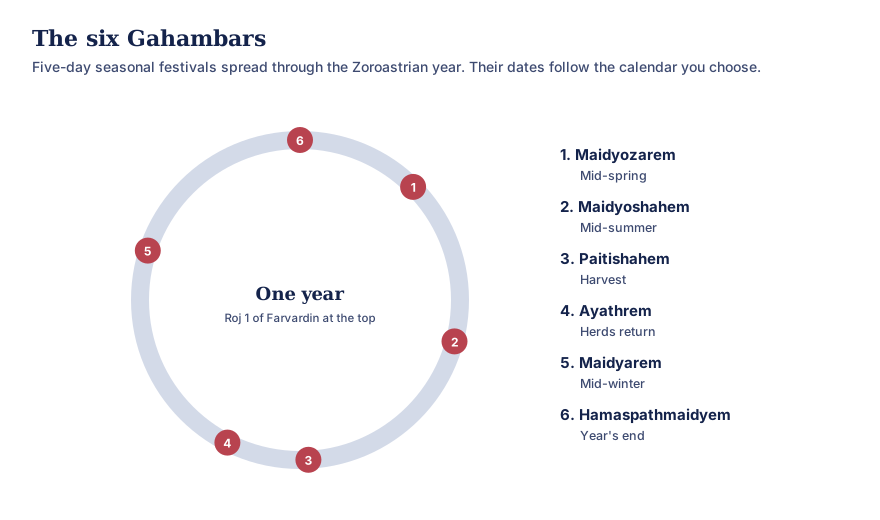
The six Gahambars, each five days long, in order through the year: Maidyozarem (mid-spring), Maidyoshahem (mid-summer), Paitishahem (harvest), Ayathrem (herds return), Maidyarem (mid-winter) and Hamaspathmaidyem (the last days of the year, the Gatha days).
The six Gahambars
| # | Gahambar | Meaning of the name | Season | Creation honoured | Roj of Mah |
|---|---|---|---|---|---|
| 1 | Maidyozarem | Mid-spring | Green pastures | Sky | 11–15 Ardibehesht |
| 2 | Maidyoshahem | Mid-summer | Harvest of the first crops | Water | 11–15 Tir |
| 3 | Paitishahem | Bringing in the harvest | Grain harvest | Earth | 26–30 Shehrevar |
| 4 | Ayathrem | Homecoming | Herds return from pasture | Plants | 26–30 Meher |
| 5 | Maidyarem | Mid-year (mid-winter) | Winter | Animals | 16–20 Dae |
| 6 | Hamaspathmaidyem | The gathering of all | Year’s end | Humankind | The five Gatha days |
The sixth Gahambar coincides with the Gatha days at the end of the year, part of the ten-day Muktad, when the souls of the departed are remembered.
How a Gahambar is celebrated
At the heart of a Gahambar are three things:
The jashan. Mobeds (priests) perform a thanksgiving ceremony, including the Afrinagan prayers, with fire, fruit, flowers, milk, water and wine or sherbet placed before them, representing the good creations.
The communal meal. Families, community trusts or individuals sponsor a meal, and everyone is welcome: rich and poor, young and old, eating together. In many places it’s a much-loved occasion, with traditional dishes served on banana leaves. In Zoroastrian teaching, participating in and contributing to the Gahambar is a meritorious act.
Giving. Sponsoring a Gahambar, or contributing what one can, is a form of charity. Tradition holds that everyone should take part according to their means.
Many families try to attend or contribute to at least one Gahambar each year, and community trusts in Mumbai, Gujarat and elsewhere keep up long traditions of hosting them, often in memory of loved ones who endowed them.
Why the dates move
Each Gahambar is fixed by Roj and Mah. Its Gregorian date depends on which calendar you follow:
- Fasli: the calendar is fixed to the seasons, with Navroz on 21 March, so the Gahambars stay in their intended seasons on the same Gregorian dates every year.
- Shahenshahi and Kadmi: with no leap day, the calendar drifts through the seasons, so Gahambar dates move gradually earlier through the Gregorian year, and Kadmi Gahambars come 30 days before Shahenshahi ones.
This means that, in Shahenshahi and Kadmi, a Gahambar’s name may describe a different season from the one in which it now falls. The tradition continues to honour the meaning of each festival regardless. See Shahenshahi, Kadmi and Fasli.
In OIOA
The Parsi Home screen shows the six Gahambars through the year in the calendar you choose, calculated on your phone. Set a reminder for the first day of each, so you can plan to attend or contribute. If your agiary or community trust observes a Gahambar on a different day, please tell us.
Common questions
Do I have to attend all five days of a Gahambar?
No. Many people attend the jashan and the communal meal on one of the days, often the last day, which community trusts commonly choose for the main gathering. Practices differ between places, so check with your agiary or community trust.
Can non-Zoroastrians attend a Gahambar?
The communal meal has traditionally been a time of generous hospitality, but customs about who may attend religious ceremonies differ. If you’ve been invited by a Parsi friend, follow their guidance about which parts are open to guests.
What is the difference between a jashan and a Gahambar?
A jashan is a thanksgiving ceremony that can be performed on many occasions: a birthday, a new home, an anniversary or a festival. A Gahambar is one of the six seasonal festivals, at which a jashan is performed and a communal meal shared.
Why are some Gahambars named after seasons that don’t match today’s weather?
In the Shahenshahi and Kadmi calendars, which have no leap day, the calendar has slowly drifted against the seasons over the centuries. The Gahambars keep their traditional names and meanings even when they fall in a different season. In the Fasli calendar they stay in their original seasons.
What is the Muktad, and how does it relate to the sixth Gahambar?
The Muktad is the period of remembrance of the departed at the end of the year, covering the last five days of Aspandarmad and the five Gatha days. The sixth Gahambar, Hamaspathmaidyem, falls on the Gatha days, so the two overlap. Families place flowers in vases for their departed and recite special prayers.
Is sponsoring a Gahambar expensive?
It doesn’t have to be. Many Gahambars are endowed by family trusts or funded by many small contributions. Tradition values taking part according to one’s means.
Key terms
- Gahambar (Gahanbar): one of six five-day seasonal festivals.
- Jashan: a thanksgiving ceremony performed by mobeds.
- Afrinagan: prayers of blessing recited at a jashan.
- Mobed: a Zoroastrian priest.
- Gatha days: the five days at the end of the year, named after the Gathas of Zarathushtra.
- Muktad: the ten days of remembrance at the end of the year.
A festival of sharing
What makes the Gahambars special is their spirit: the whole community sitting down together, regardless of wealth or status, to give thanks for the seasons and for one another. In a time of busy, separate lives, that’s a tradition worth keeping, and one that resonates with the hope behind OIOA itself.