The shared foundation
All three Parsi calendars share the same structure: 12 months of 30 days plus 5 Gatha days, a 365-day year, with the same Roj and Mah names. See Parsi Roj and Mah. They differ in two things:
- Where the year begins relative to the Gregorian calendar.
- Whether a leap day is ever added.
Text version of this diagram
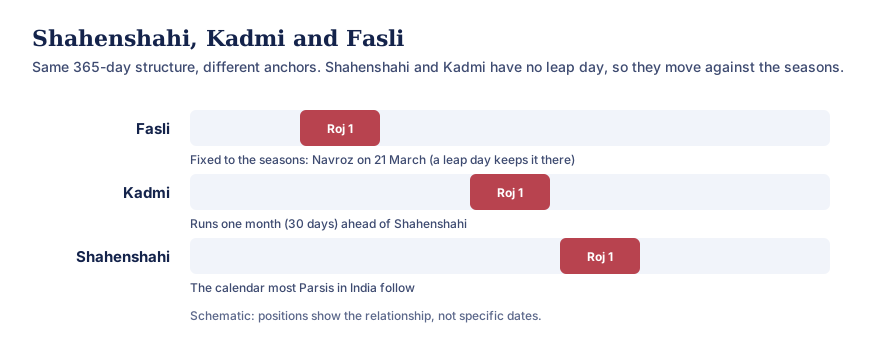
All three calendars have 12 months of 30 days plus 5 Gatha days. The Fasli calendar adds a leap day so Navroz stays on 21 March. The Shahenshahi and Kadmi calendars do not add a leap day, so they slowly move against the seasons; the Kadmi calendar runs one month (30 days) ahead of the Shahenshahi calendar.
The quarter-day problem
The solar year is about 365.24 days. A 365-day calendar falls behind by about a quarter of a day each year, about one day every four years and a full month in about 120 years. In ancient Iran, this was corrected by intercalation: an extra month (kabiseh) was added periodically to bring the calendar back in step with the seasons.
After the fall of the Sasanian empire in the 7th century and the migration of Zoroastrians who became the Parsis of India, regular intercalation lapsed. Without it, a 365-day calendar slowly moves through the seasons, which is exactly what the Shahenshahi and Kadmi calendars do.
Shahenshahi
The Shahenshahi (or Shenshai, “imperial”) calendar is followed by most Parsis in India. Parsi tradition holds that one intercalary month was added in India at some point after the community’s arrival, but not by Zoroastrians who remained in Iran. The Shahenshahi calendar has added no leap days since then.
As a result, its new year, Navroz, now falls in August, and it moves earlier by about one day every four years. Over generations, Navroz has drifted from spring into late summer.
Kadmi
In the early 18th century, contacts between Parsis in India and Zoroastrians in Iran revealed that the two calendars differed by one month. The Iranian calendar was a month ahead. A section of the Parsi community, persuaded that the Iranian reckoning was the older and more correct one, adopted it in 1745, calling it Kadmi (or Qadimi, “ancient”).
The question was debated intensely in the community for decades, a debate sometimes called the kabiseh controversy. Today Kadmi is followed by a part of the community, with its own fire temples. Kadmi dates are 30 days ahead of Shahenshahi dates: Kadmi Navroz comes about a month before Shahenshahi Navroz. Like Shahenshahi, Kadmi has no leap day, so both move through the seasons together.
Fasli
In the early 20th century, a movement arose to fix the calendar to the seasons once more. The Fasli calendar (fasl, season; also called Bastani, “ancient”) keeps the same structure but:
- begins the year with Navroz on 21 March, the spring equinox, and
- adds a leap day (the sixth Gatha day, Avardad-sal-gah) every four years, as the Gregorian calendar does.
So every Fasli date stays fixed in the Gregorian calendar and in its season: the Gahambars stay in the seasons they celebrate. Fasli is followed by a part of the community, and by many Irani Zoroastrians.
Jamshedi Navroz
Separately from all three, many Parsis celebrate Jamshedi Navroz on 21 March, the spring equinox, linked to the legendary King Jamshed. Since it coincides with Fasli Navroz, Fasli families celebrate both at once; Shahenshahi and Kadmi families celebrate Jamshedi Navroz in March and their own Navroz later in the year.
Comparing the three
| Shahenshahi | Kadmi | Fasli | |
|---|---|---|---|
| Followed by | Most Parsis in India | A section of the community | A section, including many Iranis |
| Leap day | No | No | Yes, every 4 years |
| Navroz | Currently in August | About 30 days before Shahenshahi | 21 March, fixed |
| Moves with seasons? | Slowly, about a day every 4 years | Slowly, with Shahenshahi | No |
Which should you choose?
Follow your family’s tradition, and your agiary’s. Most Parsi families in India follow Shahenshahi. If you’re not sure, ask the elders in your family or your agiary’s priest. All three are honoured traditions with long histories; OIOA treats them equally.
In OIOA
On the Parsi Home screen, choose Shahenshahi, Kadmi or Fasli. OIOA shows today’s Roj and Mah and the Gahambars in that calendar, calculated on your phone. You can switch whenever you like, for example to see when relatives following another calendar observe a day. See calendar methods.
Common questions
Why is Parsi New Year in August?
Because most Parsis in India follow the Shahenshahi calendar, which has no leap day and has slowly drifted through the seasons over the centuries. Its Navroz currently falls in August, and moves about one day earlier every four years.
Is Jamshedi Navroz the same as Parsi New Year?
Not for Shahenshahi and Kadmi families: Jamshedi Navroz is on 21 March, and their own Navroz falls later. For Fasli families, the two coincide on 21 March.
Can a family follow more than one calendar?
Many families follow one calendar for their observances but celebrate Jamshedi Navroz too, and some check other calendars for relatives’ dates. OIOA lets you switch between calendars whenever you like.
What does ‘Kabiseh’ mean?
Kabiseh refers to intercalation, adding days or a month to correct a calendar, and also gives its name to the 18th-century debate in the Parsi community over the one-month difference between the Shahenshahi and Kadmi reckonings.
What is the Yazdegardi era?
The era used to number years in the Shahenshahi and Kadmi calendars, counted from the accession of Yazdegard III, the last Sasanian king, in 632 CE. Years are written with the suffix Y.Z.
Key terms
- Shahenshahi (Shenshai): the calendar most Parsis in India follow.
- Kadmi (Qadimi): the calendar running 30 days ahead of Shahenshahi.
- Fasli (Bastani): the season-fixed calendar with a leap day.
- Kabiseh: intercalation; also the 18th-century calendar debate.
- Navroz: the new year.