The new year
Navroz (“new day”) is the first day of the Zoroastrian year: Roj Hormazd, Mah Farvardin. For Parsi families it’s a day of new beginnings: new clothes, a visit to the agiary or fire temple to pray, a doorstep decorated with rangoli (chalk) and toran, and a festive table.
The day before, the last day of the year, is often called Pateti, traditionally associated with patet, repentance, and reflection on the year gone by. It follows the ten days of the Muktad, when departed souls are remembered.
Customs
- Prayers at home and at the agiary, often a jashan.
- Sagan: a ritual of welcome with a tray holding a garland, rose water, rice, coconut and a small lamp.
- Festive food: ravo and sev in the morning, and a celebratory meal, often including patra ni machhi, sali boti and pulao dal.
- Visits to family and friends, with greetings of “Navroz Mubarak” or “Saal Mubarak”.
Why Navroz falls on different days
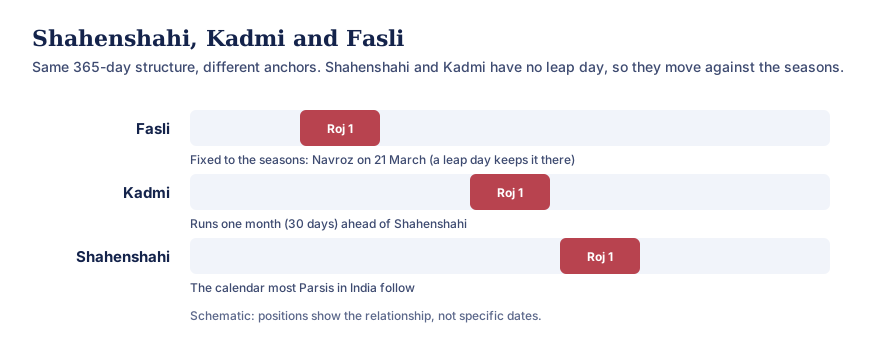
Parsis follow three calendars, so there are three Navroz dates:
Text version of this diagram
All three calendars have 12 months of 30 days plus 5 Gatha days. The Fasli calendar adds a leap day so Navroz stays on 21 March. The Shahenshahi and Kadmi calendars do not add a leap day, so they slowly move against the seasons; the Kadmi calendar runs one month (30 days) ahead of the Shahenshahi calendar.
- Shahenshahi Navroz, followed by most Parsis in India, currently falls in August, and moves about one day earlier every four years.
- Kadmi Navroz comes about one month earlier than Shahenshahi.
- Fasli Navroz is fixed on 21 March.
In addition, many Parsis celebrate Jamshedi Navroz on 21 March, the spring equinox, named after the legendary King Jamshed. So many families celebrate a new year in March and again in August. See Shahenshahi, Kadmi and Fasli.
How OIOA helps
- The Parsi Home screen shows Roj and Mah in the calendar you follow, so you know when Navroz and Pateti fall.
- Reminders for Muktad, Pateti and Navroz.
- Cards to wish family and friends, including neighbours of other communities.
- Holidays show where Parsi New Year is a holiday in your state.
Wishing someone
“Navroz Mubarak” or “Saal Mubarak”.