Who can ask
Anyone. You don’t need to be a scholar or a community leader. If your community, sect, sampradaya, gachh, calendar method, regional tradition or language isn’t in OIOA, or isn’t represented the way your family practises it, we’d like to hear from you.
Requests we’d especially welcome include:
- Communities not yet in OIOA, such as Christian, Buddhist, Bahá’í and Jewish communities, and tribal and Adivasi traditions.
- Regional calendars, such as the Tamil, Malayalam, Bengali, Odia and Assamese solar calendars, and regional new years.
- Sects and traditions within the communities already in OIOA, such as a Jain gachh or a prayer-time convention.
- Languages beyond the 14 OIOA supports today.
Send your request
You can leave your name and contact details out. If you’d like a reply, add an email address or phone number and tick the box to say we may use it to reply. We use contact details only for that, as the privacy policy explains.
What happens next
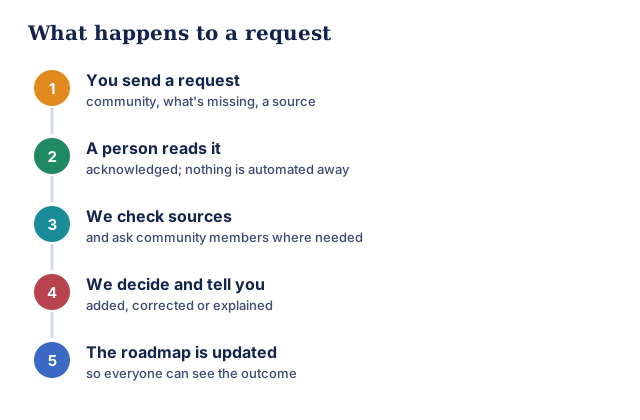
Text version of this diagram
- You send a request: the community, what is missing, and a source if you have one.
- A person on the OIOA team reads it.
- We check sources, and ask community members where needed.
- We decide and tell you: added, corrected, or explained.
- The public roadmap is updated so everyone can see the outcome.
- A person reads your request. Every request is read by someone on the OIOA team.
- We check sources. Calendars and observances need care. We look at the sources you share and others, and where it helps, we ask members of the community.
- We decide, and tell you. If you left contact details, we aim to reply within 15 days, even if the answer is “we’re still working on it”.
- The roadmap is updated. Reviewed requests appear on the public roadmap as requested, under review, then coming soon when we commit to them, then live.
What makes a request easy to act on
- Name the community or tradition as its members name it, with any other common names.
- Say what it needs. A calendar? Daily timings? Particular days? A language?
- Share a source. A published calendar, jantri, almanac, an authority the community follows, or a link.
- Say where it’s followed. A region, a city or a diaspora.
- Offer to help, if you can. People who know a tradition well are invaluable in checking our work.
Our promise
We will treat every community’s request with the same seriousness, whatever its size. We may not be able to add everything at once, and some calendars take time to build accurately, but no request will be ignored. Our correction policy sets out how requests and corrections are reviewed.
Found something wrong in a community that’s already in OIOA? Use tell us what we missed instead; it’s the same form, set up for corrections.