What Choghadiya is
Choghadiya is a way of dividing time into auspicious and less auspicious periods, widely used in Gujarat, Rajasthan, Maharashtra and by Hindu and Jain families across India and beyond. The name comes from chau (four) and ghadi, an old unit of about 24 minutes: each Choghadiya was originally about four ghadis, or 96 minutes, long.
The daytime, from sunrise to sunset, is split into eight equal Choghadiyas. The night, from sunset to the next sunrise, is split into another eight. Because day and night lengths change with the season and your location, a Choghadiya is rarely exactly 90 minutes. In midsummer the daytime Choghadiyas are longer and the night ones shorter.
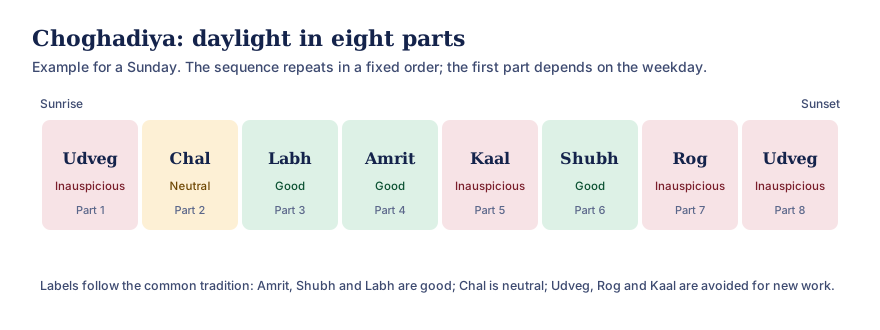
Text version of this diagram
On a Sunday the eight daytime Choghadiya, in order, are: Udveg (inauspicious), Chal (neutral), Labh (good), Amrit (good), Kaal (inauspicious), Shubh (good), Rog (inauspicious), Udveg (inauspicious). Each lasts one-eighth of the daylight. On other weekdays the same cycle of seven starts at a different point.
The seven Choghadiyas
There are seven named Choghadiyas, traditionally grouped like this:
| Choghadiya | Traditional meaning | Commonly considered |
|---|---|---|
| Amrit | Nectar | Good for all work |
| Shubh | Auspicious | Good, especially for ceremonies |
| Labh | Gain | Good, especially for business and study |
| Chal | Moving | Neutral, often favoured for travel |
| Udveg | Anxiety | Avoided for new beginnings |
| Rog | Illness | Avoided for new beginnings |
| Kaal | Loss | Avoided for new beginnings |
These descriptions follow common tradition. Families and regions interpret them in their own ways; for example, some consider Udveg suitable for government-related work. OIOA shows you which Choghadiya is running. How you use it is your choice.
How the sequence works
Each Choghadiya is associated with a planet, and the sequence follows a fixed cycle. During the day, the first Choghadiya after sunrise belongs to the planet that rules the weekday:
| Weekday | First day Choghadiya | First night Choghadiya |
|---|---|---|
| Sunday | Udveg | Shubh |
| Monday | Amrit | Chal |
| Tuesday | Rog | Kaal |
| Wednesday | Labh | Udveg |
| Thursday | Shubh | Amrit |
| Friday | Chal | Rog |
| Saturday | Kaal | Labh |
From there, the day Choghadiyas follow the cycle Udveg → Chal → Labh → Amrit → Kaal → Shubh → Rog, and the eighth period repeats the first. The night Choghadiyas follow their own cycle: Shubh → Amrit → Chal → Rog → Kaal → Labh → Udveg. For a step-by-step explanation, read How Choghadiya works.
What you see in OIOA
When your community is set to Hindu or Jain, the Home screen’s Today card shows:
- The Choghadiya running now, with when it ends.
- A live slider that lets you move through the day and night and see the Choghadiya at any time. This is handy for planning: drag to the evening and see whether a Labh or Shubh period falls when you want to start something.
- Day and night periods calculated from your own sunrise and sunset, not from a fixed 6 am to 6 pm.
OIOA calculates sunrise, sunset and the Choghadiya periods on your phone. Nothing needs to download each day, so Choghadiya is available offline.
Why OIOA uses your location
A Choghadiya chart printed for Mumbai is not quite right for Delhi, and is noticeably off for Guwahati. All of India keeps Indian Standard Time, but sunrise in the east comes much earlier by the clock than in the west, and in summer the north has longer days than the south. Because each Choghadiya is one-eighth of your local day or night, every boundary moves with your sunrise and sunset. OIOA uses your location, or a city you choose, so the times are right for where you are. If you travel, the Choghadiya follows you.
Choghadiya with other timings
Many people look at Choghadiya together with other windows:
- Rahu Kaal is another one-eighth of the day that many avoid for new beginnings. It can overlap with any Choghadiya, including a good one, and some families give Rahu Kaal priority.
- Abhijit muhurat around local noon is considered favourable by many.
- Hora divides the day into twelve planetary hours and is often used alongside Choghadiya.
OIOA shows each of these so you can combine them the way your tradition does.
Choghadiya in your language
Choghadiya names and the whole Today card switch between English and Gujarati, Hindi, Marathi and the other supported languages with the EN ⇄ local-language toggle. See multi-language.
A note on interpretation
Choghadiya is a traditional practice. OIOA calculates the periods with care using standard astronomical sunrise and sunset, but it does not claim that any period will bring a particular outcome. Please read the disclaimer, and follow the guidance of your family or community for important decisions. If you think a Choghadiya time in OIOA is wrong, tell us with your location and the time you checked.
Common questions
Which Choghadiya is best?
Traditionally, Amrit is considered the most auspicious, followed by Shubh and Labh. Chal is neutral and often preferred for travel. Many families combine Choghadiya with Rahu Kaal and their own customs, so ask at home if you’re unsure.
Is Choghadiya used by Jains as well as Hindus?
Yes. Choghadiya is widely used by both Hindu and Jain families, particularly in Gujarat and Rajasthan, which is why OIOA shows it on both the Hindu and Jain Home screens.
Why doesn’t my Choghadiya chart start at 6 am?
Because Choghadiya starts at sunrise, not at a fixed clock time. Charts that begin at 6:00 are simplified. OIOA uses your actual sunrise, so the first Choghadiya of the day begins when the Sun rises where you are.
Does the night Choghadiya continue after midnight?
Yes. The eight night Choghadiyas run from sunset until the next sunrise, so they continue through midnight. The new day’s Choghadiyas begin only at sunrise.