A calendar of the Moon and the Sun
The Hindu panchang is lunisolar. Its days and months follow the Moon, but it is kept in step with the solar year, and so with the seasons, by occasionally adding an extra month. That’s why Hindu festivals move around the Gregorian calendar by a few weeks from year to year but always come back to the same season: Diwali in autumn, Holi in spring.
The five limbs
Panchang means “five limbs”. A traditional panchang describes every day by five elements:
| Element | What it measures | How many |
|---|---|---|
| Tithi | The lunar day: each 12° the Moon gains on the Sun | 30 per lunar month |
| Vara | The weekday | 7 |
| Nakshatra | The Moon’s position among the stars | 27 (28 in Jain tradition) |
| Yoga | The combined longitude of Sun and Moon, in 27 parts | 27 |
| Karana | Half a tithi | 11 types, 60 per month |
The tithi, nakshatra, yoga and karana all change at different moments through the day, independently of midnight. The convention in most regions is to name a day by the tithi (and nakshatra) prevailing at sunrise.
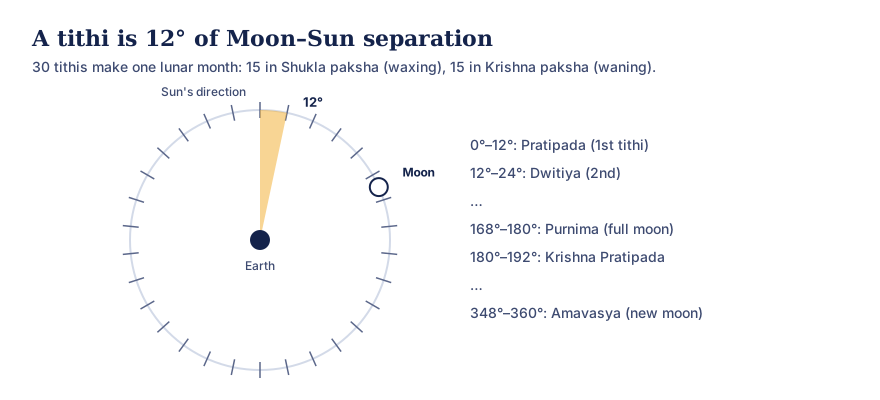
Text version of this diagram
A tithi is the time it takes for the angle between the Moon and the Sun, as seen from Earth, to grow by 12 degrees. 360 degrees divided by 12 gives 30 tithis in a lunar month. 0–12° is Pratipada, 168–180° ends at Purnima (full moon), and 348–360° ends at Amavasya (new moon).
Months and pakshas
A lunar month has two halves of 15 tithis each: Shukla paksha (waxing) and Krishna paksha (waning). The twelve months, Chaitra to Phalguna, are named after the nakshatra near which the full moon usually falls.
Regions mark the end of the month in two ways, Amanta (at new moon) and Purnimanta (at full moon), so the Krishna paksha can carry different month names in different parts of India.
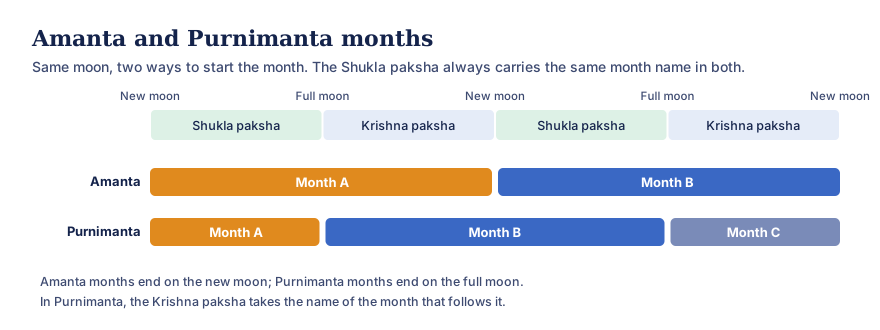
Text version of this diagram
In the Amanta system a month runs from the day after one new moon to the next new moon: Shukla paksha, then Krishna paksha. In the Purnimanta system a month runs from the day after a full moon to the next full moon: Krishna paksha, then Shukla paksha. The Shukla paksha has the same month name in both systems; the Krishna paksha is named after the following month in Purnimanta.
Keeping step with the Sun
Twelve lunar months make about 354 days. To stop the calendar sliding through the seasons, the panchang watches the Sun as well. Each time the Sun enters a new sidereal zodiac sign is a sankranti, which begins a solar month. When a lunar month contains no sankranti, it is treated as an extra month, Adhik maas, about once every 32 to 33 months. Much more rarely, a lunar month contains two sankrantis and a month is dropped (kshaya maas).
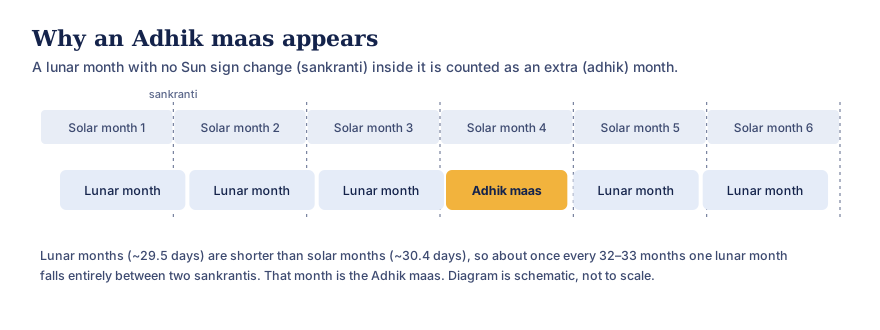
Text version of this diagram
Solar months begin at each sankranti, when the Sun enters a new zodiac sign, and last about 30.4 days. Lunar months last about 29.5 days. Because lunar months are shorter, roughly every 32 to 33 months one lunar month starts and ends without a sankranti inside it. That month is counted as an extra, or Adhik, maas.
Several regions, including Tamil Nadu, Kerala, Odisha, Assam and Bengal, use the solar months themselves as their civil calendar, with the lunar tithis alongside for religious observance. See Sankranti and solar months.
Eras
Years in the panchang are counted in eras (samvat). The two most common in India are Vikram Samvat, about 57 years ahead of the Common Era, and Shaka Samvat, about 78 years behind it, which is also the basis of the Indian national calendar.
Why panchangs differ
Two published panchangs can disagree by minutes, or occasionally by a day, for reasons that are all legitimate:
- Location: sunrise-based rules depend on where the panchang was calculated.
- Calculation school: traditional (siddhantic) and modern astronomical (drik) methods give slightly different positions.
- Ayanamsha: the offset used to convert to the star-based zodiac.
- Festival rules: which time of day decides a festival’s tithi.
What OIOA computes
On the Hindu and Jain Home screens, OIOA calculates on your phone, for your location: the tithi with paksha, the nakshatra, the lunar month and Adhik maas, sunrise and sunset, and the muhurat windows of Choghadiya, Hora, Rahu Kaal and Abhijit, with Panchak when it runs. See the panchang feature.
For the date your family observes a festival, please follow your priest, temple or community authority.