The short answer
A tithi is a lunar day. It is the time it takes for the Moon to move 12 degrees further ahead of the Sun, as seen from the Earth. Since a full cycle of the Moon’s phases is 360 degrees of separation, there are 30 tithis in a lunar month.
Tithis are the backbone of the Hindu and Jain calendars. Most fasts and festivals, including Ekadashi, Purnima, Amavasya, Ganesh Chaturthi, Ram Navami and Janmashtami, are fixed by tithi rather than by a Gregorian date.
Why 12 degrees?
Picture the Sun and the Moon as two runners on a circular track, with the Earth at the centre. Both move eastward against the stars, but the Moon is much faster: it gains about 12 degrees on the Sun every day, on average. Starting from new moon, when the two are together (0°), the Moon pulls ahead until it is opposite the Sun at full moon (180°), then keeps going until it catches up again at the next new moon (360°).
The ancient astronomers divided that 360-degree lap into thirty equal steps of 12 degrees. Each step is a tithi.
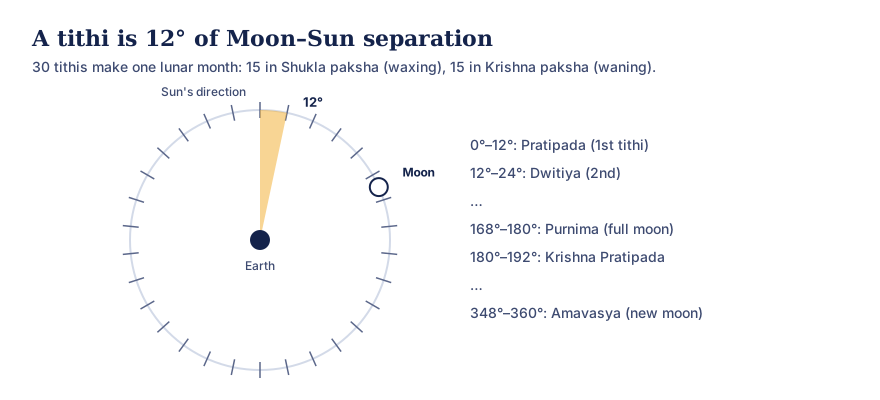
Text version of this diagram
A tithi is the time it takes for the angle between the Moon and the Sun, as seen from Earth, to grow by 12 degrees. 360 degrees divided by 12 gives 30 tithis in a lunar month. 0–12° is Pratipada, 168–180° ends at Purnima (full moon), and 348–360° ends at Amavasya (new moon).
So a tithi is not about where the Moon is among the stars (that’s the nakshatra), and it’s not about the Moon’s shape as such. It’s about the angle between the Moon and the Sun, which is also exactly what determines the Moon’s phase. That’s why tithis track the phases so closely: Purnima is always the full moon, Amavasya always the new moon, Ashtami always around the half moon.
The thirty tithis
The first fifteen tithis make up the Shukla paksha, the bright fortnight, as the Moon waxes. The second fifteen make up the Krishna paksha, the dark fortnight, as it wanes. Each paksha counts 1 to 14 with the same names, and the 15th tithi is Purnima (in Shukla paksha) or Amavasya (in Krishna paksha):
- Pratipada (Padva)
- Dwitiya (Bij)
- Tritiya (Teej)
- Chaturthi (Chauth)
- Panchami
- Shashthi (Chhath)
- Saptami
- Ashtami
- Navami
- Dashami
- Ekadashi (Gyaras)
- Dwadashi (Baras)
- Trayodashi (Teras)
- Chaturdashi (Chaudas)
- Purnima (Poonam) / Amavasya (Amas)
The names in brackets are some of the common regional forms; there are many more. Read more on the two halves in Shukla and Krishna paksha.
Why tithis are different lengths
If the Moon and Sun moved at steady speeds, every tithi would be the same length: about 23 hours and 37 minutes (a lunar month of 29.53 days divided by 30). But neither moves steadily. The Moon’s orbit is an ellipse, so it speeds up when it’s closer to the Earth and slows down when it’s further away. The Sun’s apparent motion varies a little too.
The result is that a tithi can be as short as about 20 hours or as long as about 27 hours. A tithi also has no connection to midnight or sunrise. It begins at whatever moment the Moon crosses the next 12-degree mark, which could be 3:17 in the afternoon or 4:52 in the morning.
Which tithi is “today”?
Because tithis start and end at any time, a calendar needs a rule for which tithi names the day. The most common convention in Indian calendars is the udaya tithi: the tithi running at sunrise gives its name to the whole day, from that sunrise to the next.
This leads to two special cases:
- Kshaya (lost) tithi. Sometimes a short tithi starts after one sunrise and ends before the next. It is never “the tithi at sunrise”, so it gets no day of its own. The calendar seems to skip a number, for example going from Tritiya straight to Panchami.
- Vriddhi (increased) tithi. Sometimes a long tithi starts just before one sunrise and is still running at the next. It is the tithi at sunrise on two consecutive days, so that number appears twice.
Kshaya and vriddhi tithis are perfectly normal; several happen in most months. But they matter for observances, and different traditions have different rules about which day to observe when a festival’s tithi is lost or repeated. Read the sunrise rule for tithis.
Festivals don’t all use sunrise
The sunrise rule is the default, but many festivals have their own rule tied to a particular time of day:
- Festivals honouring Ganesha on Chaturthi often look at the tithi at midday.
- Janmashtami looks at the tithi (and nakshatra) at midnight, the time of Krishna’s birth in tradition.
- Diwali’s Lakshmi Puja looks at the Amavasya prevailing in the evening (pradosh).
- Karva Chauth looks at the Chaturthi at moonrise.
That’s why a festival can fall on a day whose sunrise tithi is different from the festival’s tithi, and why two calendars occasionally put a festival on different days.
Why location matters
The moment a tithi changes is the same everywhere on Earth, because it depends only on where the Moon and Sun are. But the local time of that moment differs between time zones, and the time of sunrise differs from city to city. So the tithi at sunrise can be different in Mumbai and Kolkata on the same morning. A calendar printed for one city isn’t exactly right for another, and for relatives abroad the difference can be a whole day.
This is why OIOA calculates the tithi on your phone for your location.
A brief history
Tithis appear in the Vedanga Jyotisha, one of the oldest Indian texts on timekeeping, and are developed in detail in later astronomical works such as the Surya Siddhanta. Traditional panchangs computed tithis using formulas from these texts (siddhantic methods). Many modern panchangs instead use precise astronomical positions (drik methods). The two can differ by minutes, which is one more reason calendars sometimes disagree on the exact time a tithi ends.
Tithi in OIOA
On the Hindu and Jain Home screens, OIOA shows the current tithi with its paksha in the Today card and the panchang. Live sliders show when it changes during the day, and you can set reminders for the tithis you observe.
For the day on which your family keeps a festival or fast, please follow your family priest, temple or community authority.