Two fortnights in every month
The Hindu and Jain lunar month is divided into two halves, each called a paksha (literally “side” or “wing”). Each paksha contains 15 tithis and lasts roughly a fortnight.
- Shukla paksha (the bright half) runs from the day after Amavasya (new moon) up to Purnima (full moon). The Moon is waxing: each evening it is larger and sets later.
- Krishna paksha (the dark half) runs from the day after Purnima up to the next Amavasya. The Moon is waning: each night it is smaller and rises later.
Shukla means bright or white; Krishna means dark. The names describe the evening sky. In Shukla paksha the Moon is up in the evening, lighting the early night; in Krishna paksha the evenings are dark and the Moon rises late at night.
Regional names
The two fortnights go by many names:
| Language or region | Bright half | Dark half |
|---|---|---|
| Sanskrit | Shukla paksha | Krishna paksha |
| Gujarati, Rajasthani | Sud (Sudi) | Vad (Vadi) |
| Hindi (colloquial) | Sudi, Ujala paksha | Badi, Andhera paksha |
| Marathi | Shuddha paksha | Vadya paksha |
| Telugu | Shukla paksham | Bahula paksham |
| Tamil | Valarpirai | Theipirai |
A date such as “Kartik Sud 1” in a Gujarati calendar means the first tithi of the bright half of Kartik.
How tithis are named in each paksha
Each paksha counts its tithis with the same names, Pratipada (1) to Chaturdashi (14), and then the 15th is different: Purnima ends the Shukla paksha and Amavasya ends the Krishna paksha. So “Ekadashi” alone is ambiguous: there’s a Shukla Ekadashi and a Krishna Ekadashi in every month, about two weeks apart. That’s why the panchang, and OIOA, always shows the paksha alongside the tithi.
In some calendars the tithis of the Krishna paksha are numbered 16 to 30, continuing the count from the Shukla paksha, so that Amavasya is the 30th tithi.
Which half comes first?
This depends on how a region defines the month.
Text version of this diagram
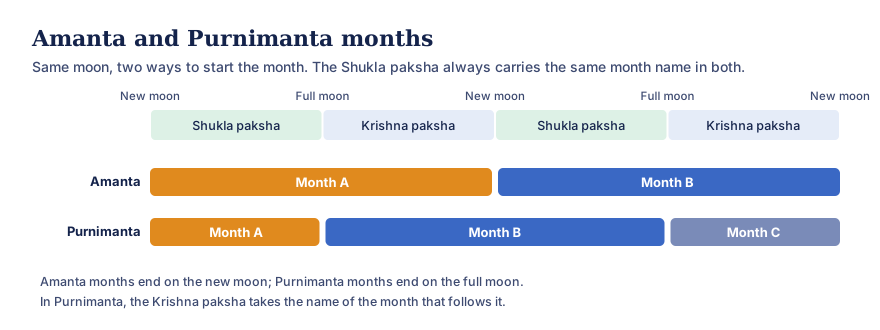
In the Amanta system a month runs from the day after one new moon to the next new moon: Shukla paksha, then Krishna paksha. In the Purnimanta system a month runs from the day after a full moon to the next full moon: Krishna paksha, then Shukla paksha. The Shukla paksha has the same month name in both systems; the Krishna paksha is named after the following month in Purnimanta.
- In the Amanta system, common in Gujarat, Maharashtra, Karnataka, Andhra Pradesh, Telangana and elsewhere, the month ends at Amavasya. It begins with Shukla paksha and ends with Krishna paksha.
- In the Purnimanta system, common across much of North and Central India, the month ends at Purnima. It begins with Krishna paksha and ends with Shukla paksha.
Both systems agree on the name of the Shukla paksha. They differ on the Krishna paksha: the dark half that Amanta calendars place at the end of one month, Purnimanta calendars place at the start of the next. So a single night, such as the Amavasya of Diwali, can be in Ashvina in one calendar and in Kartika in another. Read Purnimanta and Amanta for more.
Observances in each paksha
Many observances are tied to a particular paksha. Some common examples:
In Shukla paksha - Most new beginnings and many festivals: Ugadi and Gudi Padwa (Chaitra Shukla Pratipada), Ram Navami (Chaitra Shukla Navami), Ganesh Chaturthi (Bhadrapada Shukla Chaturthi), the nine nights of Navratri, Vijayadashami. - Purnima itself, observed with fasting and worship by many families.
In Krishna paksha - Janmashtami (Krishna Ashtami of Shravana or Bhadrapada, depending on the month system). - Pitru Paksha, the fortnight for remembering ancestors, which in Amanta reckoning is the Krishna paksha of Bhadrapada. - Dhanteras, Narak Chaturdashi and Diwali, at the end of the Krishna paksha in the Amanta month of Ashvina. - Maha Shivaratri (Krishna Chaturdashi of Magha in Amanta reckoning, Phalguna in Purnimanta).
In both - Ekadashi fasts, observed by many in both pakshas. - Pradosh (Trayodashi) and Chaturthi observances.
In the Jain calendar, Ashtami and Chaturdashi of both pakshas are important days for fasting and observance.
Is one half “better” than the other?
Traditionally, Shukla paksha has been associated with growth and is often preferred for beginnings such as weddings, housewarmings and new ventures, while Krishna paksha has been associated with letting go, remembrance and inward observance. But both pakshas have many auspicious days, and these associations vary between regions and families. Please follow your own family’s or priest’s guidance.
Paksha and the Moon you can see
The paksha is a simple way to read the sky. If the Moon is visible in the western sky at dusk and growing, you’re in Shukla paksha. If you see it in the eastern sky before dawn and shrinking, you’re in Krishna paksha. Near Amavasya you won’t see it at all.
Paksha in OIOA
On the Hindu and Jain Home screens, OIOA shows the paksha with the tithi in the Today card and the panchang, calculated on your phone for your location. Set reminders for the Ekadashi, Pradosh or other days you observe in either paksha.
Common questions
What does ‘Sud’ and ‘Vad’ mean in a Gujarati calendar?
Sud (Sudi) is the bright half, Shukla paksha; Vad (Vadi) is the dark half, Krishna paksha. So “Kartik Sud 1” is the first tithi of the bright half of Kartik, the Gujarati New Year.
How long is a paksha?
About 14 to 15½ days, because tithis vary in length and a paksha is 15 tithis.
Which paksha is it today?
OIOA shows the paksha with the tithi on the Hindu and Jain Home screens. You can also tell from the sky: a growing Moon in the evening means Shukla paksha; a shrinking Moon before dawn means Krishna paksha.
Key terms
- Paksha: a fortnight of 15 tithis.
- Shukla paksha: the bright, waxing fortnight.
- Krishna paksha: the dark, waning fortnight.
- Purnima: the full moon, ending Shukla paksha.
- Amavasya: the new moon, ending Krishna paksha.
- Sud / Vad: Gujarati and Rajasthani names for the two fortnights.