The question
A lunar month runs from one phase of the Moon to the same phase again: about 29.5 days. But which phase do you start from? India has two long-standing answers:
- Amanta (ama-anta, “ending at Amavasya”): the month ends at the new moon. Also called Amavasyant or mukhya mana.
- Purnimanta (purnima-anta, “ending at Purnima”): the month ends at the full moon. Also called Purnimant or gauna mana.
Both are ancient, both are correct, and both are in daily use across India.
Who uses which
Broadly speaking:
- Amanta is used in Gujarat, Maharashtra, Goa, Karnataka, Andhra Pradesh and Telangana, and for lunar reckoning in Tamil Nadu, Kerala, West Bengal, Assam and Tripura.
- Purnimanta is used across much of North and Central India: Uttar Pradesh, Bihar, Madhya Pradesh, Rajasthan, Delhi, Haryana, Punjab, Himachal Pradesh, Jharkhand, Chhattisgarh, Uttarakhand and Odisha.
These are generalisations: communities, temples and families within a region sometimes follow the other system, and Jain calendars in Gujarat typically follow Amanta.
Where the difference shows
Text version of this diagram
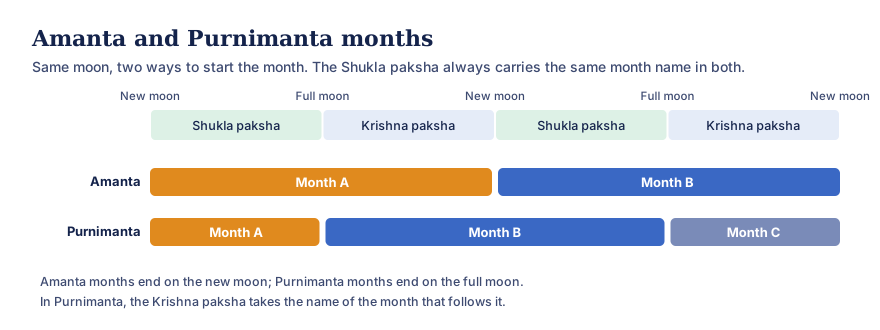
In the Amanta system a month runs from the day after one new moon to the next new moon: Shukla paksha, then Krishna paksha. In the Purnimanta system a month runs from the day after a full moon to the next full moon: Krishna paksha, then Shukla paksha. The Shukla paksha has the same month name in both systems; the Krishna paksha is named after the following month in Purnimanta.
Both systems give each lunar month a Shukla paksha (waxing half) and a Krishna paksha (waning half). The key point is:
- The Shukla paksha always has the same month name in both systems.
- The Krishna paksha is named after the month that ends with it. In Amanta, the Krishna paksha closes a month; in Purnimanta, it opens the next one. So the Purnimanta month name for a Krishna paksha is always one month ahead of the Amanta name.
An example: the fortnight after the full moon of Shravana.
- Amanta calls it Shravana Krishna (the second half of Shravana).
- Purnimanta calls it Bhadrapada Krishna (the first half of Bhadrapada).
Same days, same Moon, different label.
Festivals that change name, not date
Because of this, some festivals are described with different months while being celebrated on the same day:
| Festival | Amanta description | Purnimanta description |
|---|---|---|
| Janmashtami | Shravana Krishna Ashtami | Bhadrapada Krishna Ashtami |
| Diwali (Lakshmi Puja) | Ashvina Amavasya | Kartika Amavasya |
| Maha Shivaratri | Magha Krishna Chaturdashi | Phalguna Krishna Chaturdashi |
| Hanuman Jayanti (in many regions) | Chaitra Purnima | Chaitra Purnima |
| Ganesh Chaturthi | Bhadrapada Shukla Chaturthi | Bhadrapada Shukla Chaturthi |
Notice that festivals in the Shukla paksha, or on Purnima, have the same description in both systems. Only Krishna paksha festivals change name.
Where it gets tricky: Adhik maas
When an extra month, an Adhik maas, is inserted, the two systems can also describe its boundaries differently, because an Adhik month is defined from new moon to new moon. Purnimanta calendars then split the Adhik period across what look like different months. This is one of the few situations where the two systems can lead to genuinely different dates for an observance, and where it’s worth checking your community’s calendar.
Why two systems?
The Amanta system is the older astronomical convention: a month that runs from conjunction (new moon) to conjunction is the natural unit for calculation, and the Surya Siddhanta and most astronomical texts use it. The Purnimanta system has deep roots in North Indian usage and is associated with the Vikram era as used in that region. Over centuries, each region kept the convention that its own traditions were built on.
Practical tips
- When reading a festival date, check which system the calendar uses, especially for Krishna paksha festivals.
- If a relative in another region names a different month for the same festival, you’re probably both right.
- For festivals in Shukla paksha, there’s no difference to worry about.
- When in doubt, go by the paksha and tithi plus the season, rather than the month name alone.
In OIOA
OIOA’s panchang on the Hindu and Jain Home screens shows the tithi, paksha and lunar month, calculated on your phone. If the month name you see doesn’t match the convention your family follows, please tell us what we missed.
Common questions
Which system does my family use?
If your family is from Gujarat, Maharashtra, Karnataka, Andhra Pradesh or Telangana, it’s very likely Amanta. If from Uttar Pradesh, Bihar, Madhya Pradesh, Rajasthan or most of North India, very likely Purnimanta. Your family’s printed calendar will tell you: check whether its months end at new moon or full moon.
Does the system change the date of a festival?
Almost never. Both systems describe the same tithis on the same days; only the month label of the Krishna paksha differs. Festival dates differ between regions mainly for other reasons, such as location and festival rules.
Is Amavasya the end or the middle of a month?
In Amanta, Amavasya is the last day of the month. In Purnimanta, it falls in the middle, at the end of the first fortnight.
What are mukhya and gauna mana?
Traditional names for the two systems: mukhya mana, the “principal” reckoning, for Amanta, and gauna mana, the “secondary” reckoning, for Purnimanta. The names reflect astronomical texts’ preference, not the value of either regional tradition.
Do the Jain and Hindu calendars in the same region use the same system?
Generally yes. Jain calendars in Gujarat, for example, use Amanta months, like Hindu calendars there.
Key terms
- Amanta (Amavasyant): months ending at new moon.
- Purnimanta (Purnimant): months ending at full moon.
- Paksha: a fortnight; Shukla (waxing) or Krishna (waning).
- Nija maas: a regular month, as opposed to an Adhik (extra) month.
The takeaway
If you remember one thing, remember this: the bright half of every month has the same name everywhere, and the dark half is named one month ahead in Purnimanta calendars. With that, almost every apparent disagreement about a festival’s month disappears.