The idea
Choghadiya splits the day into two halves, daytime (sunrise to sunset) and night-time (sunset to the next sunrise), and divides each half into eight equal periods. Each period is given one of seven names, and each name carries a traditional quality: good, neutral or one to avoid for new beginnings.
The name comes from chau (four) + ghadi (a traditional unit of 24 minutes). On a day with twelve hours of daylight, each Choghadiya lasts 90 minutes, about four ghadis.
Choghadiya is particularly popular in Gujarat, Rajasthan and Maharashtra, among both Hindu and Jain families, and is widely used for choosing a time to travel, start work, open a shop or begin a ceremony.
The seven Choghadiyas
Each Choghadiya is linked with one of the seven classical planets:
| Choghadiya | Planet | Traditional quality |
|---|---|---|
| Udveg | Sun | Avoid for beginnings (some consider it suitable for government work) |
| Amrit | Moon | Best: good for all work |
| Rog | Mars | Avoid for beginnings |
| Labh | Mercury | Good, especially for business and study |
| Shubh | Jupiter | Good, especially for ceremonies |
| Chal | Venus | Neutral; often chosen for travel |
| Kaal | Saturn | Avoid for beginnings (some consider it suitable for earning money) |
The day cycle
During the day, the Choghadiyas follow this fixed repeating order:
Udveg → Chal → Labh → Amrit → Kaal → Shubh → Rog → (back to Udveg)
The first Choghadiya after sunrise belongs to the planet that rules the weekday: Sun for Sunday, Moon for Monday, and so on. From there, the cycle runs forward through all eight periods, so the eighth period always repeats the first.
| Weekday | Day Choghadiyas, in order |
|---|---|
| Sunday | Udveg, Chal, Labh, Amrit, Kaal, Shubh, Rog, Udveg |
| Monday | Amrit, Kaal, Shubh, Rog, Udveg, Chal, Labh, Amrit |
| Tuesday | Rog, Udveg, Chal, Labh, Amrit, Kaal, Shubh, Rog |
| Wednesday | Labh, Amrit, Kaal, Shubh, Rog, Udveg, Chal, Labh |
| Thursday | Shubh, Rog, Udveg, Chal, Labh, Amrit, Kaal, Shubh |
| Friday | Chal, Labh, Amrit, Kaal, Shubh, Rog, Udveg, Chal |
| Saturday | Kaal, Shubh, Rog, Udveg, Chal, Labh, Amrit, Kaal |
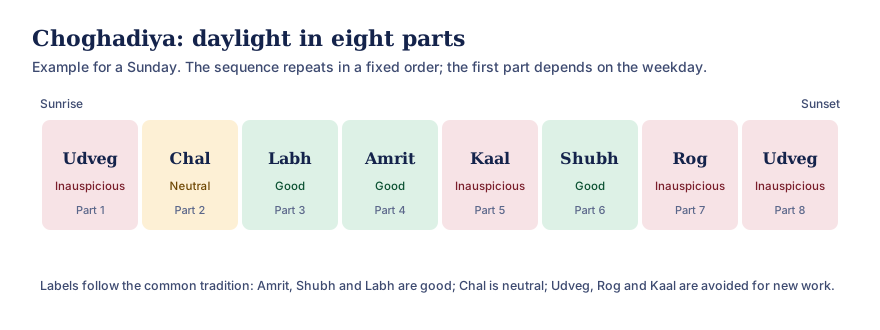
Text version of this diagram
On a Sunday the eight daytime Choghadiya, in order, are: Udveg (inauspicious), Chal (neutral), Labh (good), Amrit (good), Kaal (inauspicious), Shubh (good), Rog (inauspicious), Udveg (inauspicious). Each lasts one-eighth of the daylight. On other weekdays the same cycle of seven starts at a different point.
If you know the order of the horas, you’ll notice something: the day cycle follows the planets in the order Sun, Venus, Mercury, Moon, Saturn, Jupiter, Mars, which is exactly the hora sequence. Choghadiya and Hora come from the same scheme of planetary rulers.
The night cycle
At night, the Choghadiyas follow a different repeating order:
Shubh → Amrit → Chal → Rog → Kaal → Labh → Udveg → (back to Shubh)
And the first night Choghadiya depends on the weekday:
| Weekday | First night Choghadiya |
|---|---|
| Sunday | Shubh |
| Monday | Chal |
| Tuesday | Kaal |
| Wednesday | Udveg |
| Thursday | Amrit |
| Friday | Rog |
| Saturday | Labh |
For example, Sunday night runs Shubh, Amrit, Chal, Rog, Kaal, Labh, Udveg, Shubh.
A neat way to remember the night start: it’s the planet of the weekday four days later. Sunday night begins with Jupiter’s Shubh (Thursday’s ruler); Monday night with Venus’s Chal (Friday’s ruler); and so on.
A worked example
Say it’s a Wednesday with sunrise at 06:30 and sunset at 18:10.
- Daylight is 11 hours 40 minutes = 700 minutes.
- Each day Choghadiya = 700 ÷ 8 = 87.5 minutes.
- Wednesday starts with Labh. So: - 06:30–07:57 Labh - 07:57–09:25 Amrit - 09:25–10:52 Kaal - 10:52–12:20 Shubh - 12:20–13:47 Rog - 13:47–15:15 Udveg - 15:15–16:42 Chal - 16:42–18:10 Labh
At night, the eight periods are each one-eighth of the time from 18:10 to the next sunrise, starting with Udveg.
(Times are rounded to the minute.)
Why your local sunrise matters
Because every boundary is a fraction of your day and night, Choghadiya times change with the season and the city. A chart printed for Ahmedabad will be off in Kolkata by around an hour, because the Sun rises much earlier there by the same clock. In summer, day Choghadiyas are longer than 90 minutes and night ones shorter; in winter, the reverse. See Why sunrise times differ.
Using Choghadiya with other windows
Many families combine Choghadiya with Rahu Kaal, avoiding Rahu Kaal even if it falls within a good Choghadiya, and with the Hora or Abhijit muhurat. Families follow their own priorities; there is no single rule.
A note on interpretation
The qualities above follow common tradition and vary between families and regions. Choghadiya is a traditional practice, not a scientific prediction, and OIOA doesn’t claim that any period guarantees an outcome.
In OIOA
OIOA’s Hindu and Jain Home screens show the Choghadiya running now, for day and night, calculated on your phone from your local sunrise and sunset. Drag the live slider to see the Choghadiya at any time of day.
Common questions
Is Choghadiya the same as Hora?
They share the same planetary rulers and the same underlying order, but Choghadiya divides the day and night into eight parts each, while Hora divides them into twelve. Their boundaries don’t coincide, so a Choghadiya and a hora running at the same moment can have different rulers.
Does the eighth day Choghadiya always repeat the first?
Yes. Because the cycle has seven names and the day has eight periods, the eighth period always has the same name as the first. The same is true at night.
Which Choghadiya is good for buying gold or a vehicle?
Many families prefer Amrit, Shubh or Labh, and some favour particular weekdays and nakshatras for such purchases too, as well as festival days such as Dhanteras and Akshaya Tritiya. Follow your family’s custom.
Why is Udveg considered suitable for government work?
Udveg is associated with the Sun, which in tradition is linked with authority and government. So while Udveg is avoided for most new beginnings, some families consider it acceptable for dealings with government offices. This varies by family and region.
Key terms
- Ghadi (ghatika): a traditional unit of 24 minutes; four ghadis make about one Choghadiya.
- Day lord (var-pati): the planet that rules the weekday and the first Choghadiya and hora after sunrise.
- Day Choghadiya: one-eighth of sunrise-to-sunset.
- Night Choghadiya: one-eighth of sunset-to-next-sunrise.