Muhurtas: the old unit of time
Long before clocks, Indian timekeeping divided the full day and night into 30 muhurtas: 15 for the daytime and 15 for the night. On a day with equal day and night, each muhurta is 48 minutes long (24 hours × 60 ÷ 30). A muhurta was in turn two ghatikas (ghadis) of 24 minutes.
In traditional reckoning, the 15 daytime muhurtas are each one-fifteenth of the actual daylight, so they’re longer in summer and shorter in winter, just like horas and Choghadiyas.
The word muhurat has also come to mean an auspicious time in general, as in “wedding muhurat”. The original meaning is this precise unit of time.
The eighth muhurta
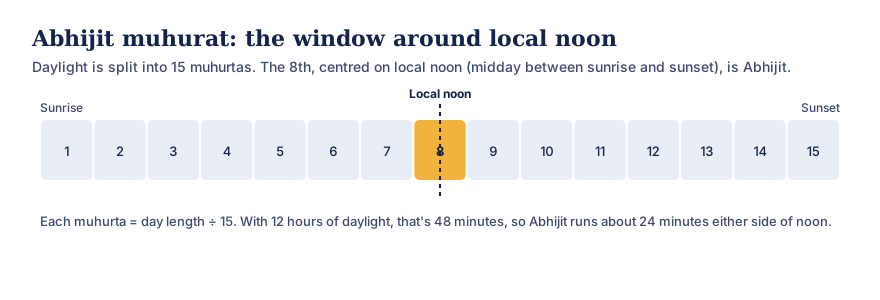
Abhijit is the eighth of the fifteen daytime muhurtas, the one exactly in the middle. Seven muhurtas come before it and seven after, so it is centred on local noon, the moment halfway between sunrise and sunset when the Sun is highest in the sky.
Text version of this diagram
Daylight is divided into 15 equal muhurtas. The 8th muhurta is centred on local noon, the midpoint between sunrise and sunset, and is called Abhijit. With 12 hours of daylight each muhurta is 48 minutes, so Abhijit runs about 24 minutes either side of local noon.
Abhijit means “victorious” or “unconquered”. It has long been regarded as one of the most favourable times of day, and is often described as able to overcome unfavourable factors in a day. For that reason, when a carefully chosen muhurat isn’t possible, many families use Abhijit for important beginnings.
How to calculate it
- Find sunrise and sunset for your location.
- Local noon = sunrise + (sunset − sunrise) ÷ 2.
- One muhurta = (sunset − sunrise) ÷ 15.
- Abhijit runs from local noon − half a muhurta to local noon + half a muhurta.
Example
Sunrise 06:20, sunset 18:05:
- Daylight = 11 h 45 min = 705 minutes.
- Local noon = 06:20 + 352.5 min = 12:12 (rounded).
- One muhurta = 705 ÷ 15 = 47 minutes.
- Abhijit ≈ 12:12 − 23.5 min to 12:12 + 23.5 min, about 11:49 to 12:36.
Why it isn’t 12 o’clock
Local noon is almost never 12:00 by the clock in India:
- Longitude. IST is set for 82.5° E. In Kolkata (about 88° E), local noon comes between about 11:20 and 11:50 IST depending on the season; in Ahmedabad (about 72.5° E), between about 12:25 and 12:55.
- The equation of time. Because of the tilt of the Earth’s axis and its elliptical orbit, solar noon at any place drifts earlier and later through the year by up to about 16 minutes.
Text version of this diagram
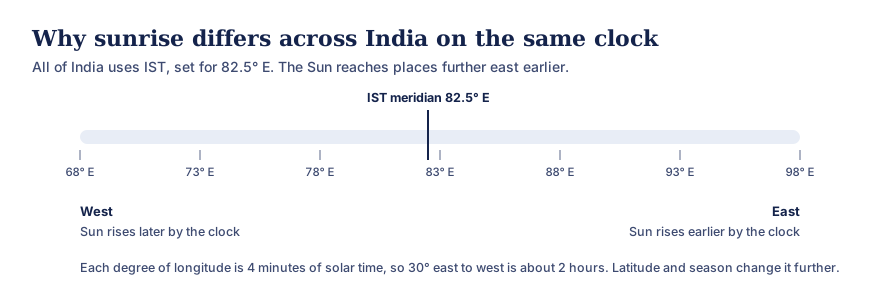
All of India uses Indian Standard Time, which is based on the 82.5° E meridian. Each degree of longitude equals four minutes of solar time, so places in the far east of India see sunrise by the clock up to about an hour earlier than IST’s reference meridian, and places in the far west up to about an hour later. Latitude and the season change sunrise times further.
So the Abhijit window for different cities on the same day can differ by more than an hour on the clock.
The Wednesday question
Several traditions hold that Abhijit is not used on Wednesdays. One practical observation: on Wednesdays, Rahu Kaal is the fifth of the eight daytime parts, which begins exactly at local noon. So the second half of Abhijit always overlaps Rahu Kaal on a Wednesday. Families who observe both usually avoid Abhijit that day, or use only its first half. Customs differ, so follow your family’s practice.
Other named muhurtas
The 15 daytime muhurtas each have traditional names, which vary slightly between texts. Lists commonly begin with Rudra, Ahi, Mitra and Pitru, with Abhijit eighth. Among the night muhurtas, the best known is Brahma muhurta, the period before sunrise traditionally considered ideal for meditation, prayer and study; it is commonly taken as the muhurta that ends one muhurta before sunrise, roughly 1½ hours to 48 minutes before sunrise.
Abhijit the nakshatra
The name Abhijit also belongs to a nakshatra, the 28th lunar mansion counted in older lists and in the Jain tradition, between Uttara Ashadha and Shravana. The two share a name and an association with victory, but are different things: a time of day versus a part of the Moon’s path. See the 28 Jain nakshatras.
In OIOA
OIOA shows Abhijit muhurat on the Hindu and Jain Home screens, calculated on your phone from your local sunrise and sunset. Use the live sliders to see whether Abhijit overlaps with Rahu Kaal, and which Choghadiya and Hora are running at the same time.
Common questions
What is the difference between a muhurta and a muhurat?
A muhurta is a precise unit of time: one-thirtieth of a day and night, about 48 minutes on an equinox day. Muhurat, in everyday speech, has come to mean any auspicious time chosen for an event, as in a wedding muhurat or a business muhurat. Abhijit is both: it is a specific muhurta, and it is widely treated as an auspicious muhurat.
Is Abhijit the same length every day?
No. It is one-fifteenth of the daylight, so it lengthens and shortens with the seasons. In New Delhi it is roughly 56 minutes in late June and roughly 41 minutes in late December. Closer to the equator the variation is smaller.
Does Abhijit muhurat depend on the tithi or nakshatra?
The window itself depends only on sunrise and sunset. Whether a family uses it on a particular day may depend on the tithi, nakshatra, weekday and the purpose of the work, according to their tradition. That’s why priests often check the full panchang before recommending Abhijit for something important.
Why do different apps show slightly different Abhijit times?
Usually because of how sunrise is defined (the Sun’s upper edge or its centre, with or without atmospheric refraction) or because they calculate for a different city. A difference of a minute or two is normal; a larger difference usually means a different location.
Is Abhijit used for daily prayer?
Some families like to begin the main work of the day, or a midday prayer, in Abhijit. It isn’t a requirement in any tradition; it’s simply a widely respected window.
Key terms
- Muhurta: one-fifteenth of the daytime (or night-time); about 48 minutes on an equinox day.
- Ghatika (ghadi): half a muhurta; about 24 minutes.
- Local noon (madhyahna): the moment halfway between sunrise and sunset, when the Sun is highest.
- Equation of time: the yearly drift of solar noon against the clock, up to about 16 minutes.
- Brahma muhurta: the pre-dawn muhurta, traditionally ideal for prayer and study.