Planetary hours
A hora is one of the 24 planetary hours of a day: twelve from sunrise to sunset and twelve from sunset to the next sunrise. Each hora is ruled by one of the seven classical “planets” of ancient astronomy: the Sun, Moon, Mars, Mercury, Jupiter, Venus and Saturn.
The word hora is shared with Greek, where it gave rise to the English “hour”. The scheme of planetary hours was known in Hellenistic astronomy and entered Indian astronomy and astrology, where it has been used for centuries for choosing suitable times.
The order of the planets
Ancient astronomers ranked the seven planets by how slowly they appear to move against the stars, from slowest to fastest:
Saturn → Jupiter → Mars → Sun → Venus → Mercury → Moon
This is often called the Chaldean order. The horas follow this order, one planet per hour, round and round. Starting from the Sun, the sequence reads:
Sun → Venus → Mercury → Moon → Saturn → Jupiter → Mars → Sun …
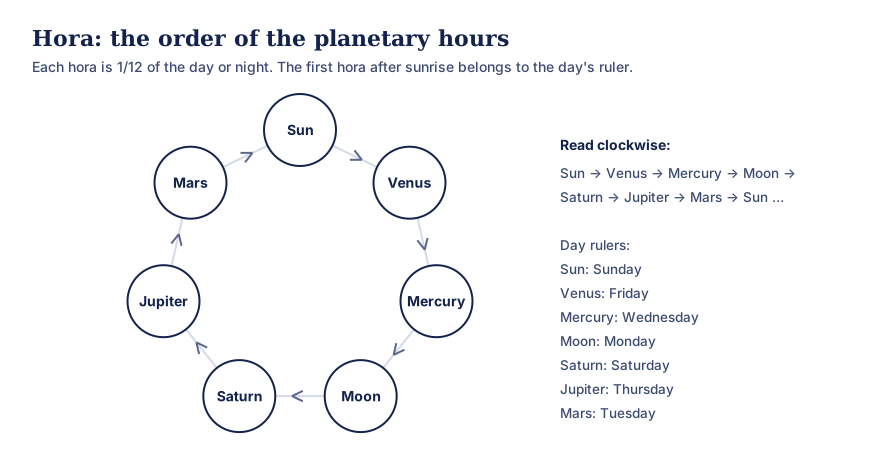
Text version of this diagram
Horas follow this repeating order: Sun, Venus, Mercury, Moon, Saturn, Jupiter, Mars, then Sun again. The first hora after sunrise belongs to the ruler of the weekday: Sun for Sunday, Moon for Monday, Mars for Tuesday, Mercury for Wednesday, Jupiter for Thursday, Venus for Friday and Saturn for Saturday.
How the order makes the week
Here’s the remarkable part. The first hora after sunrise gives its name to the day: the Sun rules the first hora of Sunday, the Moon of Monday, and so on.
Count forward 24 horas from the Sun’s first hora on Sunday. Seven horas bring you back to the Sun, so after 21 horas you’re at the Sun again, then Venus (22), Mercury (23), Moon (24), and the 25th hora, the first of the next day, belongs to the Moon: Monday.
Do it again from the Moon: 24 horas later you reach Mars, which gives Tuesday (Mangalvar). Then Mercury, Wednesday (Budhvar); Jupiter, Thursday (Guruvar); Venus, Friday (Shukravar); Saturn, Saturday (Shanivar); and back to the Sun, Sunday (Ravivar).
So the order of the weekdays, the same in Sanskrit, Hindi, Gujarati, Tamil, Latin and many other languages, comes from the planetary hours. Each day is named after the planet that rules its first hour.
Working out the horas
- Find sunrise and sunset, and the next sunrise, for your location.
- Divide the daylight into 12 equal parts, and the night into 12 equal parts.
- The first day hora belongs to the weekday’s ruler. Continue in the sequence Sun → Venus → Mercury → Moon → Saturn → Jupiter → Mars.
- Carry on into the night: the 13th hora, the first after sunset, continues the same sequence.
Example
A Thursday with sunrise at 06:00 and sunset at 18:00 (12 hours of daylight, so each hora is 60 minutes):
| Time | Hora |
|---|---|
| 06:00–07:00 | Jupiter |
| 07:00–08:00 | Mars |
| 08:00–09:00 | Sun |
| 09:00–10:00 | Venus |
| 10:00–11:00 | Mercury |
| 11:00–12:00 | Moon |
| 12:00–13:00 | Saturn |
| 13:00–14:00 | Jupiter |
| 14:00–15:00 | Mars |
| 15:00–16:00 | Sun |
| 16:00–17:00 | Venus |
| 17:00–18:00 | Mercury |
The first night hora, from 18:00, is the Moon, and the night continues Saturn, Jupiter, and so on. Twenty-four horas later, the first hora of Friday is Venus.
Equal or unequal hours?
In the traditional method above, horas are unequal: one-twelfth of the actual daylight or night, so day horas are longer in summer and shorter in winter. Some modern calendars simplify by using fixed 60-minute horas from sunrise. At the equinoxes the two agree; at other times they drift apart. If you compare charts, check which method each uses.
What each hora is traditionally used for
Traditional guidance associates each planet’s hora with certain kinds of activity. Common associations include:
- Sun: authority, government work, leadership.
- Moon: travel, home, family, things involving water or the public.
- Mars: physical effort, sport, property, surgery; often avoided for gentle beginnings.
- Mercury: study, writing, communication, trade, contracts.
- Jupiter: learning, worship, advice, finance, ceremonies.
- Venus: arts, beauty, relationships, buying clothes, jewellery or vehicles.
- Saturn: hard work, long-term or routine tasks; often avoided for celebrations.
These associations differ between teachers and regions. They are traditional, not scientific, and no outcome is guaranteed.
Hora, Choghadiya and the week
Choghadiya uses the same planetary rulers: its day sequence follows the hora order exactly, with each Choghadiya standing for one planet. Choghadiya simply divides the day into eight parts instead of twelve. So if you understand horas, you already understand the structure of Choghadiya.
In OIOA
OIOA shows the hora running now on the Hindu and Jain Home screens, starting from your local sunrise, calculated on your phone. Drag the live slider to see which hora falls at any time, alongside Choghadiya, Rahu Kaal and Abhijit muhurat.
Common questions
Is Hora used only for astrology?
Its main use today is choosing a time for activities. But its structure is also historically significant: it explains the order of the days of the week in many languages.
Do horas apply at night?
Yes. There are twelve night horas, from sunset to the next sunrise, continuing the same planetary sequence.
What is the difference between Hora and Choghadiya?
Hora has twelve parts to the day; Choghadiya has eight. They share the same planetary rulers and order, but their boundaries don’t coincide.
Why are Rahu and Ketu not in the hora sequence?
The hora system uses the seven classical planets visible to the naked eye. Rahu and Ketu are points, the lunar nodes, not visible bodies, so they have no horas.
Key terms
- Hora: a planetary hour; one-twelfth of the day or night.
- Chaldean order: the ancient order of the planets by apparent speed.
- Var-pati: the planet that rules a weekday and its first hora.
- Unequal hours: hours that are a fixed fraction of the actual day or night.