Four ways of dividing the day
Hindu tradition has several ways of judging the quality of a time of day. OIOA’s Hindu Home screen shows four of the most widely used:
| Window | How the day is divided | What OIOA shows |
|---|---|---|
| Choghadiya | 8 parts of the day, 8 of the night | The Choghadiya running now, day and night |
| Hora | 12 planetary hours of the day, 12 of the night | The hora running now |
| Rahu Kaal | 1 of 8 parts of the day, by weekday | Today’s Rahu Kaal |
| Abhijit muhurat | The 8th of 15 parts of the day | The window around local noon |
All four are tied to your local sunrise and sunset, which is why OIOA calculates them for your location rather than using a fixed chart.
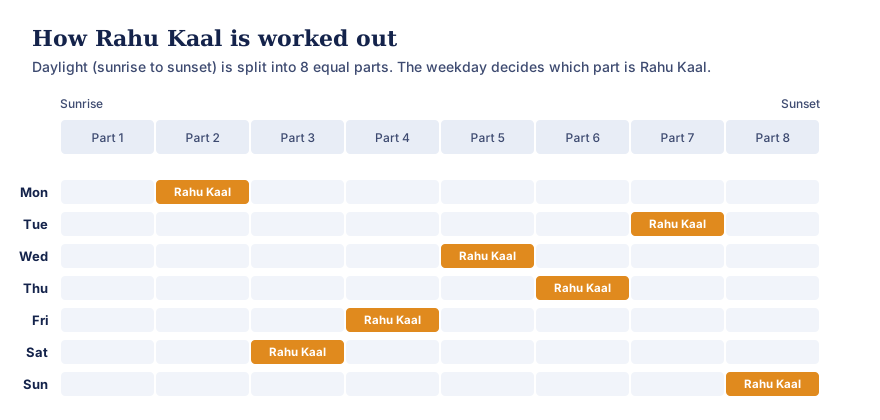
Text version of this diagram
Daylight, from sunrise to sunset, is divided into eight equal parts. Rahu Kaal is:
- Monday: part 2
- Tuesday: part 7
- Wednesday: part 5
- Thursday: part 6
- Friday: part 4
- Saturday: part 3
- Sunday: part 8
Seeing the overlaps
Because the divisions differ, their boundaries don’t line up. A Labh Choghadiya might begin halfway through a Jupiter hora; Rahu Kaal on a Wednesday overlaps with Abhijit around noon. Looking at one window alone can give a misleading picture.
The live sliders on the Today card solve this. Drag to any time of day and see, together, which Choghadiya and Hora are running, and whether that time falls in Rahu Kaal or Abhijit. When Panchak is running, it appears too.
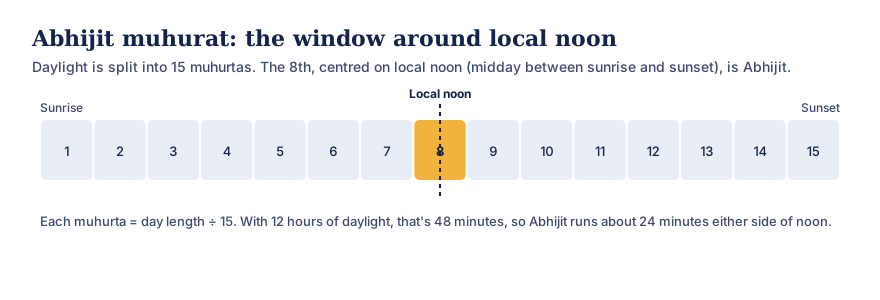
Text version of this diagram
Daylight is divided into 15 equal muhurtas. The 8th muhurta is centred on local noon, the midpoint between sunrise and sunset, and is called Abhijit. With 12 hours of daylight each muhurta is 48 minutes, so Abhijit runs about 24 minutes either side of local noon.
A simple way to choose a time
Families have their own rules, and those come first. If you’re looking for a general approach to a routine decision, such as when to leave on a journey or sign a document, many people:
- Avoid Rahu Kaal for starting something new.
- Prefer an Amrit, Shubh or Labh Choghadiya, or Chal for travel.
- Consider the Hora, choosing a planet traditionally linked to the activity.
- Use Abhijit when nothing else fits, except where their tradition avoids it on certain days.
For major ceremonies, such as weddings, griha pravesh, mundan or upanayana, families consult a priest who considers the tithi, nakshatra, the people involved and much more. OIOA gives you the timings; it does not replace that guidance. See the disclaimer.
Planning ahead
The live sliders work for the whole day, so you can check this evening’s windows in the morning. For something important on a later day, set a reminder so the time reaches you.
Why OIOA uses your sunrise
All of India keeps one clock, IST, but the Sun doesn’t rise at one time. Sunrise in Guwahati can be well over an hour earlier by the clock than in Ahmedabad on the same day, and day length changes through the year. Every muhurat window shifts with it. Why sunrise times differ explains this.