What Rahu Kaal is
Rahu Kaal (also written Rahu Kalam, Rahukalam or Rahu Kal) is a period of roughly an hour and a half each day that is traditionally considered unfavourable for starting something new: a journey, a purchase, a business deal, an interview or a ceremony. The practice is especially strong in South India, where Rahu Kalam is part of everyday conversation, and it is observed by many families throughout the country.
Rahu is one of the nine grahas in Indian astronomy and astrology. It is not a physical planet but a point in the sky, the Moon’s ascending node, where the Moon’s path crosses the Sun’s. Eclipses happen near these points, which is part of why Rahu has long been associated with disruption.
How Rahu Kaal is worked out
The calculation is simple and elegant:
- Take your local sunrise and sunset for the day.
- Divide the daylight between them into eight equal parts.
- The weekday decides which of the eight parts is Rahu Kaal.
| Weekday | Part of the day | With 6:00 sunrise and 18:00 sunset |
|---|---|---|
| Monday | 2nd | 07:30 – 09:00 |
| Tuesday | 7th | 15:00 – 16:30 |
| Wednesday | 5th | 12:00 – 13:30 |
| Thursday | 6th | 13:30 – 15:00 |
| Friday | 4th | 10:30 – 12:00 |
| Saturday | 3rd | 09:00 – 10:30 |
| Sunday | 8th | 16:30 – 18:00 |
The times in the last column are only an illustration for a day with exactly twelve hours of daylight. Real days are rarely like that, which is why a fixed Rahu Kaal chart can be out by half an hour or more.
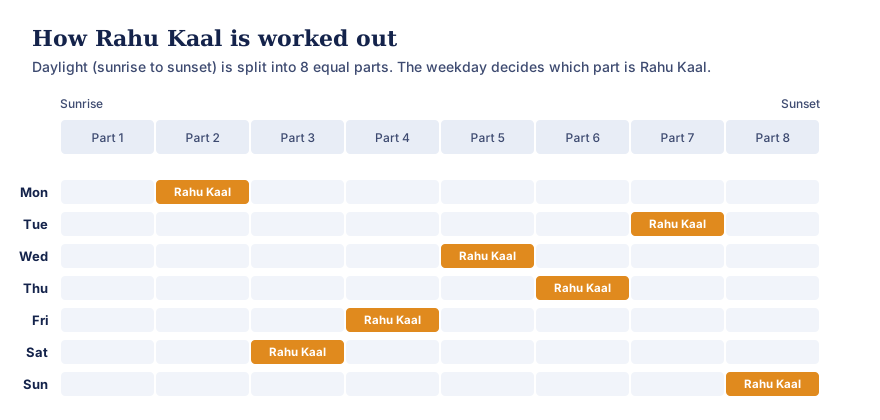
Text version of this diagram
Daylight, from sunrise to sunset, is divided into eight equal parts. Rahu Kaal is:
- Monday: part 2
- Tuesday: part 7
- Wednesday: part 5
- Thursday: part 6
- Friday: part 4
- Saturday: part 3
- Sunday: part 8
Why the time changes every day and every city
Because Rahu Kaal is one-eighth of the daylight, it stretches and shrinks with the seasons. In June, when days are long in North India, Rahu Kaal can last close to two hours. In December it is shorter. It also moves with your location: all of India uses one clock, but the Sun rises much earlier by that clock in the east than in the west. Why sunrise times differ explains this in detail.
That is why OIOA does not use a fixed chart. It calculates today’s sunrise and sunset for your location on your phone, then works out Rahu Kaal from them. If you travel, OIOA’s Rahu Kaal moves with you.
What you see in OIOA
When your community is set to Hindu or Jain, the Home screen shows:
- Today’s Rahu Kaal, with its start and end time.
- Live sliders on the Today card, so you can see at a glance whether a time you’re planning falls inside Rahu Kaal.
- Other windows nearby: the Choghadiya and Hora running at that moment, and Abhijit muhurat around local noon.
Everything is calculated on your device, so it works offline. You can read Rahu Kaal in your own language with the EN ⇄ local-language toggle.
Rahu Kaal, Yamaganda and Gulika
Calendars in South India often show two more daily periods alongside Rahu Kaal: Yamaganda (Yamagandam) and Gulika Kaal (Kuligai). Each is also one-eighth of the daylight, with its own weekday pattern. OIOA’s Home screen focuses on Rahu Kaal; the learn guide on Rahu Kaal explains how the three relate.
What people avoid, and what they don’t
Practices vary widely. Some families avoid only starting important new activities during Rahu Kaal, and are happy to continue work already begun. Others avoid travel or purchases altogether. Some temples hold special prayers during Rahu Kaal, especially on Tuesdays and Fridays. Routine daily activity is generally not affected.
OIOA shows the time. It doesn’t tell you what to do with it. Please follow the guidance of your family or community, and read the disclaimer.
Checking a time quickly
A practical way to use Rahu Kaal in OIOA:
- Open the Home screen.
- Drag the live slider to the time you have in mind.
- See whether it falls in Rahu Kaal, and which Choghadiya and Hora are running.
- If you’d like a nudge on the day, set a reminder.
If our time doesn’t match yours
If your local temple or printed calendar shows a different Rahu Kaal, the usual reasons are a different city, a fixed 6 am to 6 pm chart, or a different sunrise definition (for example, the Sun’s upper edge versus its centre). If the difference still seems wrong, tell us what we missed with your location and the times you’re comparing.
Common questions
Is Rahu Kaal at the same time every Monday?
It’s always the second eighth of the daylight on a Monday, but the clock time shifts as sunrise and sunset change through the year, and differs between cities.
Can I continue work that started before Rahu Kaal?
In most traditions, yes. The caution is about starting new undertakings during Rahu Kaal, not about continuing what’s already under way.