What Abhijit muhurat is
In the traditional reckoning, the daytime, from sunrise to sunset, is divided into 15 muhurtas. Each muhurta is one-fifteenth of the daylight, which on a day with twelve hours of daylight works out at 48 minutes. The eighth muhurta, the one in the middle, is called Abhijit. It is centred on local noon, the moment halfway between sunrise and sunset when the Sun is highest in the sky.
The name Abhijit means “victorious” or “invincible”. Many families consider this midday window favourable for starting important work, especially when a more elaborate muhurat cannot be chosen. It is sometimes described as a muhurat that is good in itself.
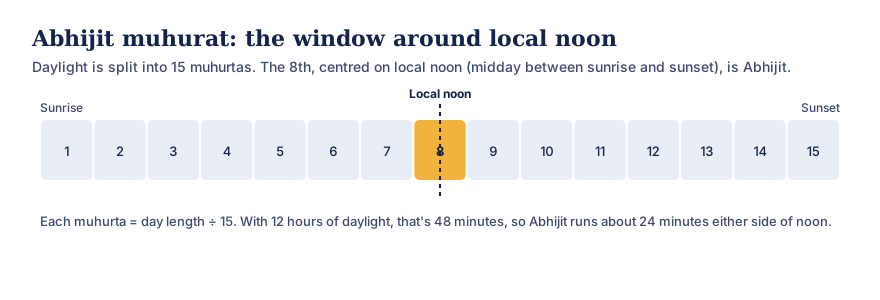
Text version of this diagram
Daylight is divided into 15 equal muhurtas. The 8th muhurta is centred on local noon, the midpoint between sunrise and sunset, and is called Abhijit. With 12 hours of daylight each muhurta is 48 minutes, so Abhijit runs about 24 minutes either side of local noon.
Why it isn’t simply 12 noon
Local noon is not the same as 12:00 on the clock. Indian Standard Time is based on the 82.5° E meridian, so in the east of India the Sun reaches its highest point well before 12:00 IST, and in the west well after. The time of local noon also drifts through the year by up to about a quarter of an hour, because of the tilt of the Earth’s axis and the shape of its orbit.
On top of that, the length of a muhurta changes with the length of the day. In summer, when daylight is longer, Abhijit is longer; in winter it is shorter.
So the Abhijit window for Kolkata, for Mumbai and for Bhuj on the same day can differ by more than an hour on the clock. OIOA calculates your local sunrise, sunset and noon on your phone, and works out Abhijit from them.
What you see in OIOA
With your community set to Hindu or Jain:
- Today’s Abhijit muhurat, with start and end times, appears with the day’s other timings.
- Live sliders on the Today card let you check whether a planned time falls inside Abhijit, and what else is running then: the Choghadiya, the Hora and whether it overlaps with Rahu Kaal.
- All calculations happen on your device, so Abhijit is available offline.
Abhijit and other windows
Abhijit can overlap with periods that people prefer to avoid. On Wednesdays, for example, Rahu Kaal is the fifth eighth of the day, which on many days begins at or near local noon and so overlaps with Abhijit. Some traditions specifically say Abhijit is not used on Wednesdays; others weigh the two differently. OIOA shows both so you can see the overlap and follow your family’s practice.
Abhijit is also the name of a nakshatra in some lists. In the Jain tradition’s 28 nakshatras, Abhijit sits between Uttara Ashadha and Shravana. The two uses of the name are related in origin but refer to different things: one a time of day, the other a section of the Moon’s path.
How the 15 muhurtas are named
Each of the 15 daytime muhurtas has a traditional name. Lists vary slightly between texts, but they commonly begin with Rudra, Ahi, Mitra and Pitru, and Abhijit is always the eighth, at the centre of the day. The night is similarly divided into 15 muhurtas, and the period before sunrise known as Brahma muhurta, considered ideal for prayer and study, belongs to this night-time division.
Using Abhijit day to day
People commonly use Abhijit muhurat for:
- signing an agreement or starting a business task,
- leaving on a journey,
- beginning a puja or a simple family ceremony,
- making a purchase that matters.
For major ceremonies such as a wedding or a griha pravesh, families usually consult a priest, who considers the tithi, nakshatra, the people involved and much more. OIOA gives you the timings; it does not replace that guidance. See the disclaimer.
Set a reminder
If you want to use Abhijit for something specific, a reminder can nudge you shortly before it starts.
Learn more
If OIOA’s Abhijit time looks wrong for your city, please tell us with your location and the time you expected.
Common questions
Is Abhijit muhurat good every day?
Many families consider Abhijit favourable on most days, but traditions add exceptions. The best known is Wednesday, when Rahu Kaal begins at local noon and overlaps the second half of Abhijit. Some traditions also take the tithi, nakshatra or the purpose of the work into account. If you’re planning something important, ask your family priest.
How long does Abhijit muhurat last?
One muhurta, which is one-fifteenth of the daylight. On a day with 12 hours of daylight that’s 48 minutes. In midsummer in North India it can be closer to 55 minutes, and in midwinter around 42.
Can I use Abhijit for a wedding or griha pravesh?
For major ceremonies, families usually ask a priest to choose a muhurat that considers many more factors, including the people involved. Abhijit is often used for smaller beginnings, or when a detailed muhurat isn’t available.
Is there an Abhijit muhurat at night?
The name Abhijit refers to the eighth daytime muhurta. The night is also divided into 15 muhurtas, with their own names; the best known of those is Brahma muhurta before dawn.