What a hora is
A hora is a planetary hour. The tradition divides the time from sunrise to sunset into twelve horas, and the time from sunset to the next sunrise into another twelve, giving 24 in a full day. Each hora is “ruled” by one of the seven classical planets: the Sun, Moon, Mars, Mercury, Jupiter, Venus and Saturn.
The word hora is related to the Greek word that gave English its “hour”, a reminder that the idea of planetary hours is shared by several ancient traditions. In India it is widely used for choosing a time, often alongside Choghadiya.
The order of the horas
The horas follow a fixed, repeating order: Sun → Venus → Mercury → Moon → Saturn → Jupiter → Mars, then back to the Sun. The first hora after sunrise always belongs to the planet that rules the weekday:
| Weekday | First hora at sunrise |
|---|---|
| Sunday | Sun (Surya) |
| Monday | Moon (Chandra) |
| Tuesday | Mars (Mangal) |
| Wednesday | Mercury (Budh) |
| Thursday | Jupiter (Guru) |
| Friday | Venus (Shukra) |
| Saturday | Saturn (Shani) |
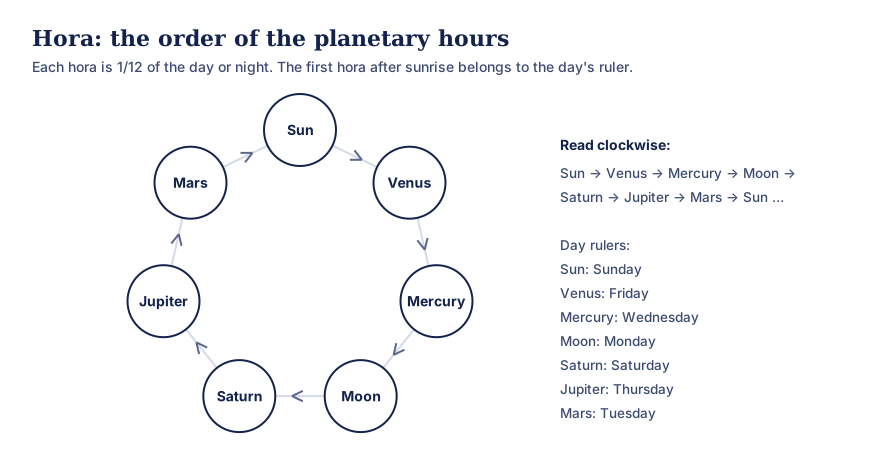
Text version of this diagram
Horas follow this repeating order: Sun, Venus, Mercury, Moon, Saturn, Jupiter, Mars, then Sun again. The first hora after sunrise belongs to the ruler of the weekday: Sun for Sunday, Moon for Monday, Mars for Tuesday, Mercury for Wednesday, Jupiter for Thursday, Venus for Friday and Saturn for Saturday.
This also explains the order of the weekdays themselves. Count 24 horas forward from the Sun’s hora on Sunday, and the 25th, the first hora of the next day, belongs to the Moon: Monday. The names of the days in many languages, Indian and European, come from this ancient scheme. Read the full story in What is Hora?
What OIOA shows
With your community set to Hindu or Jain, OIOA’s Today card shows:
- The hora running now, named by its planet.
- When it ends, so you know how long you have.
- A live slider to move through the day and night and see which hora falls at any time, which is useful for planning ahead.
OIOA starts the hora sequence from your local sunrise, so the times differ between cities and through the year. All of this is worked out on your phone, so horas are available offline.
How people use horas
Traditional guidance links each planet’s hora with certain kinds of activity. A few common associations:
- Sun (Surya): dealings with government and authority, matters of reputation.
- Moon (Chandra): travel, matters of the home and family, things that involve water.
- Mars (Mangal): physical work, sport, property; often avoided for peaceful beginnings.
- Mercury (Budh): study, writing, communication, trade.
- Jupiter (Guru): learning, religious activity, advice, finance.
- Venus (Shukra): arts, relationships, buying clothes or jewellery.
- Saturn (Shani): labour, long-term tasks; often avoided for celebrations.
These associations vary between teachers and regions, and OIOA does not promise any outcome. Use them as your tradition guides you, and see the disclaimer.
Hora, Choghadiya and Rahu Kaal together
Each of these traditions divides the day differently:
- Hora: 12 parts of the day and 12 of the night.
- Choghadiya: 8 parts of the day and 8 of the night.
- Rahu Kaal: one of the 8 parts of the day, fixed by weekday.
- Abhijit muhurat: the 8th of 15 parts of the day, around local noon.
Because the divisions differ, their boundaries don’t line up. A Jupiter hora can begin in the middle of a Labh Choghadiya and overlap with Rahu Kaal. OIOA shows all of them so you can see the whole picture and decide in the way your family does.
Equal or unequal hours?
Some modern calendars use fixed 60-minute horas starting from sunrise. The traditional method, and the one that matches the logic of sunrise-to-sunset divisions, uses unequal hours: one-twelfth of the actual daylight and night. At the equinoxes the two methods agree; at other times of year they drift apart by several minutes per hora. If a printed hora chart differs from OIOA, check which of the two methods it uses before comparing times.
Get it right for your city
If you travel, your sunrise changes, and so do your horas. OIOA uses your current location or a city you choose. If you compare OIOA with a chart printed for a different city and see different times, that is the reason. If you still think something is wrong, tell us what we missed with the time, place and the source you’re comparing with.
In your language
Planet names appear as you know them in your language: Surya, Chandra, Mangal, Budh, Guru, Shukra, Shani, or their local forms. Switch with the EN ⇄ local-language toggle.
Common questions
Which hora is considered good for starting work?
It depends on the work. Traditionally, Jupiter (Guru) hora is favoured for learning, finance and religious activity; Mercury (Budh) for study, writing and trade; Venus (Shukra) for arts and purchases; and the Moon (Chandra) for travel. Families and teachers differ, so these are guidelines rather than rules.
How many horas are there in a day?
Twenty-four: twelve from sunrise to sunset and twelve from sunset to the next sunrise.
Why is the first hora of Thursday Jupiter’s?
Because each weekday is named after the planet that rules its first hora. Thursday (Guruvar) begins with Jupiter (Guru), Friday (Shukravar) with Venus (Shukra), and so on. What is Hora? shows how this creates the order of the week.