The problem every lunar calendar faces
Twelve lunar months, from one new moon to the next, add up to about 354 days. The solar year, which brings the seasons, is about 365 days. The difference is roughly 11 days a year.
A purely lunar calendar, like the Hijri calendar, simply lets that difference accumulate, so its months move through all the seasons over about 33 years. The Hindu calendar takes a different path: it wants Diwali in autumn and Holi in spring, every year. So every so often it adds a thirteenth month. That extra month is Adhik maas: adhik means “additional”.
Three years of 11-day shortfalls add up to about 33 days, a little more than one lunar month. So an Adhik maas comes round about every 32 to 33 months, roughly seven times in every 19 years.
The elegant rule
Many lunisolar calendars around the world add an extra month by a fixed cycle. The Hindu calendar does something more precise: it watches the Sun.
The Sun appears to move through the twelve sidereal zodiac signs over the year. The moment it enters a new sign is a sankranti, and the time between two sankrantis is a solar month, about 30.4 days on average. A lunar month is about 29.5 days. So the solar months are slightly longer than the lunar months.
Usually, each lunar month contains exactly one sankranti, and the lunar month takes its name from it. But because lunar months are shorter, every so often a whole lunar month fits between two sankrantis, starting just after one and ending just before the next.
A lunar month with no sankranti in it is the Adhik maas.
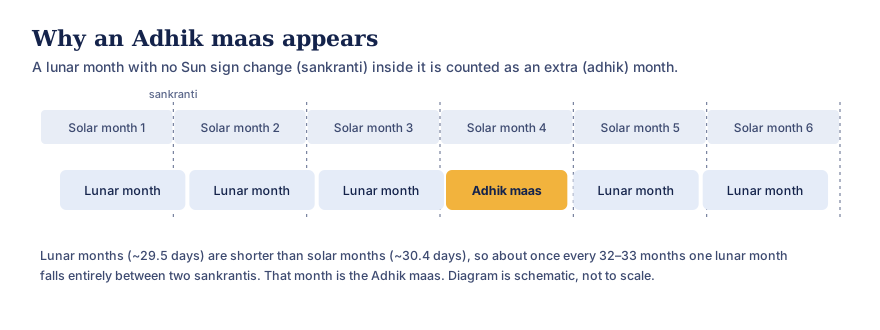
Text version of this diagram
Solar months begin at each sankranti, when the Sun enters a new zodiac sign, and last about 30.4 days. Lunar months last about 29.5 days. Because lunar months are shorter, roughly every 32 to 33 months one lunar month starts and ends without a sankranti inside it. That month is counted as an extra, or Adhik, maas.
It takes the name of the month that follows it. So if the month with no sankranti falls just before Shravana, the calendar has an Adhik Shravana followed by the regular, or Nija (own), Shravana.
When does it happen?
Because the Sun moves at slightly different speeds through the year, faster around January and slower around July, solar months are shorter in winter and longer in summer. A lunar month is more likely to fit entirely inside a long solar month, so Adhik maas falls most often in the months from Chaitra to Ashvina, the spring and summer half of the year. It almost never occurs in the winter months.
The rarer kshaya maas
The opposite can also happen, though rarely. In winter, when solar months are shortest, a solar month can be shorter than a lunar month. Then one lunar month can contain two sankrantis, and the calendar “loses” a month, called a kshaya maas. When this happens, there is always an Adhik maas within the same year to compensate, so the year still has twelve regular months. Kshaya maas is very uncommon: intervals between occurrences have ranged from about 19 years to over a century.
Names: Adhik, Purushottam, Mal
The extra month has several names, each with its own meaning:
- Adhik maas: the additional month.
- Mal maas: an older name, sometimes understood as an “impure” or “surplus” month in which auspicious ceremonies are avoided.
- Purushottam maas: a devotional name. In Puranic tradition, Lord Vishnu, as Purushottam, took the unclaimed month as his own, making it especially sacred for prayer, charity, recitation and fasting.
What changes during an Adhik maas
Practices vary by region and family, but commonly:
- Auspicious ceremonies are avoided. Weddings, griha pravesh (housewarming), mundan, upanayana and the start of major undertakings are usually not scheduled in Adhik maas.
- Devotion is encouraged. Many people undertake special prayers, scripture reading, charity and pilgrimage. In some traditions, gifts of particular items such as malpua or diyas are customary.
- Festivals move to the regular month. A festival that would fall in, say, Shravana is usually celebrated in Nija Shravana, after the Adhik month. This is why, in an Adhik maas year, festivals can seem to arrive about a month “late” compared with the previous year.
- Monthly observances continue. Ekadashi, Purnima, Amavasya and other recurring observances continue as usual, and the Ekadashis of Adhik maas have their own names (Padmini and Parama Ekadashi).
Adhik maas in Amanta and Purnimanta calendars
An Adhik maas is defined from new moon to new moon. In Amanta calendars this fits neatly: Adhik Shravana is one whole month. In Purnimanta calendars, where months run full moon to full moon, the Adhik period is described as falling between the two halves of the regular month: the Krishna paksha of Shravana, then the Adhik month, then the Shukla paksha of Shravana. It’s the same period of time described differently. See Purnimanta and Amanta.
Adhik maas in the Jain calendar
The Jain calendar is also lunisolar and also has Adhik months. Jain traditions differ in how they count an Adhik month for observances, which can affect when Paryushan falls in a year that has one. See Jain sects and their calendars.
Why it matters for planning
If you’re planning a wedding or other ceremony, an Adhik maas in the year can rule out a month you’d otherwise have considered. If you’re expecting a festival around the same time as last year and it seems late, an Adhik maas is the likely reason.
Adhik maas in OIOA
OIOA’s panchang on the Hindu and Jain Home screens marks Adhik maas while it is running, calculated on your phone from the positions of the Sun and Moon. For how your family observes it, please follow your priest or community authority. Read more in the panchang and Adhik maas.
Common questions
How often does Adhik maas come?
About every 32 to 33 months, which works out at roughly seven times in 19 years.
Which months can be Adhik?
Most often the months from Chaitra to Ashvina, when the Sun moves more slowly and solar months are longer. It is very rare in the winter months.
Do Ekadashi fasts continue in Adhik maas?
Yes. Monthly observances continue, and the two Ekadashis of Adhik maas have their own names, Padmini and Parama.