Five elements, four you check daily
A traditional panchang describes each day through five elements: tithi, vara (weekday), nakshatra, yoga and karana. On the Hindu Home screen, OIOA shows the elements people check most often: the tithi with its paksha, the nakshatra, the lunar month, and Adhik maas when it occurs. The weekday, of course, is always there.
Paksha: the two halves of the month
Each lunar month has two halves of about 15 days each:
- Shukla paksha, the bright or waxing half, from the day after new moon (Amavasya) to full moon (Purnima).
- Krishna paksha, the dark or waning half, from the day after full moon to new moon.
Many observances name the paksha as well as the tithi: Shukla Ekadashi and Krishna Ekadashi are different days, two weeks apart. OIOA shows the paksha next to the tithi so there’s no confusion. Read more in Shukla and Krishna paksha.
Naming the lunar month
The twelve lunar months are Chaitra, Vaishakha, Jyeshtha, Ashadha, Shravana, Bhadrapada, Ashvina, Kartika, Margashirsha, Pausha, Magha and Phalguna. Each takes its name from the nakshatra near which the full moon usually falls.
There are two ways to mark where a month ends:
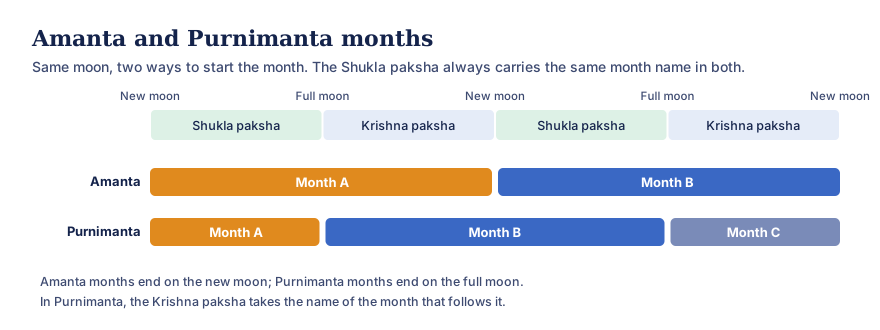
Text version of this diagram
In the Amanta system a month runs from the day after one new moon to the next new moon: Shukla paksha, then Krishna paksha. In the Purnimanta system a month runs from the day after a full moon to the next full moon: Krishna paksha, then Shukla paksha. The Shukla paksha has the same month name in both systems; the Krishna paksha is named after the following month in Purnimanta.
- Amanta months end on the new moon. This is common in Gujarat, Maharashtra, Karnataka, Andhra Pradesh and Telangana, among others.
- Purnimanta months end on the full moon. This is common across much of North and Central India.
The Shukla paksha has the same month name in both systems. The Krishna paksha differs: what one region calls the dark half of Ashvina, another calls the dark half of Kartika. That’s why a festival such as Diwali, on the new moon, can be described as falling in Ashvina in one calendar and Kartika in another, while being the same night. See Purnimanta and Amanta explained.
Adhik maas
A lunar year of twelve months is about 354 days, roughly 11 days shorter than the solar year. Left alone, festivals would drift through the seasons. The panchang corrects this with an extra month, the Adhik maas (also called Purushottam maas or Mal maas), roughly every 32 to 33 months.
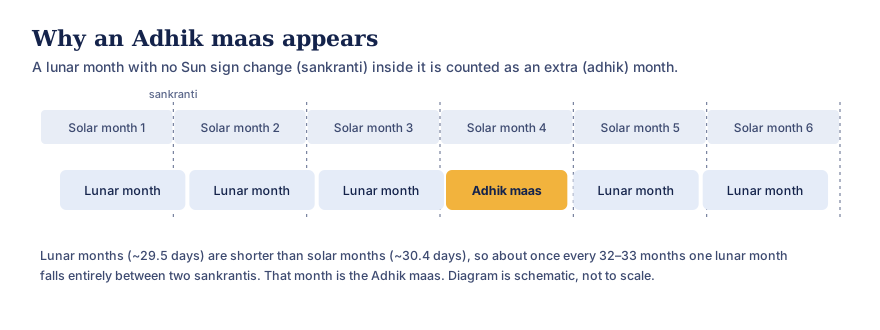
Text version of this diagram
Solar months begin at each sankranti, when the Sun enters a new zodiac sign, and last about 30.4 days. Lunar months last about 29.5 days. Because lunar months are shorter, roughly every 32 to 33 months one lunar month starts and ends without a sankranti inside it. That month is counted as an extra, or Adhik, maas.
The rule is elegant. Solar months begin at each sankranti, when the Sun enters a new zodiac sign. If a whole lunar month passes without any sankranti in it, that month is Adhik, and it takes the name of the regular month that follows it. So you may see “Adhik Shravana” followed by “Nija (regular) Shravana”.
During an Adhik maas, many families avoid weddings and other auspicious ceremonies, and many devote the month to prayer and charity. Festivals that would fall in that month are usually celebrated in the regular month instead. OIOA marks Adhik maas on the Home screen whenever it is running, so the reason festivals seem “late” that year is clear. For the full story, including the rarer kshaya (lost) month, read Adhik maas explained.
Calculated for you
Every element here is astronomy: the tithi from the Moon–Sun angle, the nakshatra from the Moon’s sidereal position, the sankrantis from the Sun’s. OIOA calculates them on your phone for your location, so the panchang is right for where you are and works offline.
If your calendar differs
A different city, a different month system or a different astronomical school can each explain a difference from your printed panchang. If you’ve checked those and still think OIOA is wrong, please tell us what we missed.