The era and the months
The Nanakshahi calendar counts years from 1469 CE, the year of Guru Nanak Dev Ji’s birth. Its months are Chet, Vaisakh, Jeth, Harh, Sawan, Bhadon, Assu, Katak, Maghar, Poh, Magh and Phagun, beginning with Chet in March. The first day of each month is Sangrand.
Two versions
Text version of this diagram
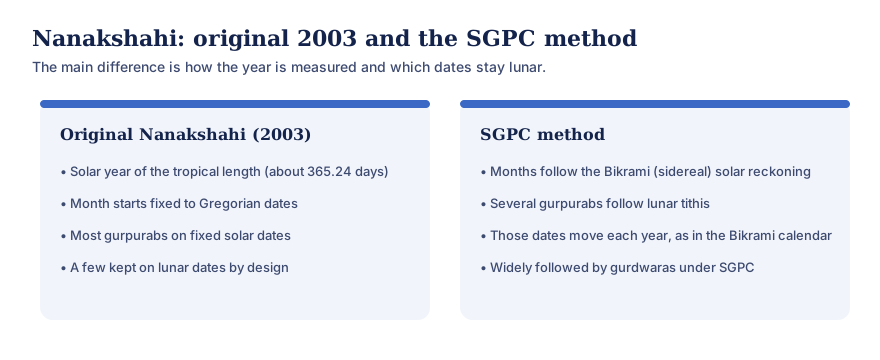
Original Nanakshahi (2003): a solar year of tropical length, month starts fixed to Gregorian dates, and most gurpurabs on fixed solar dates that stay the same each year, with a few kept on lunar dates by design.
SGPC method: months follow the Bikrami solar reckoning and several gurpurabs follow lunar tithis, so those dates move from year to year.
The original Nanakshahi calendar, adopted in 2003, is a solar calendar of the tropical year’s length. Month starts fall on fixed Common Era dates (1 Chet = 14 March), and most gurpurabs are fixed too, with a few kept on lunar dates.
The SGPC method, following the 2010 amendment, returned month starts to Bikrami solar reckoning, which uses the slightly longer sidereal year, and returned several gurpurabs to lunar dates. Under this method, Sangrand moves by about a day from year to year and some gurpurabs move by weeks.
See the two versions compared and Nanakshahi calendar history.
Why dates differ
- Solar year length. The tropical year (≈365.242 days) and the sidereal year (≈365.256 days) differ by about 20 minutes, so Bikrami month starts drift slowly later against the Common Era calendar, by about a day every 70 years or so.
- Lunar dates. Gurpurabs kept by tithi move against any solar calendar, by up to about three weeks between years.
- Version followed. A gurdwara or family following one version and a relative following the other may observe the same gurpurab on different days.
What OIOA computes
The Sikh and Punjabi community has its own Home screen in OIOA. It calculates on your phone the Nanakshahi calendar in the version you choose: original 2003 or SGPC method. See the Sikh/Punjabi community page. For observances, please follow your gurdwara and your community’s authority.