Before Nanakshahi: the Bikrami calendar
For most of Sikh history, dates were reckoned by the Bikrami (Vikrami) calendar used across North India. It combines:
- Solar months beginning at each Sangrand (sankranti), the Sun’s entry into a new sidereal zodiac sign, and
- Lunar tithis, by which many festivals, including several gurpurabs, were dated, for example Guru Nanak Dev Ji’s gurpurab on the full moon of Katak.
The Bikrami calendar’s solar year is sidereal, about 20 minutes longer than the tropical year of the seasons, so over centuries its months drift slowly later against the Gregorian calendar. Its lunar dates move by up to about three weeks from year to year.
The Gurus’ own compositions use the Bikrami months: Barah Maha in Sri Guru Granth Sahib Ji, by Guru Nanak Dev Ji and Guru Arjan Dev Ji, reflects on the twelve months from Chet to Phagun.
The idea of a Sikh calendar
In the late 20th century, the Canadian Sikh engineer Pal Singh Purewal proposed a new calendar for the Sikh community. His aims included:
- a calendar distinct to the Sikh faith, rather than one shared with other traditions,
- dates that stayed fixed each year in the Common Era calendar, so that, for example, a gurpurab would fall on the same date every year,
- a year length matching the tropical year, so months would stay aligned with the seasons and wouldn’t drift.
He named it Nanakshahi, with its era beginning in 1469 CE, the year of Guru Nanak Dev Ji’s birth.
Adoption in 2003
The calendar was approved by the Shiromani Gurdwara Parbandhak Committee (SGPC) and implemented from 1 Chet, Nanakshahi 535, which was 14 March 2003, with the endorsement of the Akal Takht. Its key features:
- 1 Chet = 14 March, and each month begins on a fixed Gregorian date.
- Month lengths: the first five months (Chet to Sawan) have 31 days; the remaining seven have 30, with Phagun gaining a day in leap years.
- Gurpurabs and other days fixed to dates in this calendar, with a few, including Guru Nanak Dev Ji’s gurpurab, Bandi Chhor Divas and Hola Mohalla, kept on their traditional lunar dates.
- Vaisakhi fixed on 14 April (1 Vaisakh).
The 2010 amendment
The new calendar was welcomed by many, particularly among the Sikh diaspora, and questioned by others, including some sants, deras and scholars who preferred the traditional reckoning. In 2010, the SGPC amended the calendar. Under the amendment:
- Sangrand and month starts returned to Bikrami solar reckoning.
- Several gurpurabs returned to lunar dates, so they move from year to year again.
Since then, the SGPC publishes an annual jantri under its method, and this is the calendar followed by gurdwaras under SGPC management and by many others. Some Sikh organisations, gurdwaras and sangats, particularly outside India, continue to follow the original 2003 calendar.
Two calendars, one community
The question of which calendar to follow is one on which Sikhs hold sincere and differing views, grounded in different priorities: distinctiveness and fixity on one hand, continuity with tradition on the other. This page doesn’t take a side.
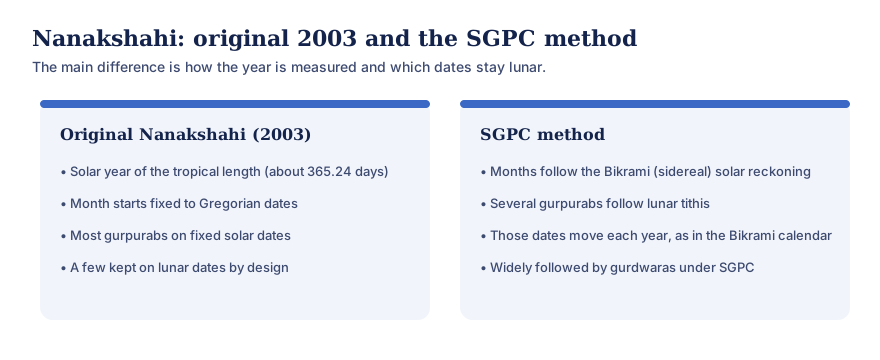
Text version of this diagram
Original Nanakshahi (2003): a solar year of tropical length, month starts fixed to Gregorian dates, and most gurpurabs on fixed solar dates that stay the same each year, with a few kept on lunar dates by design.
SGPC method: months follow the Bikrami solar reckoning and several gurpurabs follow lunar tithis, so those dates move from year to year.
What it means in practice is simple: two gurdwaras, or two relatives, may observe the same gurpurab on different days in some years. That’s a difference of calendar, not of devotion.
Practical tips
- Check which version your gurdwara follows. Its notice board or committee can tell you.
- For gurpurabs that move under the SGPC method, look at the year’s jantri.
- For fixed dates under the original calendar, the date is the same every year.
- For Vaisakhi, both versions usually fall on 13 or 14 April.
In OIOA
The Sikh/Punjabi Home screen lets you choose the original 2003 Nanakshahi calendar or the SGPC method, and switch at any time. Both are calculated on your phone. See the two versions compared.
Common questions
Who designed the Nanakshahi calendar?
Pal Singh Purewal, a Sikh engineer and calendar scholar based in Canada, who proposed the calendar’s structure and rules.
When did the Nanakshahi calendar start?
It was implemented from 1 Chet, Nanakshahi 535, which was 14 March 2003.
What changed in 2010?
The SGPC amended the calendar, returning month starts (Sangrand) to Bikrami solar reckoning and several gurpurabs to lunar dates. Since then, the SGPC publishes a jantri each year under this method.
Do Sikhs outside India follow the original calendar?
Some gurdwaras and organisations, in India and abroad, follow the original 2003 calendar, while many others follow the SGPC jantri. Practice varies by gurdwara.
What is a jantri?
A jantri is an annual almanac or calendar listing the year’s dates, festivals and observances. The SGPC publishes one each year.
Why is Guru Nanak Dev Ji’s gurpurab on a lunar date in both versions?
By long tradition, Guru Nanak Dev Ji’s Prakash Purab is celebrated on the full moon (Puranmashi) of Katak. The original 2003 calendar kept this lunar date as one of a few exceptions to its fixed-date scheme, and the SGPC method keeps it too.
Key terms
- Bikrami: the Vikram Samvat calendar as used in Punjab.
- Sangrand: the first day of a solar month.
- Puranmashi: the full moon.
- Masya: the new moon (Amavasya).
- Barah Maha: compositions on the twelve months in Sri Guru Granth Sahib Ji.
Why history matters here
Understanding how the two versions came about helps explain why a gurdwara notice board and a relative’s calendar might show different dates. It also helps make sense of a debate that is, at heart, about how best to honour the Gurus’ memory in the reckoning of time: a debate conducted with sincerity on all sides.
Related: Sankranti and solar months, the Nanakshahi calendar explained, and Vaisakhi.