Why there are two versions
For centuries, Sikh observances followed the Bikrami calendar used across North India: solar months for civil dates, and lunar tithis for many religious days. In the late 20th century, a new calendar was designed so that Sikh dates would be fixed and easy to predict, independent of the Bikrami system. It was named Nanakshahi and was adopted in 2003.
In 2010 the Shiromani Gurdwara Parbandhak Committee (SGPC) amended the calendar, returning month starts and several gurpurabs to the traditional Bikrami and lunar reckoning. Since then, sangats, gurdwaras and organisations have followed one version or the other.
This is a matter on which the community holds sincere and differing views. OIOA’s role is not to settle it, but to show each family the calendar they follow, accurately.
Text version of this diagram
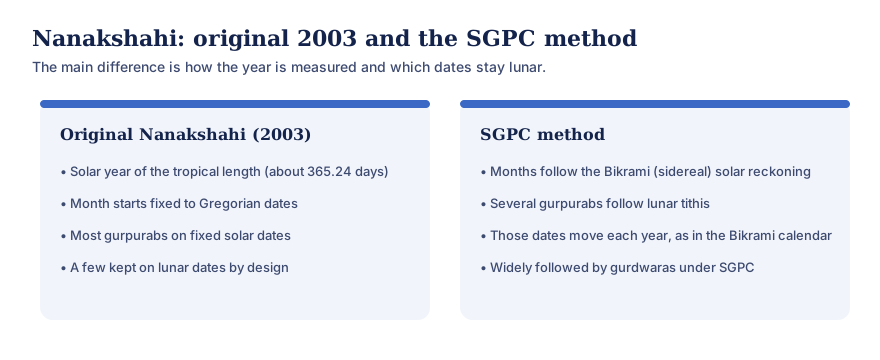
Original Nanakshahi (2003): a solar year of tropical length, month starts fixed to Gregorian dates, and most gurpurabs on fixed solar dates that stay the same each year, with a few kept on lunar dates by design.
SGPC method: months follow the Bikrami solar reckoning and several gurpurabs follow lunar tithis, so those dates move from year to year.
The original 2003 calendar
- Solar year of the length of the tropical year (about 365.24 days), the same length as the Common Era calendar.
- Month starts fixed to Common Era dates: Chet begins on 14 March, Vaisakh on 14 April, and so on. The first five months have 31 days and the rest 30, with Phagun gaining a day in leap years.
- Most gurpurabs on fixed dates, so they fall on the same Common Era date every year. For example, the Prakash Purab of Guru Gobind Singh Ji is fixed in this version.
- A few days kept on lunar dates, including Guru Nanak Dev Ji’s gurpurab, as well as Bandi Chhor Divas and Hola Mohalla.
The SGPC method
- Months follow the Bikrami solar reckoning, which uses the sidereal year, so month starts and Sangrand vary by a day or so from year to year and drift slowly against the Common Era calendar.
- Several gurpurabs follow lunar tithis, as they did before 2003, so their Common Era dates move each year, sometimes by several weeks.
- Published by the SGPC each year as a jantri, and followed by gurdwaras under its management and by many others.
What this means in practice
| Original 2003 | SGPC method | |
|---|---|---|
| Start of the year | 1 Chet = 14 March | Chet by Bikrami reckoning |
| Sangrand | Fixed dates each year | Varies by about a day |
| Most gurpurabs | Same Common Era date every year | Many move with the lunar calendar |
| Guru Nanak Dev Ji’s gurpurab | Lunar (Katak Puranmashi) | Lunar (Katak Puranmashi) |
Choosing yours in OIOA
On the Sikh/Punjabi Home screen, choose original 2003 or SGPC. You can switch at any time, for example to see when a relative’s gurdwara observes a gurpurab. If you’re unsure which version your family follows, ask at your gurdwara.
Learn more
If OIOA shows a date that differs from the jantri your gurdwara uses, please tell us what we missed. Include the version, the day and your source.