The Nanakshahi era
The Nanakshahi calendar numbers its years from 1469 CE, the year of Guru Nanak Dev Ji’s birth. The year begins with the month of Chet, in March. So a Nanakshahi year spans parts of two Common Era years, and its number is the Common Era year minus 1468 for the part of the year from Chet onwards (and minus 1469 before it).
The twelve months
| Month | Approximate Common Era span | |
|---|---|---|
| 1 | Chet | mid-March to mid-April |
| 2 | Vaisakh | mid-April to mid-May |
| 3 | Jeth | mid-May to mid-June |
| 4 | Harh | mid-June to mid-July |
| 5 | Sawan | mid-July to mid-August |
| 6 | Bhadon | mid-August to mid-September |
| 7 | Assu | mid-September to mid-October |
| 8 | Katak | mid-October to mid-November |
| 9 | Maghar | mid-November to mid-December |
| 10 | Poh | mid-December to mid-January |
| 11 | Magh | mid-January to mid-February |
| 12 | Phagun | mid-February to mid-March |
These names will be familiar to anyone who knows Barah Maha, the poems of the twelve months in Sri Guru Granth Sahib Ji, which use the months to reflect on the soul’s longing for the Divine.
The exact first day of each month depends on the version you follow. In the original 2003 calendar, month starts are fixed to Common Era dates (Chet begins on 14 March). In the SGPC method, months follow the Bikrami solar reckoning, so their first days vary a little from year to year.
Sangrand
The first day of each month is Sangrand (from sankranti, the Sun’s entry into a new sign). Many Sikhs visit the gurdwara on Sangrand to hear the Barah Maha verse for the new month. Because the two versions place the month start differently, Sangrand can fall on different days in each. OIOA shows Sangrand according to the version you choose.
What OIOA shows
On the Sikh/Punjabi Home screen:
- Today’s Nanakshahi date, with month and year.
- Your choice of version, original 2003 or SGPC, changeable at any time.
- Months and Sangrand as they fall in that version.
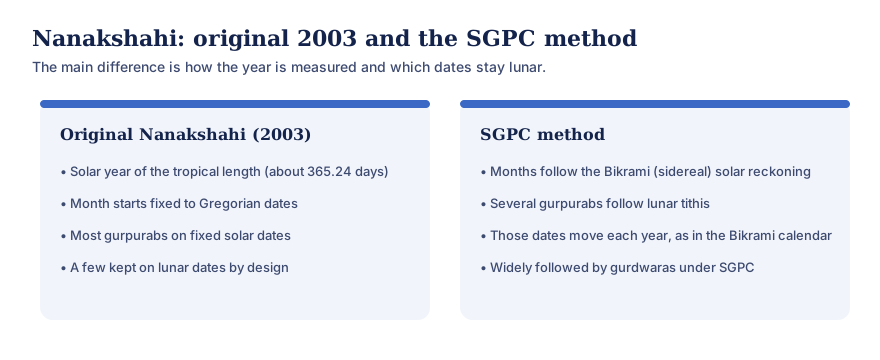
Text version of this diagram
Original Nanakshahi (2003): a solar year of tropical length, month starts fixed to Gregorian dates, and most gurpurabs on fixed solar dates that stay the same each year, with a few kept on lunar dates by design.
SGPC method: months follow the Bikrami solar reckoning and several gurpurabs follow lunar tithis, so those dates move from year to year.
The calendar is calculated on your phone, so it works offline.
Lunar dates in the calendar
Some days in the Sikh calendar have traditionally been observed by the lunar calendar, by tithi, such as the gurpurab of Guru Nanak Dev Ji on Katak Puranmashi (the full moon of Katak). Even the original 2003 calendar kept a few such days on lunar dates, and the SGPC method follows lunar dates for more of them. Lunar dates move against the solar calendar each year, which is why some gurpurabs fall on different Common Era dates every year.
Learn more
- The original 2003 calendar and the SGPC method
- Nanakshahi calendar history
- Sankranti and solar months
If a date in OIOA doesn’t match your gurdwara’s jantri, please tell us what we missed and mention which version your gurdwara follows.