What a sankranti is
Over a year, the Sun appears to travel once around the zodiac, the band of twelve constellations through which the Sun, Moon and planets move. Indian astronomy measures this in the sidereal zodiac, fixed against the stars. The moment the Sun crosses from one sign (rashi) into the next is a sankranti (from the Sanskrit for “transition” or “passage”).
There are twelve sankrantis a year, one for each sign. The time from one sankranti to the next is a solar month.
| Sankranti (Sun enters) | Approximate date | Solar month begins (examples) |
|---|---|---|
| Mesha (Aries) | 13–15 April | Tamil Chithirai, Bengali Boishakh, Odia Baisakha, Punjabi Vaisakh |
| Vrishabha (Taurus) | 14–15 May | Tamil Vaikasi |
| Mithuna (Gemini) | 14–15 June | Tamil Aani |
| Karka (Cancer) | 16–17 July | Tamil Aadi, Malayalam Karkidakam |
| Simha (Leo) | 16–17 August | Malayalam Chingam |
| Kanya (Virgo) | 16–17 September | Tamil Purattasi |
| Tula (Libra) | 17 October | Tamil Aippasi |
| Vrishchika (Scorpio) | 16 November | Tamil Karthigai |
| Dhanu (Sagittarius) | 15–16 December | Tamil Margazhi |
| Makara (Capricorn) | 14–15 January | Tamil Thai |
| Kumbha (Aquarius) | 12–13 February | Tamil Maasi |
| Meena (Pisces) | 14–15 March | Tamil Panguni |
These Gregorian dates are approximate and can shift by a day depending on the year, the time of the sankranti and each regional calendar’s rule for which day the month begins.
Solar calendars in India
Several regional calendars use solar months as their main civil calendar, with lunar tithis alongside for religious observance:
- Tamil calendar: months Chithirai to Panguni, with the new year, Puthandu, at Mesha sankranti in mid-April.
- Malayalam calendar (Kollam era): the new year is in Chingam, in mid-August; Vishu at Mesha sankranti is also widely celebrated.
- Bengali calendar: Boishakh to Choitro, with Pohela Boishakh, the new year, in mid-April.
- Odia calendar: Pana Sankranti in mid-April marks the new year.
- Assamese calendar: Rongali (Bohag) Bihu marks the new year in mid-April.
- Punjabi (Bikrami) solar calendar: months begin at Sangrand (sankranti), with Vaisakhi in mid-April.
Each region has its own rule for whether a month starts on the day of the sankranti or the following day, depending on the time of day the sankranti occurs. That’s why a Tamil and a Bengali calendar can begin the “same” month a day apart.
Why Makar Sankranti is around 14 January
Most Hindu festivals follow the lunar calendar and move around the Gregorian year. Makar Sankranti is different: it marks the Sun’s entry into Makara (Capricorn), so it stays at a nearly fixed Gregorian date, usually 14 or 15 January. It is celebrated across India under many names: Pongal in Tamil Nadu, Uttarayan in Gujarat, Lohri the night before in Punjab, Magh Bihu in Assam, Khichdi in parts of Uttar Pradesh and Bihar.
It is sometimes said to mark the start of uttarayana, the Sun’s northward journey. Astronomically, that begins at the winter solstice around 21 December. The gap of about 24 days is the ayanamsha, the drift between the star-fixed and season-fixed zodiacs caused by the slow wobble of the Earth’s axis. Two thousand years ago they nearly coincided. Over centuries, the date of Makar Sankranti slowly moves later, by about a day every 70 years or so.
How sankrantis shape the lunar calendar
Sankrantis matter even for calendars that use lunar months. In the Hindu lunisolar calendar, each lunar month is named after the sankranti that occurs within it. When a lunar month contains no sankranti, it becomes an Adhik maas, an extra month; when a lunar month contains two, a month is dropped. So the Sun’s passage through the signs quietly keeps the whole lunar calendar in step with the seasons.
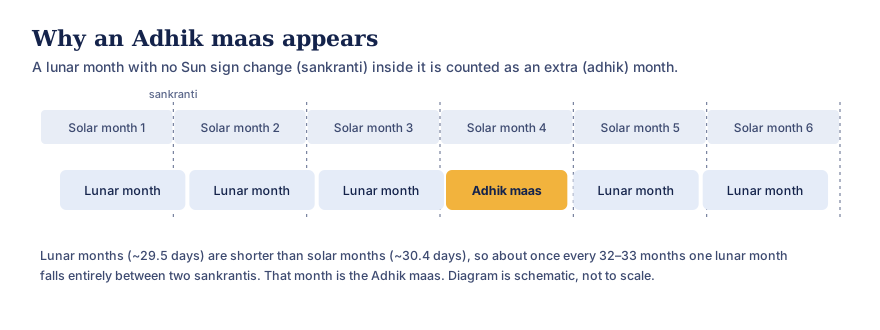
Text version of this diagram
Solar months begin at each sankranti, when the Sun enters a new zodiac sign, and last about 30.4 days. Lunar months last about 29.5 days. Because lunar months are shorter, roughly every 32 to 33 months one lunar month starts and ends without a sankranti inside it. That month is counted as an extra, or Adhik, maas.
Sangrand in the Sikh calendar
In Punjab, the first day of each solar month is Sangrand. Many Sikhs visit the gurdwara on Sangrand to hear the Barah Maha for the new month. Under the SGPC method of the Nanakshahi calendar, months follow Bikrami solar reckoning, so Sangrand follows the sankranti. Under the original 2003 Nanakshahi calendar, months begin on fixed Gregorian dates. See the Nanakshahi calendar.
Sankranti and observance
Each sankranti is considered a sacred moment by many Hindus, especially Makar and Mesha sankranti. A period before or after the sankranti, the punya kaal, is traditionally considered meritorious for bathing in holy rivers, charity and prayer. Practices vary widely by region.
In OIOA
OIOA’s panchang uses the Sun’s position, including sankrantis, to determine lunar month names and Adhik maas. The Sikh/Punjabi Home screen shows Nanakshahi months and Sangrand in the version you follow. If you’d like a regional solar calendar, such as Tamil, Malayalam, Bengali, Odia or Assamese, added to OIOA, please request it.
Common questions
Why is Makar Sankranti sometimes on 15 January?
Because the moment the Sun enters Makara can fall late on 14 January, and regional rules may then assign the festival to the next day, or the moment itself can fall on the 15th. Over the long term, the date is slowly moving later.
Is Pongal the same as Makar Sankranti?
Pongal is Tamil Nadu’s harvest festival, beginning with Bhogi and including Thai Pongal on the first day of the Tamil month Thai, which begins at Makara sankranti. So they coincide, with regional customs of their own.
Do sankrantis affect Hindu festivals that follow the Moon?
Indirectly, yes. The lunar months are named by the sankrantis within them, and Adhik maas is defined by them, so sankrantis decide which lunar month a festival falls in.
Key terms
- Sankranti: the Sun’s entry into a sidereal zodiac sign.
- Solar month: the time from one sankranti to the next.
- Punya kaal: the meritorious period around a sankranti.
- Ayanamsha: the offset between the star-based and season-based zodiacs.
- Sangrand: the Punjabi name for the first day of a solar month.