Eras and new years
Two questions are easy to mix up:
- Which era counts the years? Vikram Samvat, Shaka Samvat, the Common Era, the Vira Nirvana Samvat, the Kollam era, the Bengali San, and others.
- When does the year turn? In spring with the lunar month of Chaitra, after Diwali in Kartika, at the Sun’s entry into Aries in mid-April, in mid-August in Kerala, or on a fixed solar date.
Different regions combine these differently. That’s why India has so many new years, and why they’re all legitimate.
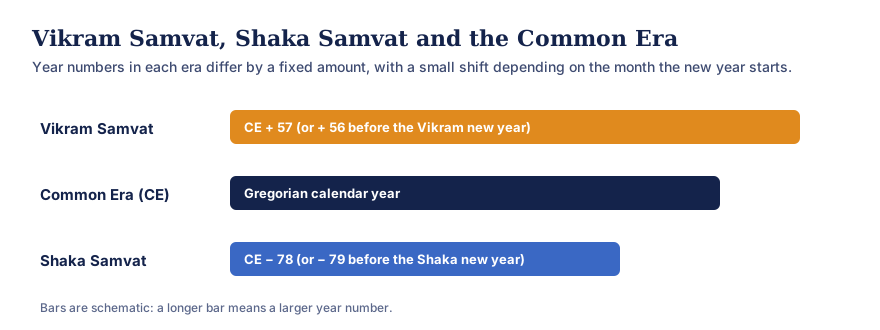
Text version of this diagram
- Vikram Samvat year = Common Era year + 57, or + 56 for the part of the year before the Vikram new year.
- Shaka Samvat year = Common Era year − 78, or − 79 for the part of the year before the Shaka new year.
Vikram Samvat
Vikram Samvat is about 57 years ahead of the Common Era. It is associated in tradition with King Vikramaditya of Ujjain, and is the most common era in North and West India, and Nepal’s official calendar.
It has two new-year conventions:
- Chaitradi: the year begins on Chaitra Shukla Pratipada, the day after the new moon of Chaitra, in March or April. This is the Hindu New Year in much of North India and coincides with the start of Chaitra Navratri.
- Kartikadi: the year begins on Kartika Shukla Pratipada, the day after Diwali. This is the convention in Gujarat, where the day is celebrated as Bestu Varas, the Gujarati New Year.
So between Chaitra and Diwali each year, a North Indian calendar and a Gujarati calendar show Vikram Samvat year numbers that differ by one. Both are correct.
Converting
- After the Vikram new year: VS = CE + 57
- Before it: VS = CE + 56
The Gujarati New Year
For Gujarati families, the days around Diwali carry the turning of the year: Dhanteras, Kali Chaudas, Diwali itself (the last day of the year, Ashvina Amavasya in the Amanta reckoning used in Gujarat), then Bestu Varas on Kartika Sud 1, and Bhai Bij the day after. Many businesses traditionally close their account books on Diwali and open new ones, with chopda pujan, for the new year.
The new year is greeted with “Saal Mubarak” and “Nutan Varshabhinandan”. Jain families in Gujarat share the same date, because the Jain new year, in the Vira Nirvana Samvat, also begins the day after Diwali, which marks Bhagwan Mahavir’s nirvana. See the Jain calendar.
Shaka Samvat
Shaka Samvat counts from 78 CE: Shaka = CE − 78 (or − 79 before the Shaka new year). In traditional use, especially in Maharashtra, Karnataka, Andhra Pradesh and Telangana, its year begins with Chaitra Shukla Pratipada, celebrated as Gudi Padwa in Maharashtra and Ugadi in Karnataka, Andhra Pradesh and Telangana. Konkani and Sindhi communities mark the same season with Samvatsar Padvo and Cheti Chand.
In 1957, India adopted a reformed national calendar based on the Shaka era, with fixed solar months: 1 Chaitra is 22 March (21 March in leap years). See Shaka Samvat and the national calendar.
The solar new years of mid-April
Many regions start their year when the Sun enters Mesha (Aries) at the sankranti around 13 to 15 April:
- Puthandu in Tamil Nadu
- Vishu in Kerala (though the Malayalam era year begins in Chingam)
- Pohela Boishakh in West Bengal, Tripura and among Bengalis everywhere
- Pana Sankranti in Odisha
- Rongali Bihu in Assam
- Vaisakhi in Punjab, also the harvest festival and the founding day of the Khalsa
The many new years of other communities
The new years don’t stop there:
- Navroz for Parsis, in the Shahenshahi, Kadmi or Fasli calendar, and Jamshedi Navroz on 21 March.
- The Islamic new year on 1 Muharram, about 11 days earlier each Gregorian year.
- The Nanakshahi new year on 1 Chet, in mid-March.
- The Jain new year after Diwali.
- 1 January, celebrated by almost everyone.
In a single year, many Indian families celebrate more than one new year, sometimes their own and their neighbours’.
Why so many?
India’s calendars grew up in different regions, around different eras and different astronomical conventions, over more than two thousand years. Rather than replacing one another, they continued side by side. The variety is part of the richness of Indian life, and a good reason to wish your neighbours on their new year as well as your own.
In OIOA
OIOA’s panchang shows the lunar month, tithi and Adhik maas that these new years are reckoned from, calculated on your phone for your location. For which era and new-year convention your family follows, please follow your community’s practice. The Diwali festival page explains the festival days around the Gujarati New Year.
Common questions
What Vikram Samvat year is it?
Add 57 to the Common Era year after the Vikram new year, or 56 before it. Remember that the new year is in Chaitra in much of North India and after Diwali in Gujarat.
What is Bestu Varas?
The Gujarati New Year, on Kartika Sud 1, the day after Diwali, when the Vikram Samvat year turns in Gujarat.
Is Gudi Padwa the same day as Ugadi?
Yes. Both fall on Chaitra Shukla Pratipada, the day after the new moon of Chaitra, celebrated as Gudi Padwa in Maharashtra and Ugadi in Karnataka, Andhra Pradesh and Telangana.
Why is the Bengali New Year in April?
The Bengali calendar is solar, and its year begins with the month Boishakh, when the Sun enters Mesha (Aries) in mid-April.
Key terms
- Samvat: an era used to number years.
- Chaitradi: a year beginning in Chaitra.
- Kartikadi: a year beginning in Kartika, after Diwali.
- Bestu Varas: the Gujarati New Year.
- Saka (Shaka) era: the era counting from 78 CE, also the basis of India’s national calendar.
Wishing your neighbours
With so many new years through the year, there are plenty of chances to share good wishes across communities. A short message in your neighbour’s own greeting, such as “Saal Mubarak”, “Navroz Mubarak” or “Puthandu vazhthukal”, goes a long way.