In one sentence
Rahu Kaal is one-eighth of the daylight, from sunrise to sunset, chosen by weekday, that is traditionally considered unfavourable for starting new undertakings.
Who, or what, is Rahu?
In Indian astronomy and astrology, Rahu is one of the nine grahas. Unlike the Sun, Moon and planets, Rahu is not a physical body. It is a mathematical point: the place where the Moon’s orbit crosses the Sun’s apparent path (the ecliptic) as the Moon heads northward, known in astronomy as the Moon’s ascending node. Its opposite point, the descending node, is Ketu.
Eclipses can happen only when the Sun and Moon are near these nodes. In Puranic tradition, this is told through the story of the churning of the ocean: the asura Svarbhanu drank the nectar of immortality in disguise, was beheaded by Vishnu’s discus, and his head (Rahu) and body (Ketu) became shadowy grahas who periodically “swallow” the Sun and Moon. With that association with eclipses, Rahu came to be linked with disruption and obstacles.
How Rahu Kaal is calculated
The method is simple:
- Find sunrise and sunset for your location and date.
- Divide the daylight between them into eight equal parts.
- Pick the part assigned to the weekday:
| Weekday | Rahu Kaal is part… |
|---|---|
| Monday | 2 |
| Saturday | 3 |
| Friday | 4 |
| Wednesday | 5 |
| Thursday | 6 |
| Tuesday | 7 |
| Sunday | 8 |
The first part of the day, starting at sunrise, is never Rahu Kaal.
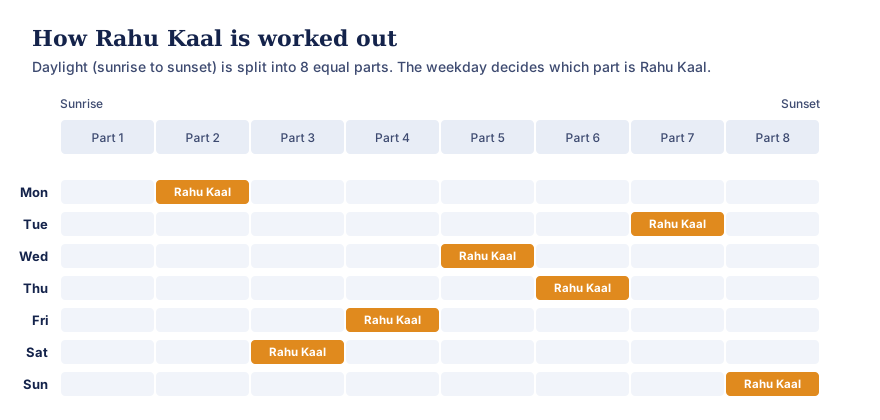
Text version of this diagram
Daylight, from sunrise to sunset, is divided into eight equal parts. Rahu Kaal is:
- Monday: part 2
- Tuesday: part 7
- Wednesday: part 5
- Thursday: part 6
- Friday: part 4
- Saturday: part 3
- Sunday: part 8
A popular way to remember the order is a sentence whose word initials follow the sequence Monday, Saturday, Friday, Wednesday, Thursday, Tuesday, Sunday, such as “Mother Saw Father Wearing The Turban Suddenly”. Many families have their own mnemonic in their own language.
A worked example
Suppose sunrise is at 06:10 and sunset at 18:30 on a Wednesday.
- Daylight = 12 hours 20 minutes = 740 minutes.
- One part = 740 ÷ 8 = 92.5 minutes.
- Wednesday is part 5, which starts after 4 parts: 06:10 + 4 × 92.5 min = 06:10 + 370 min = 12:20.
- It ends 92.5 minutes later, at about 13:52.
Change the city or the season and the answer changes, which is why a fixed chart (Monday 7:30–9:00, and so on) is only an approximation.
Why it changes with season and place
On a day with exactly 12 hours of daylight, each part is exactly 90 minutes. But in North India in June, daylight can be more than 13½ hours, making Rahu Kaal over 100 minutes long; in December it can be under 80 minutes. And because India uses one time zone, sunrise in the north-east can be well over an hour earlier by the clock than in the west. Why sunrise times differ explains this.
Yamaganda and Gulika
South Indian calendars often show two more periods of the same length:
- Yamaganda (Yamagandam), associated with Yama, also considered unfavourable for beginnings.
- Gulika Kaal (Kuligai), associated with Gulika, a sub-graha linked with Saturn. In some traditions, actions begun in Gulika Kaal are believed to repeat, so it’s avoided for things you don’t want repeated, while some consider it acceptable for things you’d like to recur.
Each is also one of the eight parts of the day, with its own weekday pattern, so on any day Rahu Kaal, Yamaganda and Gulika fall in three different parts.
What is avoided
Customs vary, but commonly Rahu Kaal is avoided for starting something new: a journey, a purchase, a business deal, an interview, a ceremony, signing an agreement. Work already in progress usually continues. Routine daily life is not affected.
Some people do the opposite with intent: many temples, particularly in South India, offer special worship during Rahu Kaal on Tuesdays and Fridays, for example to Durga.
Rahu Kaal at night?
Rahu Kaal is traditionally a daytime period only. Some calendars also give a night-time equivalent by dividing the night into eight parts, but most everyday use, and most calendars, refer only to the daytime period.
A note on belief
Rahu Kaal is a traditional practice. There is no scientific evidence that it affects outcomes, and many people don’t observe it at all. Those who do observe it value it as part of a tradition of mindful timing. OIOA shows Rahu Kaal accurately for those who want it, and leaves the choice to you.
In OIOA
OIOA shows today’s Rahu Kaal on the Hindu and Jain Home screens, calculated from your local sunrise and sunset on your phone. Use the live sliders on the Today card to see whether a time you’re planning falls in it, and what Choghadiya and Hora are running then. See also muhurat windows.
Common questions
Is Rahu Kaal the same everywhere in India?
No. It’s one-eighth of the daylight, so it depends on local sunrise and sunset, which differ across India by over an hour.
How long is Rahu Kaal?
One-eighth of the daylight: about 90 minutes on a 12-hour day, longer in summer and shorter in winter.
Can I pray during Rahu Kaal?
Yes. Prayer and worship are not avoided; some temples hold special worship during Rahu Kaal.
Why isn’t the first part of the day ever Rahu Kaal?
In the traditional scheme the first eighth after sunrise is never assigned to Rahu, which is why the weekday pattern uses parts 2 to 8 only.
Key terms
- Rahu: the Moon’s ascending node; one of the nine grahas.
- Ketu: the Moon’s descending node.
- Graha: a celestial influence in Indian astronomy and astrology, including the Sun, Moon, planets, Rahu and Ketu.
- Yamaganda, Gulika: other daily periods of one-eighth of the day.