An era, not a separate calendar
Vikram Samvat (also Vikrami or Bikrami) is a way of numbering years. The months and days within those years come from the lunisolar Hindu panchang. Tradition associates the era’s beginning with King Vikramaditya of Ujjain. It is used across much of North and West India, especially Gujarat, Rajasthan and Madhya Pradesh, and is the official calendar of Nepal.
Converting years
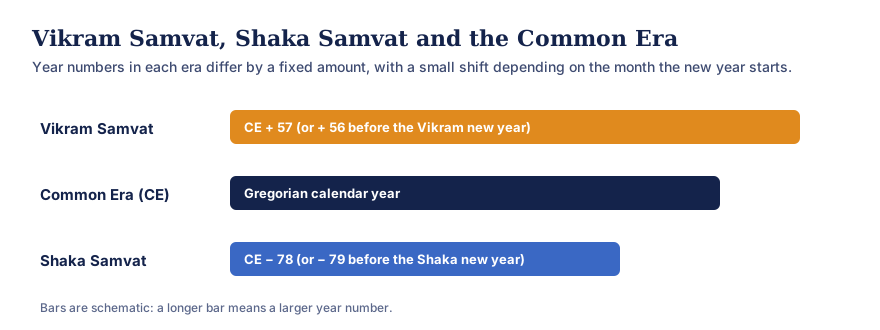
The Vikram Samvat year is about 57 years ahead of the Common Era (CE):
- After the Vikram new year: VS = CE + 57
- Before the Vikram new year in that Common Era year: VS = CE + 56
Text version of this diagram
- Vikram Samvat year = Common Era year + 57, or + 56 for the part of the year before the Vikram new year.
- Shaka Samvat year = Common Era year − 78, or − 79 for the part of the year before the Shaka new year.
So the arithmetic depends on which new year you count from, and that differs by region.
Two new years
- Chaitradi (Chaitra-based). In much of North India the Vikram year begins on Chaitra Shukla Pratipada, in March or April. This is also when Navratri in Chaitra begins.
- Kartikadi (Kartika-based). In Gujarat and among many Gujarati and Jain communities, the Vikram year begins on Kartika Shukla Pratipada, the day after Diwali, celebrated as Bestu Varas or Gujarati New Year.
So for a few months each year, a Gujarati calendar and a North Indian calendar show different Vikram Samvat year numbers. Neither is wrong. Read Vikram, Shaka and Gujarati New Year.
Months: Amanta and Purnimanta
The way months are bounded also differs by region. Gujarat uses Amanta months (ending at new moon); much of North India uses Purnimanta (ending at full moon). See Purnimanta and Amanta.
Bikrami in Punjab
In Punjab the same era is known as Bikrami, with solar months beginning at Sangrand (sankranti) as well as lunar tithis. The SGPC version of the Nanakshahi calendar follows Bikrami reckoning for many of its dates.
What OIOA computes
OIOA calculates the panchang that Vikram Samvat dates are expressed in: the tithi, paksha, lunar month and Adhik maas, for your location, on your phone. See the panchang. For which new-year convention and month system your family follows, please follow your community’s authority.