A year of named days
The Zoroastrian calendar has 12 months (Mah) of 30 days (Roj), followed by 5 Gatha days, giving 365 days. Days are not numbered but named: each of the 30 days of the month is dedicated to a divine being, and each month likewise. A date is written as a Roj and a Mah, for example Roj Khordad, Mah Farvardin.
When the day’s name matches the month’s name, the day is a jashan (feast): Avan Roj of Avan Mah, Adar Roj of Adar Mah, Meher Roj of Meher Mah, and so on. See Parsi Roj and Mah for all the names.
Three versions
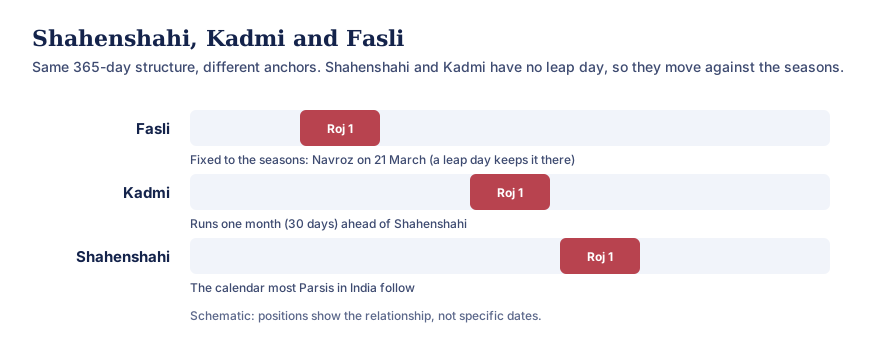
Text version of this diagram
All three calendars have 12 months of 30 days plus 5 Gatha days. The Fasli calendar adds a leap day so Navroz stays on 21 March. The Shahenshahi and Kadmi calendars do not add a leap day, so they slowly move against the seasons; the Kadmi calendar runs one month (30 days) ahead of the Shahenshahi calendar.
| Leap day | New year (Navroz) | Followed by | |
|---|---|---|---|
| Shahenshahi | None | Moves through the seasons; currently in August | Most Parsis in India |
| Kadmi | None | One month before Shahenshahi | A part of the community |
| Fasli | Every 4 years | Fixed on 21 March | A part of the community, including many Iranis |
Without a leap day, a 365-day year is about a quarter of a day short of the solar year, so Shahenshahi and Kadmi dates slowly move earlier through the seasons, by about one day every four years. Fasli adds the leap day and stays fixed. Read the full history in Shahenshahi, Kadmi and Fasli.
The Gahambars
Six five-day seasonal festivals, the Gahambars, are fixed by Roj and Mah. In the Fasli calendar they keep to their seasons; in the others they move with the calendar.
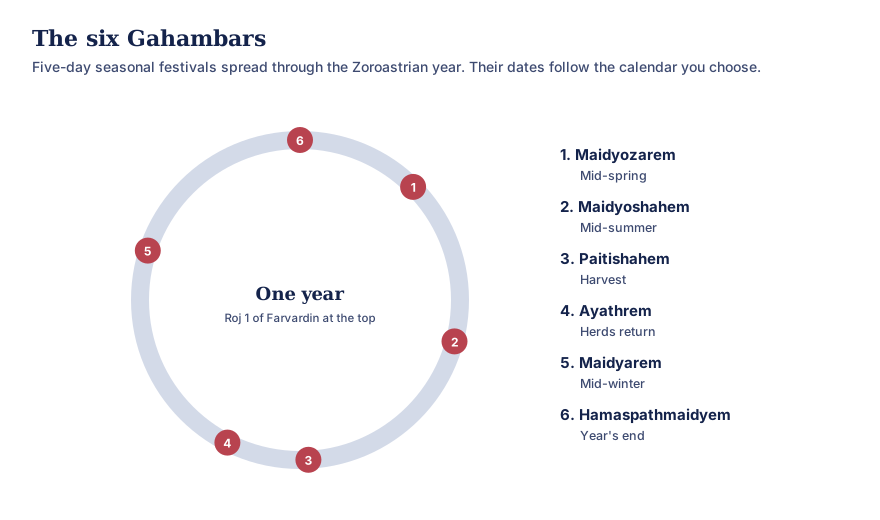
Text version of this diagram
The six Gahambars, each five days long, in order through the year: Maidyozarem (mid-spring), Maidyoshahem (mid-summer), Paitishahem (harvest), Ayathrem (herds return), Maidyarem (mid-winter) and Hamaspathmaidyem (the last days of the year, the Gatha days).
Why dates differ
The same Roj and Mah falls on different Gregorian dates in the three calendars: a Kadmi date is 30 days before the same Shahenshahi date, and the Fasli date can be months away from both. Families who follow different calendars may observe Navroz, Khordad Sal or a remembrance day on different days. That’s expected.
What OIOA computes
The Parsi community has its own Home screen in OIOA. It calculates on your phone today’s Roj and Mah in the calendar you choose, Shahenshahi, Kadmi or Fasli, and the Gahambars. See the Parsi community page. For observances, please follow your family’s and agiary’s practice.