The era: Vira Nirvana Samvat
The Jain religious calendar counts years in the Vira Nirvana Samvat (Veer Samvat), from the nirvana of Bhagwan Mahavir, the 24th tirthankara. In tradition, this took place on the night of Diwali, and the Jain new year begins on the following day, Kartika Shukla Pratipada.
The Vira Nirvana Samvat is 470 years ahead of Vikram Samvat and about 527 years ahead of the Common Era (526 before the Jain new year in a given year). Many Jain families also use Vikram Samvat, especially in Gujarat and Rajasthan, where its year also turns after Diwali.
Lunisolar months and tithis
Like the Hindu panchang, the Jain calendar is lunisolar: lunar months with tithis, kept in step with the seasons by an occasional Adhik maas. Month names are the same: Kartika, Margashirsha, Pausha and so on.
The tithi at sunrise usually decides the day. Fasting and observance are closely tied to particular tithis, notably Ashtami and Chaturdashi, along with the five kalyanak days of each tirthankara, Ayambil Oli and Paryushan. Because the tithi at sunrise depends on where you are, the calendar is location-dependent. See Jain tithi and the sunrise rule.
28 nakshatras
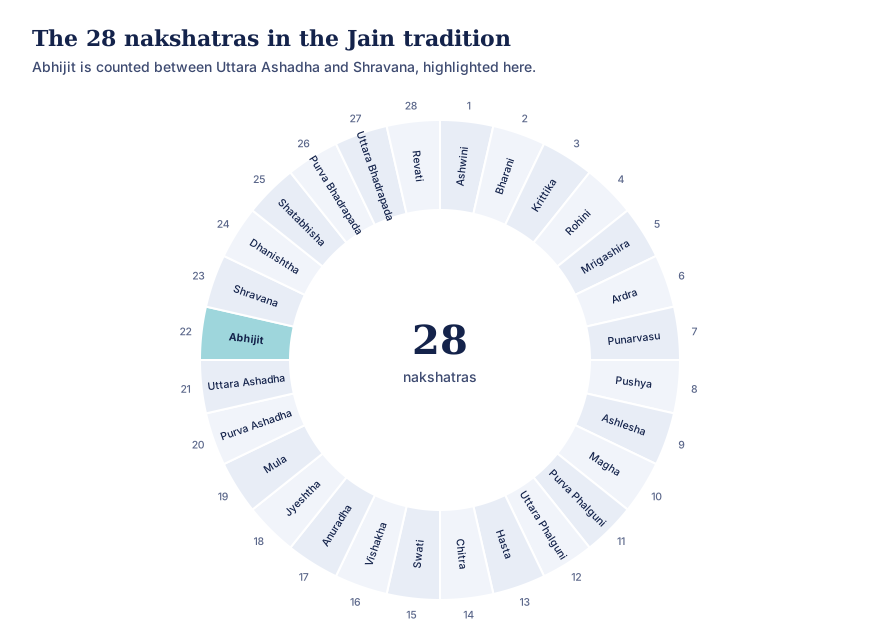
Jain astronomy counts 28 nakshatras, including Abhijit between Uttara Ashadha and Shravana.
Text version of this diagram
The Jain tradition counts 28 nakshatras. They are the familiar 27, with Abhijit placed between Uttara Ashadha (21st) and Shravana, making Abhijit the 22nd and Revati the 28th.
Why sects may differ
Jain traditions, Shwetamber and Digamber, and within them many gachhs and sampradayas, sometimes assign an observance to different days. The usual reasons are how a lost (kshaya) or repeated (vriddhi) tithi is handled, and how an Adhik maas is counted. Paryushan and Samvatsari are the best-known example. Each sangh’s published calendar is the authority for its members. See Jain sects and their calendars.
Daily practice: Navkarshi and more
Many daily vows are timed from sunrise and sunset: Navkarshi (48 minutes after sunrise), Porsi, Chauvihar and others. These change daily and by location. See Navkarshi explained.
What OIOA computes
On the Jain Home screen, OIOA calculates on your phone, for your location: the full panchang (tithi, paksha, lunar month, Adhik maas, sunrise and sunset, Choghadiya, Hora, Rahu Kaal, Abhijit muhurat and Panchak), the 28 Jain nakshatras, daily Navkarshi time, and calendars for Shwetamber, Digamber, Khartargachh, Sthanakwasi and other traditions. See the Jain community page.
For the day your family observes, please follow your sangh’s calendar and your gurus’ guidance.