Tithis at the heart of Jain practice
In Jain life, the calendar is more than a list of festivals. Fasting, restraint and observance follow the rhythm of the lunar month. A tithi, the lunar day, decides when a family keeps an upvas (fast), ekasanu (one meal), ayambil, or simply avoids green vegetables.
The parva tithis
Certain tithis are especially important for observance. Commonly, in Shwetamber tradition, twelve parva tithis are kept each month:
- Bij (2nd) of each paksha
- Pancham (5th) of each paksha
- Atham (8th, Ashtami) of each paksha
- Agiyaras (11th, Ekadashi) of each paksha
- Chaudas (14th, Chaturdashi) of each paksha
- Poonam (full moon) and Amas (new moon)
Of these, Atham and Chaudas are especially widely observed. Some families keep a smaller set of five or six parva tithis. Digamber tradition also gives special importance to Ashtami and Chaturdashi. In addition, the kalyanak days, the five auspicious events in the life of each of the 24 tirthankaras, fall on particular tithis through the year.
The sunrise rule
Like most Indian calendars, Jain calendars name each day by the tithi prevailing at sunrise, the udaya tithi. The tithi at sunrise governs the day’s observances, from that sunrise to the next. So if Atham is running at sunrise, the day is Atham, even if Atham ends mid-morning.
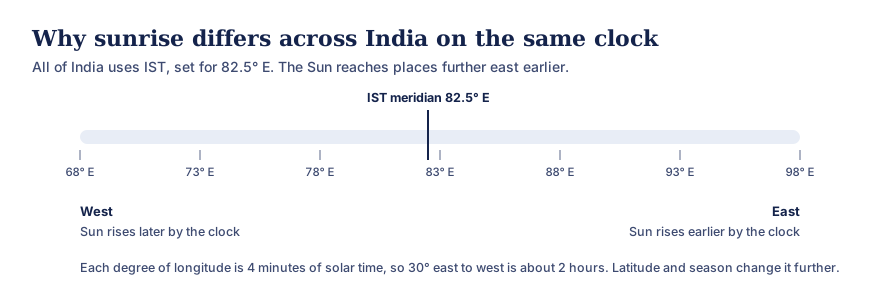
Since sunrise differs from place to place, a tithi change near sunrise can make the day Atham in one city and Satam (7th) in another. This is why a Jain calendar is always calculated for a particular place, and why a family that moves cities may see their parva days shift.
Text version of this diagram
All of India uses Indian Standard Time, which is based on the 82.5° E meridian. Each degree of longitude equals four minutes of solar time, so places in the far east of India see sunrise by the clock up to about an hour earlier than IST’s reference meridian, and places in the far west up to about an hour later. Latitude and the season change sunrise times further.
When a tithi is lost or doubled
Because tithis vary in length (about 20 to 27 hours), two situations happen every month or two:
- Kshaya tithi: a tithi starts after one sunrise and ends before the next, so no day has it at sunrise.
- Vriddhi tithi: a tithi spans two sunrises, so two days have it at sunrise.
For ordinary tithis this doesn’t matter much. For parva tithis, it matters a great deal: on which day should a family fast if Atham is lost, or appears twice?
How traditions resolve it
A well-known Sanskrit verse, traditionally attributed to Acharya Umaswati, gives the guiding principle: when a tithi is lost (kshaya), observe it on the preceding tithi; when it is doubled (vriddhi), observe it on the later day.
Communities apply this principle in different ways, particularly where two parva tithis are adjacent, such as Chaudas and Poonam, or where the rule interacts with festivals like Samvatsari. Within the Shwetamber Murtipujak tradition alone, there are long-standing and sincerely held differences between groups on these points, which is one reason the date of Samvatsari can differ between sanghs in some years.
Digamber, Sthanakwasi and Terapanthi traditions have their own conventions, and each sangh’s published calendar (panchang or tithi-darpan) is the authority for its members.
OIOA’s role is to show each family its own tradition faithfully, not to judge between them. That’s why the Jain Home screen offers sect-aware calendars.
A worked example
Suppose, in a given month:
- Saptami runs at Monday’s sunrise and ends at 9:40 am Monday.
- Ashtami begins at 9:40 am Monday and ends at 5:50 am Tuesday, before Tuesday’s sunrise at 6:20 am.
- Navami runs at Tuesday’s sunrise.
Ashtami never touches a sunrise: it is kshaya. Monday’s sunrise tithi is Saptami and Tuesday’s is Navami. Under the principle above, the Atham observance moves to the preceding day, Monday. A different city with an earlier sunrise, or a sangh following a different convention, might reach a different result, which is why your sangh’s calendar is the final word.
Paryushan and the calendar
The most visible effect of these differences is Paryushan. Shwetamber Paryushan is eight days ending with Samvatsari, traditionally on Bhadrapada Shukla Chaturthi (or Panchami in some traditions). Digamber Das Lakshana Parva is ten days beginning on Bhadrapada Shukla Panchami. Tithi rules, and in some years the counting of an Adhik maas, can place these on different days for different sanghs. See Paryushan.
In OIOA
The Jain Home screen shows the tithi at sunrise for your location, calculated on your phone, and lets you choose a calendar for Shwetamber, Digamber, Khartargachh, Sthanakwasi and other traditions. If a parva tithi in OIOA doesn’t match your sangh’s calendar, please tell us what we missed.
Common questions
Which tithis are parva tithis?
In common Shwetamber practice, twelve each month: Bij, Pancham, Atham, Agiyaras and Chaudas of both pakshas, plus Poonam and Amas. Some families keep a smaller set. Atham and Chaudas are the most widely observed.
What happens when Atham and Chaudas fall close to a festival?
When parva tithis coincide with festival days or with each other, sanghs apply their own conventions. This is where calendars of different traditions most often differ, so please follow your sangh.
Does the sunrise rule apply abroad?
Yes, using local sunrise. Jain families outside India therefore sometimes observe a parva tithi on a different Gregorian day from relatives in India, and sanghs abroad often publish calendars for their own cities.
Key terms
- Parva tithi: a tithi of special observance.
- Udaya tithi: the tithi at sunrise, which names the day.
- Kshaya tithi: a tithi lost between two sunrises.
- Vriddhi tithi: a tithi that spans two sunrises.
Why this matters
For a family keeping Atham or Chaudas, getting the right day is not a technicality: it’s the difference between keeping a vow and missing it. That’s why OIOA calculates the tithi at sunrise for your own location, and why it offers each tradition’s calendar rather than a single one for everyone.