Navkarshi
Navkarshi (also written Navkarsi or Navakarasi) is one of the simplest and most widely kept Jain pachchakhan, or vows of restraint. It means not eating or drinking anything, not even water, from sunset until 48 minutes after sunrise the next morning, and then reciting the Navkar Mantra before breaking the fast.
Forty-eight minutes is one muhurta in the traditional reckoning. Because sunrise changes every day and differs from place to place, so does the Navkarshi time.
Text version of this diagram
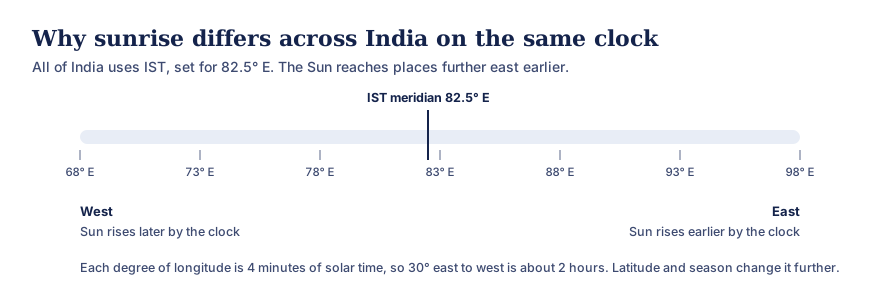
All of India uses Indian Standard Time, which is based on the 82.5° E meridian. Each degree of longitude equals four minutes of solar time, so places in the far east of India see sunrise by the clock up to about an hour earlier than IST’s reference meridian, and places in the far west up to about an hour later. Latitude and the season change sunrise times further.
OIOA’s Jain Home screen shows today’s Navkarshi time for your location, calculated from your local sunrise on your phone. You don’t need a chart printed for another city, and it works offline.
Other pachchakhan times
Navkarshi is one of a family of time-based vows. Others are measured in prahars (quarters of the day): Porsi at one prahar after sunrise, Sadh-Porsi at one and a half, Purimaddh at two (around midday) and Avaddh at three. Many families also keep Chauvihar, not eating after sunset. All are calculated from sunrise and sunset. If you’d like OIOA to show more of these, please tell us.
Sect-aware calendars
The Jain community is united in its devotion to the tirthankaras, and diverse in its traditions. The two great traditions are Shwetamber and Digamber, and within them are many sampradayas and gachhs, including Murtipujak gachhs such as Khartargachh and Tapagachh, the Sthanakwasi and Terapanth traditions among Shwetambers, and several panths among Digambers.
These traditions sometimes reckon observance days differently. The most common reasons are:
- Kshaya and vriddhi tithis. When a tithi is lost (it starts and ends between two sunrises) or repeated (it spans two sunrises), traditions differ in which day they assign the observance to.
- Adhik maas. Traditions differ in how an extra lunar month is counted for observances such as Paryushan.
- Festival rules. For example, Shwetamber Paryushan is eight days ending with Samvatsari, while Digamber Das Lakshana Parva is ten days and begins as Shwetamber Paryushan ends.
OIOA supports calendars for Shwetamber, Digamber, Khartargachh, Sthanakwasi and other traditions. Choose the one your family follows, and the Jain Home screen follows it. This is not about which tradition is right; it is about showing each family its own calendar faithfully.
Choosing your calendar
If you’re not sure which calendar your family follows, ask at your derasar, sthanak or upashraya, or ask the elders in your family. Families who move cities sometimes change which calendar they use to match their local sangh; OIOA lets you switch whenever you need to.
If your tradition isn’t listed
The Jain community has many traditions, and we know we haven’t covered every one. If your sampradaya, gachh or panth isn’t supported, or a date doesn’t match your sangh’s calendar, please request it. Tell us the tradition, the observance and, if possible, the calendar or jantri your sangh publishes. We’ll review it and show the outcome on the roadmap.