One dharma, many traditions
All Jains revere the 24 tirthankaras, from Bhagwan Rishabhdev to Bhagwan Mahavir, and share the core principles of ahimsa (non-violence), anekantavada (many-sidedness of truth) and aparigraha (non-possessiveness). Over more than two millennia, the community has developed distinct traditions of monastic practice, scripture and ritual. These traditions sometimes also reckon the calendar differently.
This page describes those traditions briefly and respectfully. It doesn’t rank them or say which is right. Anekantavada itself teaches that truth can be seen from many sides.
The two great traditions
Shwetamber (“white-clad”): monks and nuns wear white garments. Shwetamber tradition includes:
- Murtipujak (or Derawasi) communities, who worship images of the tirthankaras in temples (derasars). They are organised into gachhs, monastic lineages, including Tapagachh, Khartargachh, Anchalgachh (Achalgachh), Tristutik and others.
- Sthanakwasi communities, who do not worship images and gather in sthanaks for religious practice.
- Terapanth, a non-image-worshipping Shwetamber tradition founded in the 18th century, organised under a single acharya.
Digamber (“sky-clad”): the most senior monks renounce all clothing. Digamber tradition includes panths such as Bispanthi, Terapanthi (distinct from the Shwetamber Terapanth) and Taranpanthi, among others.
Each tradition, and often each sangh, publishes its own calendar (panchang, tithi-darpan or tippanu) for its members.
Why calendars differ
All Jain calendars are lunisolar and use tithis, and most follow the tithi at sunrise. Differences arise in a few specific places:
1. Kshaya and vriddhi tithis. When a parva tithi is lost or repeated between sunrises, traditions apply the guiding principle (observe a lost tithi on the preceding one, a doubled tithi on the later day) in different ways, especially when two parva tithis are adjacent.
2. Adhik maas. When the year has an extra lunar month, traditions differ in whether observances such as Paryushan are counted from the regular month or include the Adhik month in the count.
Text version of this diagram
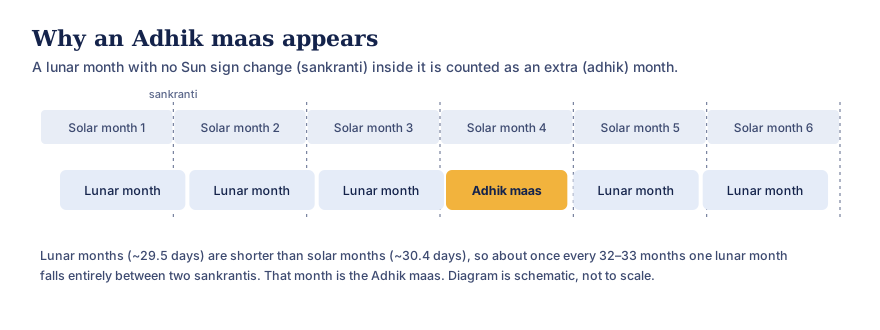
Solar months begin at each sankranti, when the Sun enters a new zodiac sign, and last about 30.4 days. Lunar months last about 29.5 days. Because lunar months are shorter, roughly every 32 to 33 months one lunar month starts and ends without a sankranti inside it. That month is counted as an extra, or Adhik, maas.
3. Calculation. Some sanghs follow calendars based on traditional (siddhantic) methods, others on modern astronomical (drik) positions, which can shift a tithi’s end time by minutes, enough occasionally to change the tithi at sunrise.
4. Festival definitions. Shwetamber Paryushan is eight days culminating in Samvatsari, the day of the annual pratikraman and seeking forgiveness, Michhami Dukkadam. Digamber Das Lakshana Parva is ten days, devoted to ten virtues, beginning on Bhadrapada Shukla Panchami, and concludes with Kshamavani, the day of forgiveness. They follow one another but are distinct observances.
The result is that, in some years, sanghs in the same city observe Samvatsari or other parva days on different dates. Each is faithfully following its own tradition and its own acharyas’ guidance.
Khartargachh
Khartargachh is one of the oldest Shwetamber Murtipujak lineages, with a strong presence in Rajasthan, Gujarat, Madhya Pradesh and among Marwari communities across India. It has its own traditions of calculation and observance, and its calendar can differ from other gachhs’ calendars on some days. OIOA lists Khartargachh as its own calendar option for that reason.
Sthanakwasi
Sthanakwasi communities have their own calendar traditions, often published by their sanghs and associations. OIOA offers a Sthanakwasi calendar option.
Choosing your calendar
If you’re unsure which calendar to follow:
- Ask the elders in your family.
- Ask at your derasar, sthanak or upashraya.
- Follow the calendar of the sangh you belong to locally.
Families who move to a new city sometimes adopt the local sangh’s calendar. OIOA lets you change your calendar whenever you need to.
In OIOA
The Jain Home screen offers calendars for Shwetamber, Digamber, Khartargachh, Sthanakwasi and other traditions, with the tithi at sunrise for your location, the 28 Jain nakshatras and daily Navkarshi time, all calculated on your phone.
The Jain community is diverse, and we know we haven’t covered every tradition. If yours isn’t represented, or OIOA’s calendar doesn’t match your sangh’s on a particular day, please request it and include your sangh’s published calendar if you can.
Common questions
Why do Shwetamber and Digamber Paryushan fall on different days?
They are different observances. Shwetamber Paryushan is eight days ending with Samvatsari; Digamber Das Lakshana Parva is ten days beginning on Bhadrapada Shukla Panchami. They follow one another, so a city’s Shwetamber and Digamber communities observe them across consecutive days.
Why do two Shwetamber sanghs sometimes keep Samvatsari on different days?
Because of differences in how kshaya and vriddhi tithis are handled, how an Adhik maas is counted, or which calculation a calendar uses. Each sangh follows the guidance of its acharyas.
Is one calendar more correct than the others?
OIOA doesn’t take that view. Each tradition’s calendar is the authority for its members. The Jain principle of anekantavada, that truth has many sides, is a good guide to how we try to present these differences.
I belong to a smaller gachh or panth. Can you add it?
Please request it, with your sangh’s published calendar if possible. Every request is read and reviewed.
Key terms
- Gachh: a monastic lineage within the Shwetamber Murtipujak tradition.
- Sampradaya: a tradition or school.
- Sangh: the community of a tradition, often organised locally.
- Tippanu, panchang, tithi-darpan: names for the calendars published by sanghs.
A note on respect
Differences of calendar between sanghs are sometimes discussed with strong feeling, because they touch on what people hold sacred. OIOA’s approach is simple: describe each tradition accurately, offer each family its own calendar, and never present one tradition as the standard against which others are measured. If you feel we’ve fallen short of that anywhere, please tell us.
Can I see another sangh’s calendar in OIOA?
Yes. You can switch your calendar on the Jain Home screen at any time, which can help when relatives or friends follow a different tradition.