An older way of dividing the sky
The Moon takes about 27.3 days to travel once around the sky against the stars. That’s between 27 and 28 days, and early Indian astronomers used both numbers. In the Vedic period, lists of 28 nakshatras are found alongside lists of 27. Over time, Hindu astronomy standardised on 27 equal nakshatras of 13°20′ each.
The Jain tradition preserved the 28-nakshatra system. Jain canonical texts dealing with astronomy and cosmology, such as the Surya Prajnapti and the Chandra Prajnapti, describe the Moon’s passage through 28 nakshatras, and this list remains part of Jain calendrical tradition.
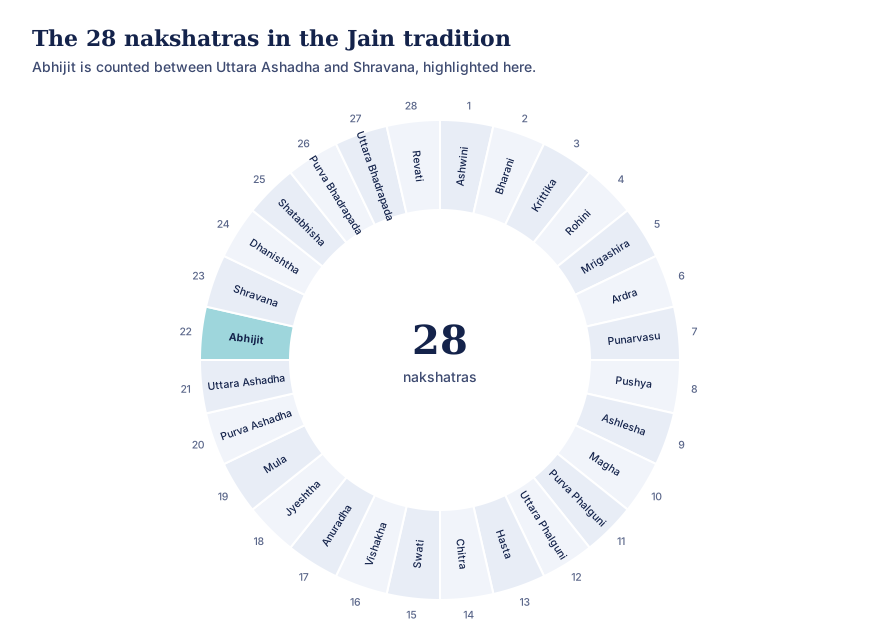
Text version of this diagram
The Jain tradition counts 28 nakshatras. They are the familiar 27, with Abhijit placed between Uttara Ashadha (21st) and Shravana, making Abhijit the 22nd and Revati the 28th.
The extra nakshatra: Abhijit
The 28th nakshatra is Abhijit, placed between Uttara Ashadha and Shravana. It is associated with the bright star Vega (Alpha Lyrae), one of the brightest in the northern sky.
Vega lies far north of the Moon’s path, which may be one reason Abhijit was eventually dropped from the standard equal-division scheme: the Moon never passes close to it. In the 28-nakshatra system, Abhijit occupies only a small portion of the zodiac, commonly described as the last quarter of Uttara Ashadha and the first fifteenth of Shravana, about 4°14′.
Unequal spans
The 28-nakshatra scheme in Jain texts doesn’t divide the zodiac equally. Traditional texts group the nakshatras by the length of time the Moon associates with each, typically in three classes: some of half the standard measure, most of standard measure, and some of one and a half times the standard measure, with Abhijit as a very small portion. This reflects older observation-based reckoning rather than the later neat geometric division.
In practice, for identifying “the Moon’s nakshatra now”, the two systems agree for most of the sky. They differ chiefly around Uttara Ashadha, Abhijit and Shravana.
Compared with the 27-nakshatra system
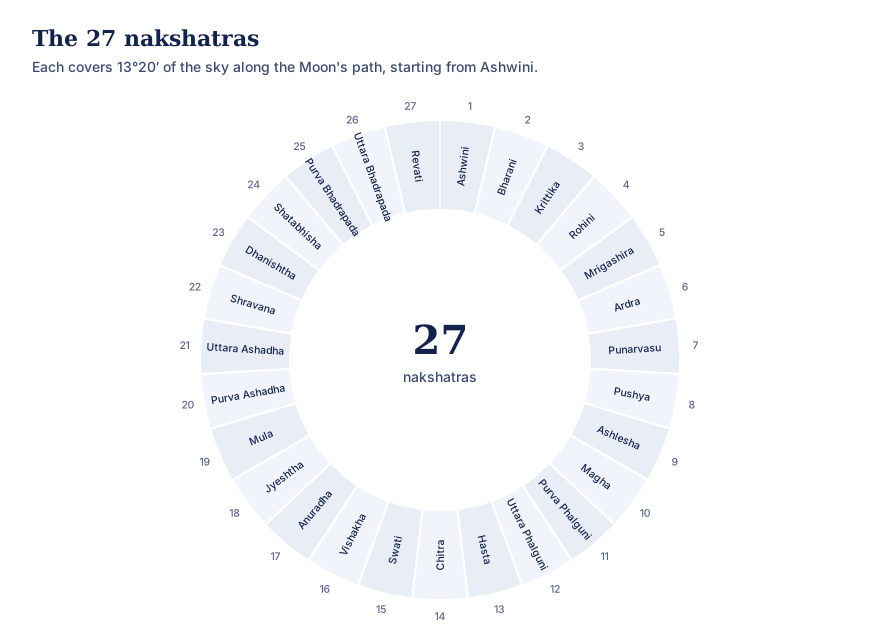
Text version of this diagram
The 27 nakshatras, in order: Ashwini, Bharani, Krittika, Rohini, Mrigashira, Ardra, Punarvasu, Pushya, Ashlesha, Magha, Purva Phalguni, Uttara Phalguni, Hasta, Chitra, Swati, Vishakha, Anuradha, Jyeshtha, Mula, Purva Ashadha, Uttara Ashadha, Shravana, Dhanishtha, Shatabhisha, Purva Bhadrapada, Uttara Bhadrapada and Revati. Each covers 13°20′ of the zodiac.
| 27-nakshatra system | 28-nakshatra system | |
|---|---|---|
| Used in | Most Hindu panchangs | Jain tradition, older Vedic lists |
| Spans | Equal, 13°20′ each | Unequal; Abhijit is small |
| Includes Abhijit | No (Abhijit survives as a muhurta name) | Yes, between Uttara Ashadha and Shravana |
| Padas and rashis | 4 padas each, 9 padas to a rashi | Not structured into equal padas |
Abhijit in other places
The name Abhijit (“victorious”) also survives as the name of the Abhijit muhurat, the eighth of the fifteen daytime muhurtas, around local noon. It’s the same word, with the same association with victory and auspiciousness, applied to a time of day rather than a part of the sky.
How Jain families use the nakshatras
The nakshatra appears in Jain calendars alongside the tithi, and in traditional practice it’s considered in choosing times for religious events such as diksha (initiation), pratishtha (consecration of an image), and the start of pilgrimages and studies. The kalyanak days of the tirthankaras are also associated with particular nakshatras in the scriptures.
In OIOA
On the Jain Home screen, OIOA uses the 28-nakshatra list when it shows today’s nakshatra, calculated on your phone from the Moon’s position, alongside the tithi, Navkarshi and your sect’s calendar. See the 28 nakshatras in OIOA.
If your tradition uses a different convention for the spans or the starting point, please tell us what we missed, with your source.
Common questions
Is Abhijit a real star?
Yes. Abhijit is traditionally identified with Vega, in the constellation Lyra, the fifth-brightest star in the night sky. In India it is visible high in the sky on summer evenings. It lies well north of the Moon’s path, which is part of why its nakshatra is described differently from the others.
Why did Hindu astronomy drop Abhijit?
As Indian mathematical astronomy developed, astronomers preferred to divide the zodiac into equal parts for calculation. With 27 equal parts of 13°20′, each nakshatra also divides neatly into four padas, and nine padas make a zodiac sign. A 28th, unequal division didn’t fit that scheme, so Abhijit was dropped from the standard list while it remained in Jain tradition and in the name of the Abhijit muhurat.
Do Jain calendars use the 28 nakshatras for everything?
Jain tradition uses the 28-nakshatra list in its own astronomical and calendrical texts, and Jain calendars present the nakshatras in that tradition. Some Jain families also refer to the 27-nakshatra list used in general panchangs, for example in matters of horoscope. Practice varies; follow your sangh’s calendar.
What are the Surya Prajnapti and Chandra Prajnapti?
They are Jain canonical texts (upangas in the Shwetamber canon) that deal with the movements of the Sun, Moon and stars as understood in Jain cosmology. They describe, among other things, the Moon’s association with the 28 nakshatras and the reckoning of time.
Are the kalyanak days tied to nakshatras?
The scriptures associate the five kalyanaks of each tirthankara, conception, birth, renunciation, omniscience and liberation, with particular tithis and nakshatras. In practice, Jain calendars observe the kalyanak days by tithi.
Why does OIOA use the 28-nakshatra list for Jain users?
Because it is the list of the Jain tradition. OIOA aims to show each community its calendar as that community keeps it, rather than imposing one standard on everyone.
Key terms
- Nakshatra: a lunar mansion, a section of the Moon’s path among the stars.
- Abhijit: the 28th nakshatra in the Jain list, associated with the star Vega.
- Pada: a quarter of a nakshatra in the 27-nakshatra system (3°20′).
- Kalyanak: one of the five auspicious events in the life of a tirthankara.
A living tradition
The 28-nakshatra list is a reminder that Jain astronomy is a living tradition with its own texts and its own way of seeing the sky. Showing it faithfully is part of OIOA’s commitment to presenting every community’s calendar as that community keeps it.