Mansions of the Moon
Watch the Moon over a few nights and you’ll see it move against the background stars, about 13 degrees each day, completing a circuit in roughly 27.3 days. Very early in Indian history, astronomers divided the Moon’s path into 27 sections, each roughly a day’s journey for the Moon. Each section was named after a prominent star or group of stars within it. These are the nakshatras, sometimes called lunar mansions: places where the Moon “stays” for a night.
In the standard system used in Hindu calendars today, the 360 degrees of the zodiac are divided equally: 360 ÷ 27 = 13°20′ per nakshatra.
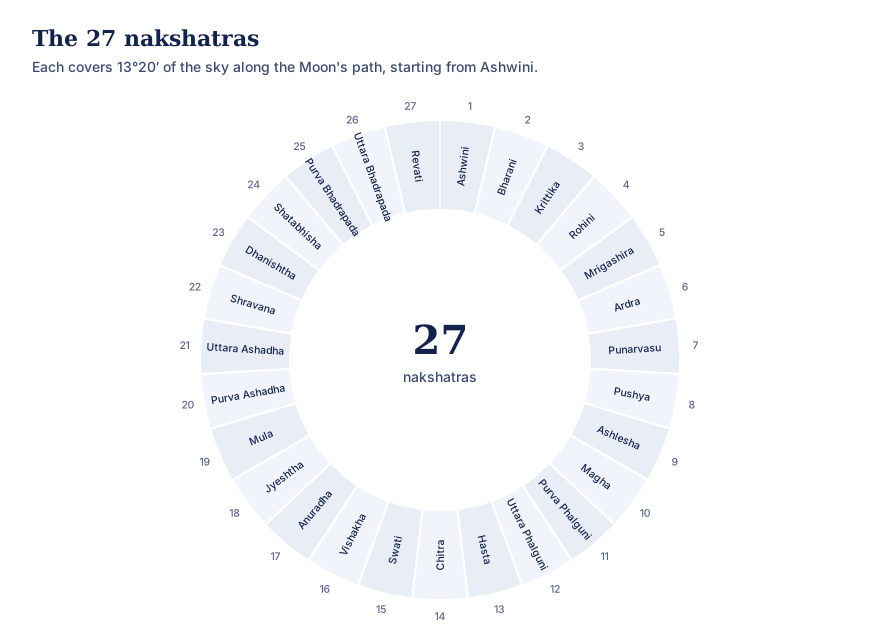
Text version of this diagram
The 27 nakshatras, in order: Ashwini, Bharani, Krittika, Rohini, Mrigashira, Ardra, Punarvasu, Pushya, Ashlesha, Magha, Purva Phalguni, Uttara Phalguni, Hasta, Chitra, Swati, Vishakha, Anuradha, Jyeshtha, Mula, Purva Ashadha, Uttara Ashadha, Shravana, Dhanishtha, Shatabhisha, Purva Bhadrapada, Uttara Bhadrapada and Revati. Each covers 13°20′ of the zodiac.
The 27 names
| # | Nakshatra | # | Nakshatra | # | Nakshatra |
|---|---|---|---|---|---|
| 1 | Ashwini | 10 | Magha | 19 | Mula |
| 2 | Bharani | 11 | Purva Phalguni | 20 | Purva Ashadha |
| 3 | Krittika | 12 | Uttara Phalguni | 21 | Uttara Ashadha |
| 4 | Rohini | 13 | Hasta | 22 | Shravana |
| 5 | Mrigashira | 14 | Chitra | 23 | Dhanishtha |
| 6 | Ardra | 15 | Swati | 24 | Shatabhisha |
| 7 | Punarvasu | 16 | Vishakha | 25 | Purva Bhadrapada |
| 8 | Pushya | 17 | Anuradha | 26 | Uttara Bhadrapada |
| 9 | Ashlesha | 18 | Jyeshtha | 27 | Revati |
Many of these are recognisable stars. Rohini is Aldebaran, the red eye of Taurus; Krittika is the Pleiades; Chitra is Spica; Swati is Arcturus; Magha is Regulus; Jyeshtha is Antares. Names vary by region: Shravana is Thiruvonam in Tamil and Malayalam, Purva Phalguni is Pubba in parts of the south, Mrigashira is Mrigasira or Makayiram, and so on.
Twenty-seven or twenty-eight?
Older Indian texts, and the Jain tradition, count 28 nakshatras, adding Abhijit between Uttara Ashadha and Shravana. In the 28-nakshatra system the sections are not all equal. Over time, the equal 27-part division became standard in Hindu astronomy, while Abhijit survived in Jain calendars and in the name of the Abhijit muhurat. Read the 28 Jain nakshatras.
Padas and the zodiac
Each nakshatra is divided into four padas (quarters) of 3°20′. That makes 27 × 4 = 108 padas around the circle. The twelve zodiac signs (rashis) are 30° each, which is exactly nine padas. So:
- Ashwini (4 padas) + Bharani (4) + Krittika pada 1 = Mesha (Aries)
- Krittika padas 2–4 + Rohini (4) + Mrigashira padas 1–2 = Vrishabha (Taurus)
- …and so on around the zodiac, ending with Purva Bhadrapada pada 4 + Uttara Bhadrapada (4) + Revati (4) = Meena (Pisces).
This tight link means the nakshatra also tells you the Moon’s sign, and it explains why Panchak, the Moon’s passage through the last five nakshatras from the second half of Dhanishtha, corresponds to the Moon being in Kumbha and Meena. The number 108, so significant in Indian tradition, is also the number of padas.
Measured against the stars
Nakshatras are measured in the sidereal zodiac, fixed against the stars. The familiar Western zodiac is tropical, tied to the equinoxes. Because the Earth’s axis slowly wobbles (precession), the two zodiacs drift apart by about one degree every 72 years; today they differ by roughly 24 degrees. The offset between them is called the ayanamsha.
To find the current nakshatra, a calendar takes the Moon’s position from modern astronomy and subtracts the ayanamsha. Different traditions use slightly different ayanamsha values, the Lahiri (Chitrapaksha) ayanamsha adopted by the Indian Calendar Reform Committee being the most widely used, which can shift the time a nakshatra changes by some minutes. That’s one honest reason why two panchangs can disagree slightly.
How the nakshatra is used
Birth nakshatra. The nakshatra the Moon occupied at a person’s birth, the janma nakshatra, is recorded by many families. It is used in some naming traditions, where each pada is linked with a starting syllable for the child’s name, and in traditional horoscope matching.
Festivals. Some festivals are fixed by nakshatra rather than, or as well as, tithi. Onam falls on Thiruvonam nakshatra in the Malayalam month of Chingam; Thaipusam on Pusam (Pushya) in the Tamil month of Thai; Karthigai Deepam when the full moon is near Krittika. Many temples in South India celebrate annual festivals by nakshatra.
Choosing a time. Traditional muhurat-setting classifies nakshatras by their character, such as fixed, movable, gentle, sharp and so on, and considers them alongside the tithi, weekday and other factors. Families consult a priest for important ceremonies.
Naming the months. The lunar months are named after the nakshatra near which the full moon usually falls: Chaitra after Chitra, Vaishakha after Vishakha, Jyeshtha after Jyeshtha, and so on.
How long is the Moon in a nakshatra?
On average just under a day: about 24 hours and 20 minutes. But the Moon’s speed varies along its orbit, so the actual time ranges from roughly 20 to 27 hours. Like a tithi, a nakshatra can begin at any time of day, and occasionally one is “lost” between two sunrises or spans two.
Nakshatras in OIOA
OIOA shows today’s nakshatra on the Hindu and Jain Home screens, calculated on your phone. With your community set to Jain, it uses the 28-nakshatra list. When the Moon is in the last five nakshatras, OIOA shows Panchak.
Common questions
Which nakshatra is considered most auspicious?
Traditions give special regard to several, including Pushya, often called the best for beginnings, Rohini, Hasta, Shravana and Revati, but suitability depends on the purpose and other factors. Muhurat practice is detailed; ask a priest for specific occasions.
Can two people born on the same day have different nakshatras?
Yes. The Moon can move into the next nakshatra at any hour, so two people born on the same day, but hours apart or in different places, can have different birth nakshatras.
Are nakshatras the same as constellations?
Related, but not the same. A nakshatra is an equal 13°20′ section of the zodiac named after a star or group within or near it, whereas a constellation is an irregular area of sky. The section and the stars it’s named for don’t always line up exactly.
How do I find today’s nakshatra?
Open the Hindu or Jain Home screen in OIOA, where the Today card shows it.