The five nakshatras
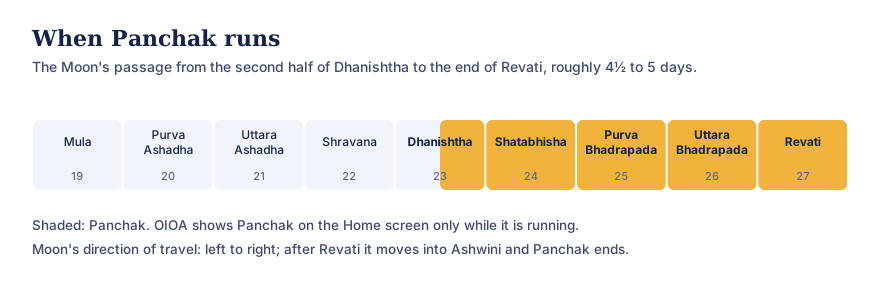
The Moon passes through all 27 nakshatras roughly every 27.3 days. Panchak (from pancha, five) is the time it spends in the last five:
- Dhanishtha, the second half
- Shatabhisha
- Purva Bhadrapada
- Uttara Bhadrapada
- Revati
Strictly, that’s four and a half nakshatras: Panchak begins when the Moon enters the second half of Dhanishtha. That point is also where the Moon enters the zodiac sign Kumbha (Aquarius), and Panchak ends when the Moon leaves Revati, which is also where it leaves Meena (Pisces). So Panchak is equivalently described as the time the Moon is in Kumbha and Meena.
Text version of this diagram
Panchak begins when the Moon enters the second half of Dhanishtha and lasts until it leaves Revati: Dhanishtha (second half), Shatabhisha, Purva Bhadrapada, Uttara Bhadrapada and Revati. This takes roughly four and a half to five days. OIOA shows Panchak only while it is running.
Since the Moon covers about one nakshatra a day, Panchak lasts roughly four and a half to five days, and comes once in each lunar cycle, so about thirteen times a year.
What tradition says to avoid
Panchak is mentioned in traditional texts on muhurat, and customs about it are widely known in North and West India. Commonly avoided during Panchak:
- Collecting fuel, wood or grass, in older tradition, especially during Dhanishtha.
- Building or laying a roof, or beginning construction.
- Making or buying a bed, cot or charpai.
- Travelling south, the direction associated with Yama.
- Funeral rites require special care. If a death occurs in Panchak and the rites can’t be postponed, tradition prescribes specific remedial rituals, commonly including five effigies, so that harm is not believed to come to five more members of the family. These customs vary considerably.
Everyday life, work and many kinds of activity continue normally. Some families take Panchak very seriously; others pay it no attention.
Types of Panchak by weekday
Some calendars name each Panchak by the weekday on which it begins, and give each a different character:
| Starting day | Name | Traditional association |
|---|---|---|
| Sunday | Rog Panchak | Illness |
| Monday | Raj Panchak | Considered favourable, especially for government or property matters |
| Tuesday | Agni Panchak | Fire; caution with construction and machinery |
| Wednesday | (often unnamed) | Considered milder |
| Thursday | (often unnamed) | Considered milder |
| Friday | Chor Panchak | Theft; caution with travel and money |
| Saturday | Mrityu Panchak | Considered the most inauspicious |
These names and associations appear in some panchangs and not others, and the interpretations vary. They are part of tradition, not prediction.
Is Panchak inauspicious for everything?
No. Even within tradition, Panchak is a caution for specific activities, not a blanket prohibition. Some nakshatras within Panchak, such as Revati and Uttara Bhadrapada, are considered favourable for many purposes in general muhurat practice. That’s why many families ask their priest about a specific plan rather than avoiding Panchak entirely.
Why calendars can differ on the timing
Panchak begins and ends at the moment the Moon crosses particular points among the stars. That moment is the same everywhere, but panchangs can disagree by some minutes because they use different ayanamsha values, the offset between the star-based and season-based zodiacs, and different calculation schools. If your printed panchang and OIOA differ by a few minutes, that’s usually the reason.
Why OIOA shows Panchak only while it runs
Panchak is active only on a few days each month. Showing “Panchak: no” every other day would clutter the Home screen and could worry people needlessly. So OIOA shows Panchak only while it is running, with when it ends, as part of the panchang on the Hindu and Jain Home screens. If you don’t see it, it isn’t Panchak.
Because Panchak follows the Moon’s position, it can be calculated in advance. If you’re planning something your family would avoid in Panchak, ask your priest about the dates and set a reminder.
In OIOA
See Panchak in OIOA and today’s nakshatra. For how your family observes Panchak, please follow your priest or community authority, as the disclaimer explains.
Common questions
When is the next Panchak?
Panchak comes once in each lunar cycle, about every 27 days, whenever the Moon reaches the second half of Dhanishtha. OIOA shows it on the Home screen while it’s running, and your priest or panchang can tell you dates in advance.
Is it safe to travel during Panchak?
Tradition advises caution about travelling south during Panchak. Many people travel during Panchak without concern; it’s a matter of family custom.
Can a marriage take place in Panchak?
Muhurat selection for marriage considers many factors, and practice varies. Ask your family priest about a specific date.
Is Panchak observed in South India?
Panchak customs are best known in North and West India. South Indian traditions have their own ways of judging times, such as Rahu Kalam, Yamagandam and Gulika.
Key terms
- Panchak: the Moon’s passage through the last five nakshatras.
- Kumbha and Meena: the zodiac signs Aquarius and Pisces, which the Moon occupies during Panchak.
- Ayanamsha: the offset between the star-based and season-based zodiacs.
Remember
Panchak is about the Moon’s position, not about luck. Many families treat it as a reminder to take care with certain decisions for a few days, and many don’t observe it at all. Whatever your family’s practice, OIOA simply tells you accurately when it is running.
Does every panchang show Panchak?
Most North and West Indian panchangs do. Some calendars, especially in South India, don’t list it, reflecting regional practice.
Panchak and planning ahead
Because Panchak follows the Moon, its dates are known in advance. If your family avoids, for example, starting roof work in Panchak, it’s worth checking the coming months before fixing a date with a contractor. A reminder set a few days before the next Panchak can help you plan around it without it coming as a surprise.
When in doubt about a specific plan, ask your family priest.