What Panchak is
Panchak (from pancha, five) is the period when the Moon travels through the last five of the 27 nakshatras: from the second half of Dhanishtha, through Shatabhisha, Purva Bhadrapada and Uttara Bhadrapada, to the end of Revati. In zodiac terms, this is the time the Moon spends in Kumbha (Aquarius) and Meena (Pisces).
Since the Moon takes a little over 27 days to go round all the nakshatras, Panchak comes once in each lunar cycle and lasts about four and a half to five days.
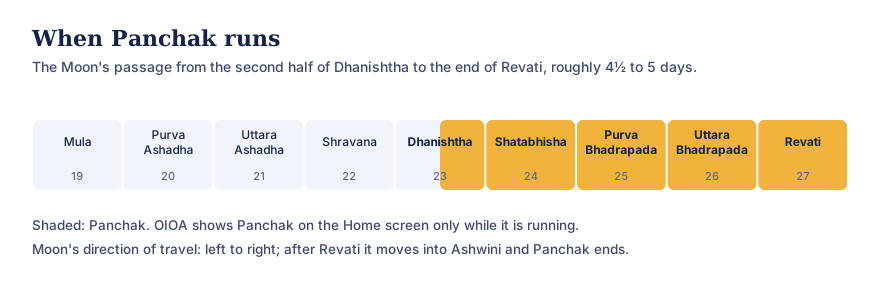
Text version of this diagram
Panchak begins when the Moon enters the second half of Dhanishtha and lasts until it leaves Revati: Dhanishtha (second half), Shatabhisha, Purva Bhadrapada, Uttara Bhadrapada and Revati. This takes roughly four and a half to five days. OIOA shows Panchak only while it is running.
Why OIOA shows it only while it’s running
Most days are not Panchak days. A permanent “Panchak: no” line on the Home screen would add clutter without helping anyone. So OIOA shows Panchak only while it is running, with when it will end. If you don’t see it, it isn’t Panchak.
This fits how most people use Panchak: as a notice that certain activities are traditionally avoided for the next few days.
What is traditionally avoided
Traditions vary by region and family. Activities commonly avoided during Panchak include:
- starting construction of a roof, or laying a roof,
- collecting firewood or fuel,
- making or buying a bed or cot,
- travelling towards the south,
- some rituals connected with death, for which special remedies are prescribed if they cannot be postponed.
Everyday activity continues as usual. Many families pay attention to Panchak only for specific decisions, such as when to begin building work. Please follow your family’s or priest’s guidance; OIOA shows the period but does not advise what to do in it. See the disclaimer.
Kinds of Panchak by weekday
Some calendars name a Panchak by the weekday on which it begins, and give each kind its own character:
| Begins on | Commonly called |
|---|---|
| Sunday | Rog Panchak |
| Monday | Raj Panchak |
| Tuesday | Agni Panchak |
| Friday | Chor Panchak |
| Saturday | Mrityu Panchak |
Panchaks beginning on Wednesday and Thursday are often considered milder. These names are traditional and not universal; you’ll see them in some printed panchangs and not in others.
How OIOA calculates Panchak
Panchak depends on one thing: the Moon’s position among the stars. OIOA calculates the Moon’s sidereal position on your phone and checks whether it lies in the last five nakshatras. Because the nakshatra changes at the same instant everywhere, the start and end of Panchak happen at the same moment across India, but OIOA shows them in your local time.
Different panchangs use slightly different ayanamsha values (the offset between the seasonal and star-based zodiacs), which can move the start or end of Panchak by a few minutes. If your printed calendar is a little different, that is usually why. Read more in The 27 nakshatras explained.
Panchak on the Today card
When Panchak is running, it appears with the rest of the day’s information on the Hindu and Jain Home screens: the tithi, nakshatra, Choghadiya, Rahu Kaal and so on. Drag the live slider to see when, during the day, Panchak ends.
Planning around Panchak
If you’re planning something that your family would avoid during Panchak, such as starting building work, you’ll want to know when the next one falls. OIOA calculates Panchak from the Moon’s position, so it is known in advance. You can set a reminder for the things you’re planning.
Learn more
- What is Panchak?, a longer guide with its history and regional practice.
- The 27 nakshatras
- The Hindu panchang
If OIOA’s Panchak times differ from what your family follows, please tell us what we missed and include your source.
Common questions
How often does Panchak occur?
Once in every lunar cycle of about 27 days, so roughly thirteen times a year.
Is Panchak inauspicious for everything?
No. Tradition advises caution for specific activities, such as building a roof, gathering fuel, buying a bed or travelling south. Ordinary daily life continues normally.
What is Raj Panchak?
A Panchak that begins on a Monday. In tradition, it is considered more favourable than other kinds, especially for government and property matters.
Why doesn’t OIOA show ‘No Panchak’?
Because it would add clutter on most days. OIOA shows Panchak only while it is running; if you don’t see it, it isn’t Panchak.
Does Panchak apply to Jain families?
Panchak is part of the panchang tradition and appears on both the Hindu and Jain Home screens. Whether and how a family observes it is a matter of its own custom.
Does Panchak start at the same moment everywhere?
Yes. It depends only on the Moon’s position, so it begins at the same instant across India. OIOA shows it in your local time.
Is Panchak the same every month?
It always covers the same five nakshatras, but its start and end times, and the weekday on which it begins, change from month to month.