What a nakshatra is
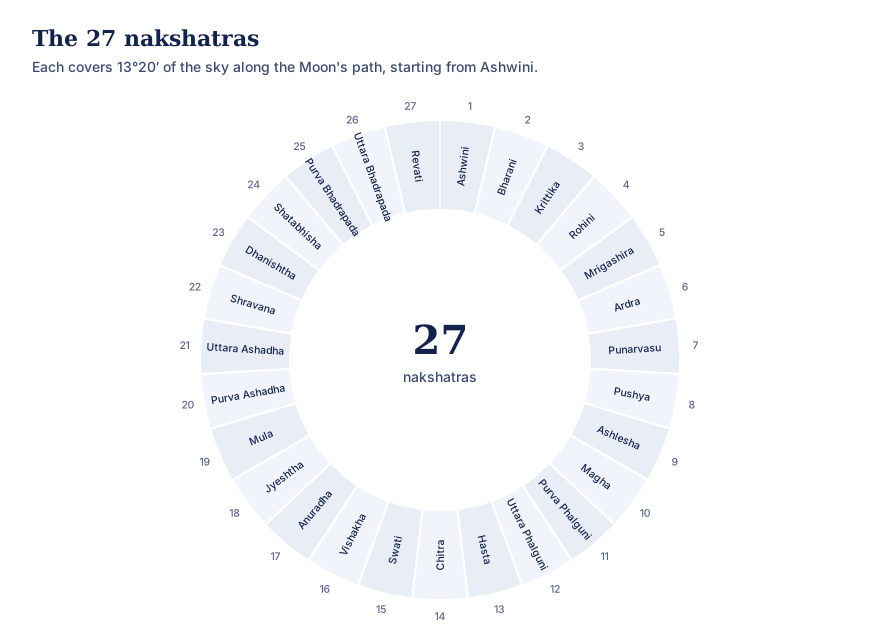
As the Moon travels around the sky each month, it passes a belt of stars. Indian astronomy divides that belt into 27 equal sections called nakshatras, each spanning 13 degrees and 20 minutes. Each nakshatra is named after a star or group of stars in that part of the sky: Ashwini, Bharani, Krittika, Rohini and so on, through to Revati.
The Moon takes a little over 27 days to complete the circle, so it spends roughly a day in each nakshatra. Like the tithi, the nakshatra changes at any hour, not at midnight, because the Moon’s speed varies.
Text version of this diagram
The 27 nakshatras, in order: Ashwini, Bharani, Krittika, Rohini, Mrigashira, Ardra, Punarvasu, Pushya, Ashlesha, Magha, Purva Phalguni, Uttara Phalguni, Hasta, Chitra, Swati, Vishakha, Anuradha, Jyeshtha, Mula, Purva Ashadha, Uttara Ashadha, Shravana, Dhanishtha, Shatabhisha, Purva Bhadrapada, Uttara Bhadrapada and Revati. Each covers 13°20′ of the zodiac.
What OIOA shows
On the Hindu and Jain Home screens, OIOA shows the nakshatra the Moon is in right now, as part of the Today card and the full panchang. Move the live sliders through the day and you’ll see when the Moon passes into the next nakshatra.
When your community is set to Jain, OIOA uses the 28-nakshatra list of the Jain tradition, which includes Abhijit between Uttara Ashadha and Shravana. See the 28 Jain nakshatras.
As with everything in OIOA’s calendar, the nakshatra is calculated on your phone from the date and your location, so it is available offline.
The 27 nakshatras
- Ashwini
- Bharani
- Krittika
- Rohini
- Mrigashira
- Ardra
- Punarvasu
- Pushya
- Ashlesha
- Magha
- Purva Phalguni
- Uttara Phalguni
- Hasta
- Chitra
- Swati
- Vishakha
- Anuradha
- Jyeshtha
- Mula
- Purva Ashadha
- Uttara Ashadha
- Shravana
- Dhanishtha
- Shatabhisha
- Purva Bhadrapada
- Uttara Bhadrapada
- Revati
Names are spelled differently across India: Kartika or Krittika, Pubba for Purva Phalguni in parts of the south, Thiruvonam for Shravana in Tamil, and many more. Switch the app to your language with the EN ⇄ local-language toggle to see the names you know.
Why people check the nakshatra
Birth nakshatra. Many families note the nakshatra in which a child was born, called the janma nakshatra. It is used in naming traditions and in traditional horoscope matching. OIOA’s family and match-making features use birth details, including date, time and place, on your device.
Festivals and observances. Some observances are tied to a nakshatra as well as a tithi. Onam, for example, is linked to Thiruvonam (Shravana) nakshatra in the Malayalam month of Chingam, and several temple festivals in South India are fixed by nakshatra.
Choosing a time. Traditional muhurat-setting considers the nakshatra alongside the tithi, weekday and other factors. OIOA shows the nakshatra so you have it to hand; please consult your family priest or community authority for the full muhurat.
Panchak. When the Moon passes through the last five nakshatras, from the second half of Dhanishtha to the end of Revati, many people observe Panchak and avoid certain activities. OIOA shows Panchak on the Home screen only while it is running.
Nakshatra and the Moon sign
Each nakshatra is divided into four quarters called padas, of 3 degrees 20 minutes each. Nine padas make one zodiac sign (rashi) of 30 degrees. So the nakshatra also tells you the Moon’s sign: Ashwini, Bharani and the first quarter of Krittika fall in Mesha (Aries), and so on around the circle. This is why the last five nakshatras of Panchak correspond to the Moon being in Kumbha and Meena.
How the nakshatra is calculated
The nakshatra depends on the Moon’s position measured along the ecliptic against the fixed stars, the sidereal zodiac used in Indian astronomy. To get there from modern astronomical positions, calendars subtract an ayanamsha, the gradual shift between the seasonal (tropical) and star-based (sidereal) zodiacs. Different traditions use slightly different ayanamshas, which can move the moment a nakshatra changes by some minutes. That is one of the reasons two calendars can disagree on the exact time.
Read more in The 27 nakshatras explained.
Something not right?
If the nakshatra in OIOA differs from your family’s calendar, please tell us what we missed with the date, time, place and the source you compared against. Every report is read, and corrections are noted on the roadmap.
Common questions
How do I find my birth nakshatra?
You need your date, time and place of birth. The Moon’s position at that moment gives the nakshatra. Because the Moon moves through a nakshatra in about a day, the birth time matters; near a boundary, even an hour can change the answer.
Is the nakshatra the same as the zodiac sign?
No, but they’re linked. There are 27 nakshatras and 12 signs; each sign spans two and a quarter nakshatras. Knowing the nakshatra and its quarter (pada) tells you the Moon’s sign.
Why does the nakshatra change in the middle of the day?
Because it depends on the Moon’s position, which changes continuously. The Moon moves into the next nakshatra whenever it crosses a boundary, at any hour.