A lunar day, not a calendar day
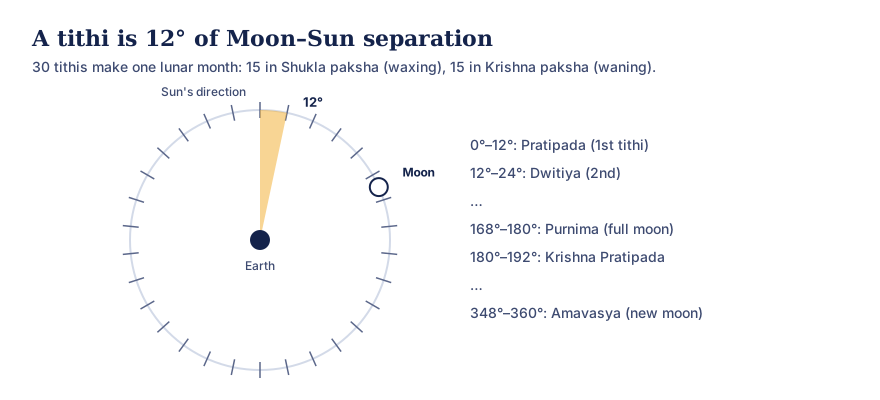
A tithi is a lunar day. It measures how far the Moon has moved ahead of the Sun in the sky. Each time the angle between them grows by 12 degrees, one tithi ends and the next begins. There are 30 tithis in a lunar month: 15 in Shukla paksha, the bright half that runs from new moon to full moon, and 15 in Krishna paksha, the dark half that runs back to new moon.
Text version of this diagram
A tithi is the time it takes for the angle between the Moon and the Sun, as seen from Earth, to grow by 12 degrees. 360 degrees divided by 12 gives 30 tithis in a lunar month. 0–12° is Pratipada, 168–180° ends at Purnima (full moon), and 348–360° ends at Amavasya (new moon).
Because the Moon’s speed varies along its orbit, a tithi is not a fixed length. It can last from roughly 20 to 27 hours. That is why a tithi rarely starts at midnight or at sunrise. It might begin in the middle of the afternoon and end the next morning. Occasionally a tithi begins after one sunrise and ends before the next, so it never touches a sunrise at all. Traditional calendars call this a kshaya (lost) tithi. At other times one tithi spans two sunrises and is counted twice, called a vriddhi (increased) tithi.
What OIOA shows
On the Hindu and Jain Home screens, the tithi appears in the Today card and in the full panchang:
- The name of the current tithi, such as Pratipada, Panchami, Ekadashi, Purnima or Amavasya.
- The paksha it belongs to, so you can tell Shukla Ekadashi from Krishna Ekadashi at a glance.
- Live sliders that let you move through the day and see how the tithi changes, which matters on days when it ends in the morning or evening.
All of this is computed on your phone from your location and the date, so it works offline.
The names of the tithis
The 15 tithis of each paksha share the same names, counted in order:
| Number | Tithi | Number | Tithi |
|---|---|---|---|
| 1 | Pratipada | 9 | Navami |
| 2 | Dwitiya | 10 | Dashami |
| 3 | Tritiya | 11 | Ekadashi |
| 4 | Chaturthi | 12 | Dwadashi |
| 5 | Panchami | 13 | Trayodashi |
| 6 | Shashthi | 14 | Chaturdashi |
| 7 | Saptami | 15 | Purnima (Shukla) or Amavasya (Krishna) |
| 8 | Ashtami |
Regional spellings vary: Padva for Pratipada, Chauth for Chaturthi, Poonam for Purnima, and many more. OIOA shows tithi names in your chosen language when you switch with the language toggle.
Which tithi counts for a festival?
This is one of the most common questions, and the answer depends on tradition. Many observances follow the udaya tithi, the tithi running at sunrise, which then “belongs” to the whole day. Others look at the tithi prevailing at a specific time, such as midday, the evening twilight or midnight. Some festivals have their own rules agreed by a community or a temple.
OIOA shows you the astronomical facts: which tithi is running and when it changes. It does not decide on your behalf which day your family should observe. For that, please follow your community’s authority, and read the sunrise rule for tithis to understand why two calendars may list a festival on different days.
Why your location matters
The tithi is a world-wide quantity: when it changes, it changes at the same instant everywhere. What differs from place to place is the local time at which that happens and which tithi is running at your sunrise. A tithi that ends at 6:30 am IST might still be running at sunrise in Gujarat but already over at sunrise in Assam. That is why OIOA calculates for your location, and why a printed calendar for another city can give a different tithi “for the day”.
Common uses of the tithi
- Fasting days. Ekadashi, Pradosh (Trayodashi), Purnima and Amavasya are observed by many families. A reminder can tell you the day before.
- Festivals. Most Hindu and Jain festivals are fixed by tithi and lunar month rather than by Gregorian date. See festivals.
- Anniversaries. Some families remember birthdays and remembrance days by tithi. Keep them together with the family feature.
- Planning. People often combine the tithi with a Choghadiya or Hora when choosing a time for something important.
Tithi in the Jain calendar
Jain calendars also run on tithis, and certain tithis, such as Ashtami and Chaturdashi, have special significance for fasting and observance. Jain traditions differ in how they treat kshaya and vriddhi tithis, which is one reason sect-aware calendars matter. With your community set to Jain, OIOA shows the tithi along with the 28 Jain nakshatras and calendars for your sect. Read more in Jain tithi and the sunrise rule.
If something looks wrong
If OIOA’s tithi doesn’t match the calendar your family relies on, please tell us what we missed. Include your location, the date and time you checked, and the source you compared with. Differences are usually explained by location or method, but if we have made a mistake we will correct it and say so on the roadmap.
Common questions
What is today’s tithi?
Open the Hindu or Jain Home screen in OIOA: the Today card shows the tithi running now and its paksha, for your location.
Why are there two Ekadashis in a month?
Because there is one in each paksha: Shukla Ekadashi in the bright half and Krishna Ekadashi in the dark half, about two weeks apart.
Can a tithi be missed out altogether?
Yes. A short tithi that begins after one sunrise and ends before the next never names a day. Calendars call this a kshaya tithi.