The puzzle
A tithi is a lunar day of somewhere between about 20 and 27 hours. It begins and ends at whatever moment the Moon gains another 12 degrees on the Sun, which might be the middle of the afternoon or the dead of night. A civil day, by contrast, runs from one sunrise to the next in Indian tradition (or midnight to midnight on the clock).
So on any given day there are usually two tithis: the one that’s ending and the one that’s beginning. Which one names the day?
The sunrise rule
The most widely used answer in Indian calendars is the udaya tithi: the tithi prevailing at the moment of sunrise (udaya) is the tithi of the whole day, from that sunrise until the next. If Ekadashi is running at sunrise, the day is Ekadashi, even if Ekadashi ends at 9 am and Dwadashi runs the rest of the day.
This rule has deep roots. The Hindu day begins at sunrise, and morning rituals, fasts and prayers are anchored to it. Naming the day by the sunrise tithi means the morning’s observances match the day’s name.
When the rule produces a “missing” or “doubled” tithi
Because tithis vary in length, two situations arise regularly:
Kshaya tithi (lost). A short tithi begins after one sunrise and ends before the next. It’s never “the tithi at sunrise”, so no day bears its name. The calendar jumps, say, from Saptami straight to Navami, with Ashtami having come and gone between two sunrises.
Vriddhi tithi (increased). A long tithi begins shortly before one sunrise and is still running at the next. It’s the sunrise tithi on two consecutive days, so its name appears twice, for example two days of Dashami.
Both are normal and happen most months. But they matter a great deal when an observance falls on the affected tithi: if Ekadashi is kshaya, which day do you fast? If it’s vriddhi, do you fast on the first day or the second?
How traditions resolve it
Different texts and communities have their own rules, and this is one of the main reasons festival dates sometimes differ between calendars. Some common principles:
- Ekadashi has its own detailed rules. Vaishnava traditions, for example, often require that Ekadashi not be “touched” by Dashami at a particular time before sunrise, which can move the fast to the next day. This is why some calendars list two Ekadashi dates, one for smarta and one for vaishnava observance.
- For a kshaya tithi, many traditions observe on the day when the tithi began or the day it ended, depending on the observance.
- For a vriddhi tithi, many traditions observe on the first day, others on the second, depending on the observance.
The Jain tradition also has well-developed rules for kshaya and vriddhi tithis, and gachhs and sampradayas differ in them. See Jain tithi and the sunrise rule.
Festivals with their own time of day
The sunrise rule is the default for naming days, but many festivals are tied to the tithi at a particular time of day that suits the festival:
| Festival | Tithi considered at | Why |
|---|---|---|
| Ganesh Chaturthi | Midday (madhyahna) | Ganesha’s birth is traditionally placed at midday |
| Janmashtami | Midnight (nishita) | Krishna’s birth is traditionally placed at midnight |
| Diwali, Lakshmi Puja | Evening (pradosh) | The puja is performed after sunset on Amavasya |
| Karva Chauth, Sankashti Chaturthi | Moonrise | The fast is broken on sighting the Moon |
| Ram Navami | Midday | Rama’s birth is traditionally placed at midday |
| Maha Shivaratri | Midnight | The night-long worship centres on midnight |
So a festival can fall on a day whose sunrise tithi is different from the festival’s tithi. For example, if Chaturthi begins at 10 am, Ganesh Chaturthi can be that day even though its sunrise tithi was Tritiya.
Why location matters so much
The tithi at sunrise depends on when sunrise happens where you are. Indian Standard Time is set for 82.5° E, but sunrise in the far east of India comes well over an hour earlier by the clock than in the far west.
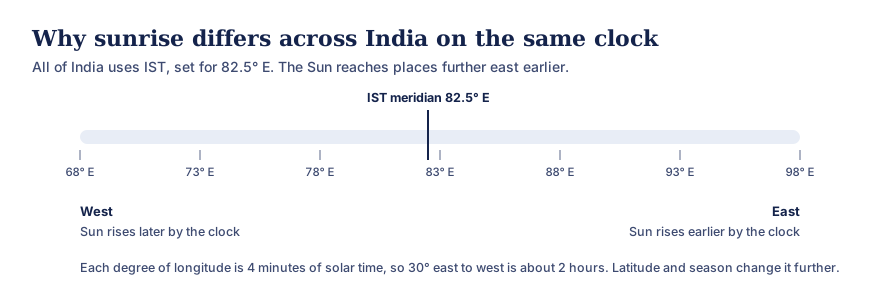
Text version of this diagram
All of India uses Indian Standard Time, which is based on the 82.5° E meridian. Each degree of longitude equals four minutes of solar time, so places in the far east of India see sunrise by the clock up to about an hour earlier than IST’s reference meridian, and places in the far west up to about an hour later. Latitude and the season change sunrise times further.
Suppose a tithi ends at 6:20 am IST. In Guwahati, where the Sun has already risen at, say, 5:00 am, the sunrise tithi is the ending tithi. In Ahmedabad, where sunrise is at, say, 6:30 am, the ending tithi has already finished, and the sunrise tithi is the next one. Same instant, same tithi change, different names for the day.
For relatives living abroad, the difference can be larger still, because the tithi change happens at a different local time altogether. This is why a printed calendar for one city is not exactly right for another, and why OIOA calculates for your location.
A practical guide
- For everyday knowledge, the sunrise tithi tells you “what tithi it is today”.
- For a festival or fast, check which time-of-day rule applies, and whether the tithi is kshaya or vriddhi this time.
- For relatives in other cities or countries, check their local calendar; it may differ by a day.
- When calendars disagree, follow your family priest or community authority. Two calendars can both be correct under different rules.
In OIOA
OIOA shows the tithi running now on the Hindu and Jain Home screens, with live sliders so you can see exactly when it changes during the day, and your local sunrise. These are calculated on your phone for your location. OIOA shows the astronomy; for which day your family observes, please follow your community’s authority, as the disclaimer explains.
Common questions
Why do calendars sometimes show two Ekadashi dates?
Because Smarta and Vaishnava traditions apply different rules about Dashami overlapping Ekadashi before sunrise, so they sometimes fast on consecutive days.
Does the sunrise rule apply to Islamic or Parsi dates?
No. The Islamic day begins at sunset, and Parsi dates follow Roj and Mah, which change at sunrise but aren’t tithis. The udaya tithi rule belongs to the lunisolar panchang.