One time zone, a wide country
India spans roughly 68° E to 97° E in longitude, almost 30 degrees. The Sun moves across the sky 15 degrees an hour, so solar time across India differs by close to two hours from end to end. Yet the whole country keeps a single time zone, Indian Standard Time (IST), UTC+5:30, based on the meridian at 82.5° E, which passes near Mirzapur in Uttar Pradesh.
Text version of this diagram
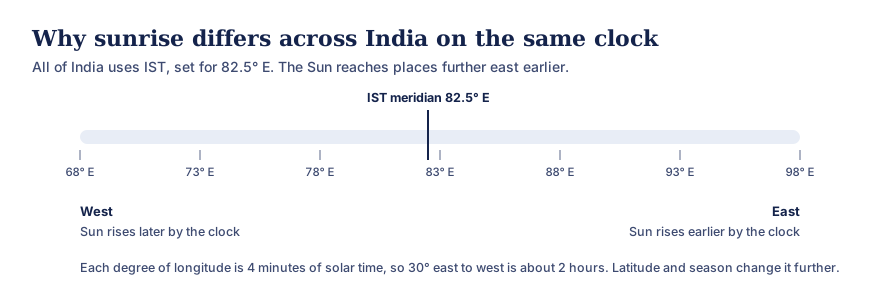
All of India uses Indian Standard Time, which is based on the 82.5° E meridian. Each degree of longitude equals four minutes of solar time, so places in the far east of India see sunrise by the clock up to about an hour earlier than IST’s reference meridian, and places in the far west up to about an hour later. Latitude and the season change sunrise times further.
The rule of thumb: each degree of longitude is four minutes of solar time.
- In the far north-east, around 95° E, the Sun rises and sets about 50 minutes earlier by the clock than at 82.5° E.
- In western Gujarat, around 69° E, it rises and sets about 55 minutes later.
That’s why on the same winter morning the Sun can be up in Arunachal Pradesh before 6 am IST while it’s still dark in Kutch past 7 am.
Latitude and the seasons
Longitude shifts sunrise and sunset by the same amount. Latitude changes the length of the day.
Near the equator, days are close to 12 hours all year. Further north, summer days are longer and winter days shorter. In Srinagar (about 34° N), June daylight is around 14½ hours and December daylight under 10; in Kanyakumari (about 8° N), the difference is only about an hour across the year.
So in June, a northern city has an earlier sunrise and a later sunset than a southern city on the same longitude; in December, the reverse.
The equation of time
There’s a subtler effect. Even at one place, solar noon, when the Sun is highest, doesn’t happen at the same clock time every day. It drifts by up to about 16 minutes earlier or later through the year, because:
- the Earth’s orbit is an ellipse, so it moves faster in early January than in early July, and
- the Earth’s axis is tilted, so the Sun’s apparent motion along the sky isn’t uniform in the east–west direction.
The difference between clock time and sundial time is called the equation of time. It’s the reason the earliest sunset of the year in India comes a couple of weeks before the shortest day, and the latest sunrise a couple of weeks after it.
What counts as “sunrise”?
Even the definition matters. Astronomical almanacs usually define sunrise as the moment the upper edge of the Sun’s disc appears on a flat horizon, allowing for atmospheric refraction, which bends light and lets us see the Sun when it’s actually just below the horizon. Some traditional calendars instead use the moment the centre of the Sun’s disc reaches the horizon, and some ignore refraction. The difference can be two to four minutes.
Hills, buildings and your height above sea level change the sunrise you actually see, but calendars use a standard flat horizon so everyone in a place gets the same answer.
Why this matters for calendars
Almost every traditional timing in OIOA is reckoned from sunrise and sunset:
- the tithi at sunrise, which names the day,
- Rahu Kaal, Choghadiya, Hora and Abhijit, which divide the day,
- Navkarshi, 48 minutes after sunrise,
- Fajr, Maghrib and Isha, tied to the Sun’s position around sunrise and sunset, and Dhuhr to solar noon,
- Sehri and iftar in Ramadan.
A chart for one city can be off by an hour in another. That’s why OIOA calculates for your location.
Your location in OIOA
OIOA uses your phone’s location, or a city you choose, and calculates sunrise, sunset and every timing derived from them on your phone. No server is needed, so it works offline. If you travel, the timings follow you; if you’ve chosen a city manually, remember to change it.
Make sure your phone’s date, time and time zone are set correctly, preferably automatically. A wrong time zone is the most common reason timings look “off”.
A quick check
If OIOA’s sunrise for your city differs from another source by:
- 1 to 4 minutes: almost certainly a different sunrise definition (upper edge vs centre, refraction).
- A few minutes to an hour: probably a different location; check the city each source uses.
- Exactly an hour or more: check your phone’s time zone.
If none of these explains it, please tell us what we missed.
Common questions
Which city in India sees sunrise first?
Places in the far east of Arunachal Pradesh, around Dong in the Anjaw district, are among the first in India to see sunrise.
Why doesn’t India have two time zones?
India has used a single standard time since shortly after independence. Proposals for a separate eastern time zone have been discussed over the years, but IST remains the single official time.
Does altitude change sunrise?
On a mountain with a clear eastern horizon you see the Sun a little earlier than at sea level. Calendars use a standard horizon so the answer doesn’t depend on where exactly you stand.
Key terms
- IST: Indian Standard Time, UTC+5:30, based on 82.5° E.
- Longitude: east–west position; 1° equals four minutes of solar time.
- Latitude: north–south position, which changes day length.
- Solar noon: when the Sun is highest in the sky.
- Equation of time: the yearly drift between solar time and clock time.
- Refraction: the bending of sunlight by the atmosphere near the horizon.
Small differences between sources are normal; large ones usually have a simple explanation.