What Navkarshi is
Navkarshi (also Navkarsi, Navkarasi or Namokarasi) is a pachchakhan, a vow of restraint, kept by many Jains every morning. It means not eating or drinking anything, not even water, from sunset the previous evening until 48 minutes after sunrise, and then reciting the Navkar Mantra (Namokar Mantra) before taking food or drink.
The name comes from that recitation: Navkar + the vow (-si, from sahita, “with”), a fast concluded “with the Navkar”. It is often described as the smallest of the Jain fasts, but kept every day it becomes a lifelong discipline of mindfulness: the day begins with restraint and prayer before anything else.
Why 48 minutes?
Forty-eight minutes is one muhurta, the traditional unit of time: one-thirtieth of a day and night. Navkarshi asks that the first muhurta after sunrise be kept free of food and water. Some traditions also describe the vow in terms of two ghadis (24 minutes each), which is the same 48 minutes.
Working out Navkarshi time
Navkarshi time = sunrise + 48 minutes.
Simple, but sunrise itself changes:
- Through the year. In Ahmedabad, for example, sunrise moves from around 6:00 am in early June to around 7:20 am in early January, so Navkarshi moves by over an hour.
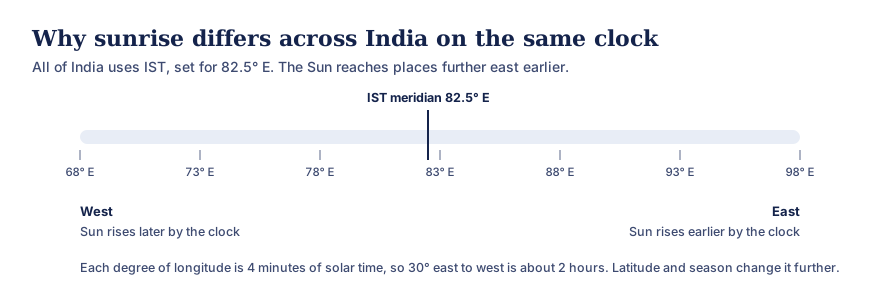
- Between cities. All of India uses one clock, IST, but sunrise in the east comes well over an hour earlier by the clock than in the west. On the same morning, Navkarshi in Kolkata can be about an hour earlier than in Mumbai.
Text version of this diagram
All of India uses Indian Standard Time, which is based on the 82.5° E meridian. Each degree of longitude equals four minutes of solar time, so places in the far east of India see sunrise by the clock up to about an hour earlier than IST’s reference meridian, and places in the far west up to about an hour later. Latitude and the season change sunrise times further.
That’s why a chart printed for one city is not right for another, and why Navkarshi needs your own sunrise. See why sunrise times differ.
The family of pachchakhan
Navkarshi is the first of several time-based pachchakhan, each measured from sunrise. A prahar is a quarter of the daytime (sunrise to sunset ÷ 4):
| Pachchakhan | Ends at |
|---|---|
| Navkarshi | Sunrise + 48 minutes |
| Porsi | Sunrise + 1 prahar (a quarter of the daytime) |
| Sadh-Porsi | Sunrise + 1½ prahar |
| Purimaddh | Sunrise + 2 prahar (about midday) |
| Avaddh | Sunrise + 3 prahar |
There are also vows tied to sunset:
- Chauvihar: no food or water of any kind after sunset, until the next morning’s pachchakhan. Many Jain families keep Chauvihar daily, taking their evening meal before sunset.
- Tivihar and Duvihar: forms that permit some things, such as water, after sunset, depending on the vow.
Exact definitions and permitted items differ between traditions; please follow your guru’s guidance and your sangh’s calendar.
Why sunrise matters so much in Jain practice
The principle of ahimsa, non-violence, is central to Jain life. Eating after dark, or before there is daylight, has traditionally been avoided because of the greater harm to small living beings that cannot be seen. Navkarshi and Chauvihar together frame the day’s eating within daylight. So the times of sunrise and sunset are not just calendar facts; they are part of daily ethics.
Practical tips
- Check today’s sunrise for where you are, especially when travelling.
- Allow a minute or two of margin: sunrise definitions vary slightly between calendars.
- Recite the Navkar Mantra before breaking the vow, as the practice requires.
- For other pachchakhan, use the prahar timings from your sangh’s calendar.
In OIOA
The Jain Home screen shows today’s Navkarshi time for your location, calculated on your phone from your local sunrise, so it works offline and follows you when you travel. See Navkarshi and sect calendars. If you’d like OIOA to show more pachchakhan times, such as Porsi or Chauvihar, please tell us.
Common questions
Can I drink water before Navkarshi time?
Not if you’re keeping Navkarshi: the vow includes all food and water until 48 minutes after sunrise, followed by the Navkar Mantra.
Is Navkarshi only for adults?
Navkarshi is one of the gentlest vows and is often the first that children learn to keep with their families. As with any practice involving fasting, families take children’s health into account, and those who are unwell or need medicine are guided accordingly by their elders and gurus.
What if I’m travelling across time zones?
Navkarshi follows local sunrise wherever you are. When you travel, use sunrise for your current location.
What is the difference between Navkarshi and Porsi?
Navkarshi ends 48 minutes after sunrise; Porsi ends one prahar, a quarter of the daytime, after sunrise, which is typically around three hours. Porsi is a longer vow.
Does Navkarshi apply on every day?
Many Jains keep it daily as a lifelong practice; others keep it on parva tithis or during Paryushan and other observances. It is a personal vow.
Why recite the Navkar Mantra before eating?
The Navkar (Namokar) Mantra, which honours the five supreme beings of Jainism, is recited to complete the vow mindfully. It’s what turns a simple delay into a spiritual practice.
Key terms
- Pachchakhan: a vow of restraint taken for a set time.
- Muhurta: 48 minutes.
- Prahar: a quarter of the daytime (or night-time).
- Chauvihar: abstaining from all food and water after sunset.
A small vow, a large meaning
Navkarshi asks for only 48 minutes. But kept every morning, it shapes the whole day: beginning with restraint and prayer, with awareness of other living beings, and with the discipline of keeping a promise to oneself. That is why so many Jain families teach it first, and why it is worth getting the time right for wherever you wake up.
Is Navkarshi time the same as Brahma muhurta?
No. Brahma muhurta is a period before sunrise, traditionally for prayer and meditation. Navkarshi ends 48 minutes after sunrise.