Two different clocks in the sky
The Gregorian calendar, the one on most walls and phones, is solar. It follows the year of the seasons, about 365.2425 days, with a leap day added in most years divisible by four. Its months have no connection with the Moon.
The Hijri calendar, the Islamic calendar, is lunar. Its months follow the cycle of the Moon’s phases, about 29.53 days, and each month has 29 or 30 days. Twelve such months make a year of about 354 or 355 days. It never adds an extra month, so it has no connection with the seasons.
| Gregorian | Hijri | |
|---|---|---|
| Based on | The Sun (seasons) | The Moon (phases) |
| Year length | 365 or 366 days | 354 or 355 days |
| Months | 28 to 31 days | 29 or 30 days |
| Day begins | Midnight | Sunset |
| Year zero / epoch | Traditional date of the birth of Jesus | The Hijrah, 622 CE |
| Leap rule | Leap day in February | Some calculated calendars add a day to the last month |
Why Islamic dates move about 11 days a year
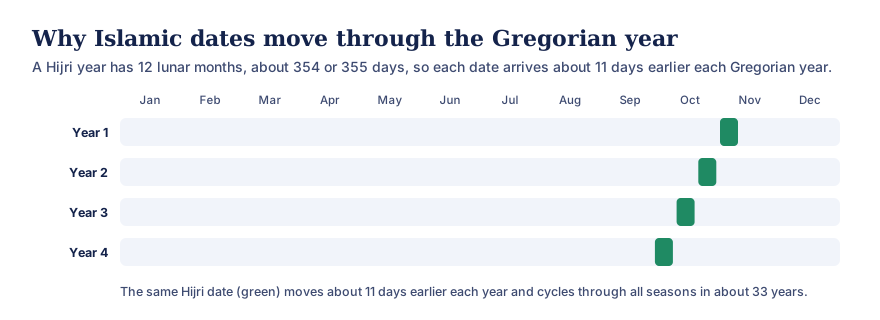
Because the Hijri year is about 11 days shorter than the Gregorian year, each Hijri date falls about 11 days earlier in the Gregorian calendar than it did the year before (sometimes 10 or 12, depending on leap years and the month lengths).
Text version of this diagram
A Hijri year has 12 lunar months and lasts about 354 or 355 days, around 11 days shorter than a Gregorian year. So a given Hijri date falls about 11 days earlier each Gregorian year and passes through every season in about 33 years.
Over about 33 years, a Hijri date travels right round the Gregorian year. That’s why Ramadan can fall in the long, hot days of summer for some years, and in the short, cool days of winter about 16 years later. A person who lives to 66 will have fasted Ramadan in every season twice.
The Hijri months
Muharram, Safar, Rabi’ al-Awwal, Rabi’ al-Thani, Jumada al-Ula, Jumada al-Thaniyah, Rajab, Sha’ban, Ramadan, Shawwal, Dhu al-Qa’dah and Dhu al-Hijjah.
Four of them, Muharram, Rajab, Dhu al-Qa’dah and Dhu al-Hijjah, are traditionally known as the sacred months.
Converting years
There’s no fixed offset between the two year counts, because Hijri years are shorter: 100 Gregorian years contain about 103 Hijri years. A useful approximation:
- Hijri year ≈ (Gregorian year − 622) × 33 ÷ 32
- Gregorian year ≈ Hijri year × 32 ÷ 33 + 622
So the Hijri year number increases a little faster than the Gregorian, and the gap between them, about 579 years today, slowly shrinks.
For exact day-to-day conversion you need to know how the months begin in the calendar you’re using, which is the next topic.
How each month begins
In a lunar calendar, a new month begins with the new crescent Moon. Communities determine this in different ways:
- By sighting the crescent with the naked eye after sunset, locally or regionally. This is the practice of many communities in India, especially for Ramadan, Shawwal and Dhu al-Hijjah. Weather and location affect sighting, so the start of a month can differ by a day between places.
- By an astronomical calculation of when the crescent is expected or is above the horizon, as in the Umm al-Qura calendar of Saudi Arabia.
- By a tabular (arithmetic) cycle of 29- and 30-day months, as in the calendar of the Dawoodi Bohra community.
See moon sighting and Umm al-Qura and Shia and Bohra calendars.
The day begins at sunset
In the Islamic calendar the day begins at sunset. So the night before a date belongs to that date. The first taraweeh prayer of Ramadan is prayed on the evening before the first fast, and Laylat al-Qadr, sought in the last ten nights of Ramadan, begins at sunset.
Living with both calendars
In India, Muslim families live with both calendars every day: the Gregorian calendar for work and school, and the Hijri calendar for religious life. Government holiday lists include Eid, Muharram and Milad-un-Nabi, often with a note that the date may change depending on moon sighting.
In OIOA
The Islamic Home screen in OIOA shows the Islamic calendar with the option you follow, Shia, Bohra (Dawoodi, Misri) or Makkah (Umm al-Qura), alongside prayer times, Jumma and the Qibla, all calculated on your phone. For months your community begins by sighting the moon, please follow your local announcement; OIOA’s date is a guide.
Common questions
What Hijri year is it now?
The Hijri year turns on 1 Muharram, which moves about 11 days earlier each Gregorian year. In 2026 CE, the Hijri year 1448 began around the middle of the Gregorian year. The Islamic Home screen shows today’s Hijri date in the calendar option you follow.
Why don’t Islamic months have fixed lengths?
Because each month begins with the new crescent, and the time between crescents varies between about 29 and 30 days. Calculated and tabular calendars assign 29 or 30 days to each month by rule; sighting-based calendars confirm the length each month.
Is the Islamic calendar used for anything other than religion?
In India it’s used mainly for religious life. In some countries it’s also an official civil calendar, as in Saudi Arabia, where the Umm al-Qura calendar is used.
Will Ramadan ever fall in the same month as last year?
It shifts about 11 days earlier each year, so it can fall partly in the same Gregorian month for two or three years in a row before moving into the previous month.
What does AH mean?
AH stands for Anno Hegirae, “in the year of the Hijrah”, the label for Hijri years, just as CE (or AD) labels Gregorian years.
Key terms
- Hijri: relating to the Hijrah; the Islamic calendar.
- Lunar month: the time from one new moon to the next, about 29.53 days.
- Hilal: the new crescent Moon that begins a month.
- AH / CE: labels for Hijri and Common Era years.