Ramadan
Ramadan (Ramzan) is the ninth month of the Hijri calendar, the month in which, in Islamic belief, the Qur’an began to be revealed. Throughout the month, adult Muslims who are able fast from true dawn to sunset, abstaining from food, drink and other things, as an act of worship, self-discipline and empathy with those in need.
Days in Ramadan are framed by two meals:
- Sehri (suhoor), before dawn, ending at the start of Fajr.
- Iftar, at Maghrib, just after sunset, often begun with dates and water.
Nights bring the special taraweeh prayers, and many seek Laylat al-Qadr, the Night of Power, in the last ten nights. Zakat and sadaqah, charity, are given generously, and before Eid every family pays Zakat al-Fitr so that everyone can celebrate.
Eid al-Fitr
Eid al-Fitr, the festival of breaking the fast, falls on 1 Shawwal, the day after Ramadan ends. It begins with the special Eid prayer in congregation in the morning, followed by visits to family and friends, new clothes, and sweet dishes such as sheer khurma and sevaiyan. Neighbours of every community in India are part of the celebrations.
How the dates are set
Ramadan begins, and ends, with the new crescent Moon. On the 29th evening of Sha’ban, people look for the crescent; if it’s seen, Ramadan begins the next day, and if not, Sha’ban completes 30 days. The same happens at the end of Ramadan for Eid. The evening of sighting before Eid is Chand Raat.
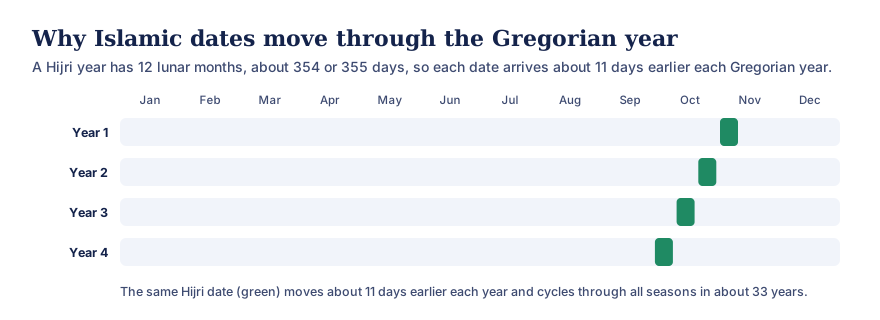
Because the Hijri year is about 11 days shorter than the Gregorian year, Ramadan moves about 11 days earlier each year.
Text version of this diagram
A Hijri year has 12 lunar months and lasts about 354 or 355 days, around 11 days shorter than a Gregorian year. So a given Hijri date falls about 11 days earlier each Gregorian year and passes through every season in about 33 years.
Communities follow different approaches to sighting and calculation, so Ramadan and Eid can begin on different days in different countries or communities. Please follow your local announcement. See moon sighting and Umm al-Qura.
How OIOA helps
- Prayer times for your location, so you know Fajr and Maghrib, the end of sehri and the time of iftar. Follow your mosque’s Ramadan timetable for local precautions.
- The Islamic calendar with the option you follow, to know when Ramadan is expected.
- Reminders before sehri and iftar, and cards for Eid wishes.
Wishing someone
“Ramadan Mubarak” or “Ramzan Kareem” during the month, and “Eid Mubarak” on Eid.