Why there is more than one method
The five daily prayers are tied to the movement of the Sun. Three of them are straightforward to calculate:
- Dhuhr begins just after the Sun passes its highest point (solar noon).
- Asr begins when an object’s shadow reaches a set length.
- Maghrib begins just after sunset.
Fajr and Isha are defined by twilight: the first light of dawn before sunrise, and the disappearance of the evening twilight after sunset. Twilight fades gradually, so calculations need a convention for how far below the horizon the Sun must be. Different scholarly bodies have adopted different angles, and that’s the main difference between methods.
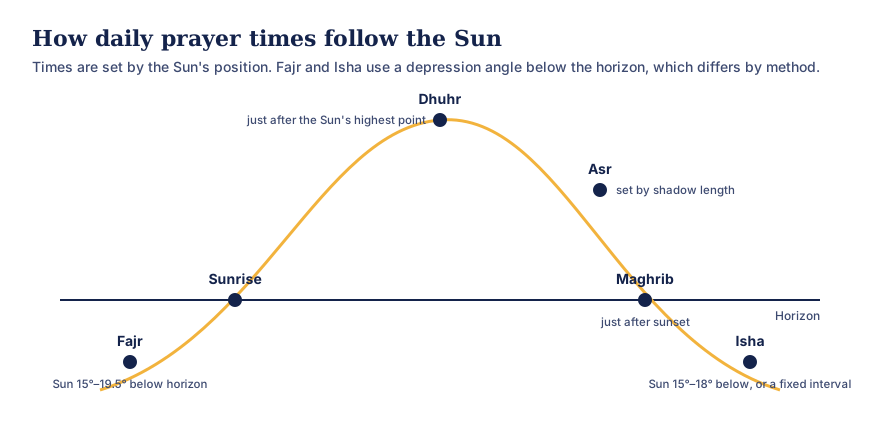
Text version of this diagram
- Fajr: when the Sun is a set angle below the eastern horizon before dawn (commonly between 15° and 19.5°, depending on the method).
- Sunrise: the end of the Fajr window.
- Dhuhr: just after the Sun passes its highest point.
- Asr: when an object’s shadow reaches a set length (the standard rule or the Hanafi rule).
- Maghrib: just after sunset.
- Isha: when the Sun is a set angle below the horizon after dusk (commonly 15° to 18°), or a fixed interval after Maghrib in some methods.
Common methods
These are widely used conventions. The figures are the Sun’s depression angle below the horizon:
| Method | Fajr | Isha | Used widely in |
|---|---|---|---|
| University of Islamic Sciences, Karachi | 18° | 18° | India, Pakistan, Bangladesh, Afghanistan |
| Muslim World League | 18° | 17° | Europe, parts of Asia, as a common default |
| Islamic Society of North America | 15° | 15° | North America |
| Egyptian General Authority of Survey | 19.5° | 17.5° | Egypt, parts of Africa and the Middle East |
| Umm al-Qura, Makkah | 18.5° | 90 minutes after Maghrib (120 in Ramadan) | Saudi Arabia |
OIOA supports Karachi, the Muslim World League and other globally accepted methods. Choose the method your mosque or community follows. In India, the Karachi method is a common choice.
What difference does it make?
A larger angle means an earlier Fajr and a later Isha. In India, the difference between methods is usually a few minutes for Fajr and Isha, while Dhuhr and Maghrib don’t change at all. Dhuhr and Maghrib are the same whatever method you choose, because they depend on solar noon and sunset alone.
Asr: standard and Hanafi
Asr has its own difference, separate from the method. Under the standard rule (followed in the Shafi’i, Maliki and Hanbali schools), Asr begins when an object’s shadow equals its length plus its noon shadow. Under the Hanafi rule, it begins when the shadow is twice the object’s length plus its noon shadow, which is later, often by around an hour in India. Many Sunni Muslims in India follow the Hanafi school. Read Asr: standard and Hanafi for more.
Jumma
On Fridays, Jumma replaces Dhuhr for those who attend the congregational prayer. OIOA shows Jumma alongside the daily times. The khutbah and congregation times are set by each mosque, so please follow your mosque’s timetable for those.
Calculated on your phone
OIOA calculates every prayer time on your device from your location, the date and the method you’ve chosen. There’s no daily download, so prayer times are available offline.
When times don’t match your mosque
If OIOA’s times differ from your mosque’s printed timetable:
- Check that the method matches (for example Karachi rather than MWL).
- Check the Asr rule.
- Check that your location or chosen city is right.
- Remember that printed timetables often add a precautionary minute or two, and that congregation times are set separately.
If you still think something is wrong, please tell us what we missed with your city, the date and the times you’re comparing. Always follow your local mosque or scholar for matters of practice.