Prayer times follow the Sun
The five daily prayers are linked to the Sun’s daily journey. Classical scholarship describes each prayer’s time by observable signs: the first light of dawn, the Sun passing its zenith, the length of shadows, sunset, and the disappearance of the evening twilight. Modern prayer timetables turn those signs into astronomy.
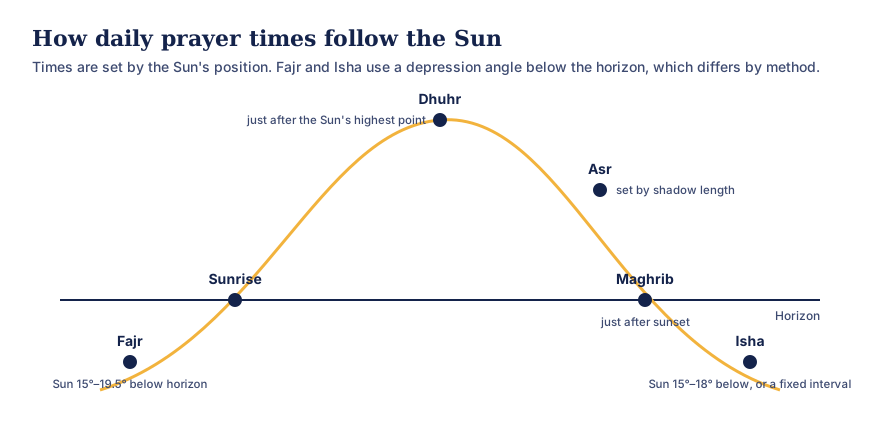
Text version of this diagram
- Fajr: when the Sun is a set angle below the eastern horizon before dawn (commonly between 15° and 19.5°, depending on the method).
- Sunrise: the end of the Fajr window.
- Dhuhr: just after the Sun passes its highest point.
- Asr: when an object’s shadow reaches a set length (the standard rule or the Hanafi rule).
- Maghrib: just after sunset.
- Isha: when the Sun is a set angle below the horizon after dusk (commonly 15° to 18°), or a fixed interval after Maghrib in some methods.
Each prayer, step by step
Fajr begins at true dawn (subh sadiq), when the first horizontal light spreads along the eastern horizon, and ends at sunrise. In calculation, true dawn is defined as the moment the Sun reaches a set angle below the horizon, typically between 15° and 19.5°, depending on the method.
Sunrise marks the end of Fajr. It’s calculated as the moment the Sun’s upper edge appears on the horizon, allowing for atmospheric refraction.
Dhuhr begins just after solar noon, when the Sun crosses the meridian and starts to decline. Timetables often add a minute or a few minutes as a precaution.
Asr begins when the shadow of an object reaches a set length, longer than its shadow at noon. There are two conventions, standard and Hanafi; see Asr: standard and Hanafi.
Maghrib begins just after sunset, when the Sun’s upper edge disappears below the horizon. (Some Shia conventions set Maghrib a little later, when the redness in the eastern sky has passed, often expressed as the Sun about 4° below the horizon.)
Isha begins when the evening twilight disappears. In calculation, that’s when the Sun reaches a set angle below the horizon, typically 15° to 18°, or in some methods a fixed interval after Maghrib.
Why methods differ
Dawn and dusk twilight fade gradually, and observations of exactly when true dawn appears and twilight disappears vary with latitude, season, atmosphere and the observer. Scholarly bodies around the world studied this and adopted conventions:
| Method | Fajr angle | Isha angle |
|---|---|---|
| University of Islamic Sciences, Karachi | 18° | 18° |
| Muslim World League (MWL) | 18° | 17° |
| Islamic Society of North America (ISNA) | 15° | 15° |
| Egyptian General Authority of Survey | 19.5° | 17.5° |
| Umm al-Qura University, Makkah | 18.5° | 90 minutes after Maghrib (120 in Ramadan) |
A larger angle means the Sun is further below the horizon: an earlier Fajr and a later Isha. In India, the difference between the common methods is usually a few minutes. Dhuhr, Asr and Maghrib don’t depend on the method at all; Asr depends only on the juristic rule.
The Karachi method is widely used in India, Pakistan, Bangladesh and Afghanistan. Choose the method your mosque or community follows.
The maths, in plain words
To find when the Sun is at a given angle below the horizon, a calculator needs:
- Your latitude and longitude.
- The date, which gives the Sun’s declination (how far north or south of the equator it is overhead) and the equation of time (the difference between clock noon and solar noon).
- The angle set by the method.
From these, spherical trigonometry gives the hour angle: how long before or after solar noon the Sun reaches that angle. Add or subtract from solar noon, convert to your time zone, and you have the prayer time. The same approach gives sunrise and sunset, using a small negative angle (about 0.833°) to allow for refraction and the Sun’s radius.
High latitudes
At latitudes far from the equator in summer, the Sun may never go 18° below the horizon, so twilight never fully ends and Fajr and Isha can’t be calculated in the usual way. Methods handle this with special rules, such as the “middle of the night”, “one-seventh of the night” or “angle-based” adjustments. For India these situations don’t arise, but they matter for relatives in the UK, Canada or Scandinavia.
Printed timetables and precaution
Many mosques’ printed timetables add a minute or two of precaution (ihtiyat) to some prayers, round times, or use local observation for particular prayers. Congregation (jamaat) times are set separately by each mosque, usually some minutes after the earliest prayer time. So a mosque’s board and a calculated time can differ a little without either being wrong.
In OIOA
The Islamic Home screen in OIOA calculates prayer times on your phone for your location, with Karachi, the Muslim World League and other globally accepted methods to choose from. It also shows Jumma and the Qibla direction. See prayer-time methods in OIOA. For practice and congregation times, please follow your mosque and scholars.
Common questions
Which method should I use in India?
Use the method your mosque or community follows. The Karachi method (University of Islamic Sciences) is common in India and across South Asia.
Why is Fajr earlier in one app than another?
Most likely because the apps use different Fajr angles: an 18° method gives an earlier Fajr than a 15° method. Check the method setting in each.
Do I need to set Asr separately?
Yes. Asr has its own juristic rule, standard or Hanafi, separate from the method that sets Fajr and Isha.
What’s the best time for sehri and iftar in Ramadan?
Sehri (suhoor) ends at Fajr, and iftar is at Maghrib, just after sunset. Many communities stop eating a few minutes before Fajr as a precaution; follow your local mosque’s Ramadan timetable.
Key terms
- Subh sadiq: true dawn, the start of Fajr.
- Shafaq: the evening twilight whose disappearance marks Isha.
- Depression angle: how far the Sun is below the horizon, in degrees.
- Declination: the Sun’s position north or south of the celestial equator.
- Ihtiyat: a precautionary margin added to calculated times.
- Jamaat time: the congregation time set by a mosque.