The afternoon prayer
Asr is the afternoon prayer, between Dhuhr and Maghrib. Classical hadith describe its beginning by the length of shadows: as the afternoon passes, the Sun sinks and shadows grow longer. The schools of Islamic jurisprudence interpreted those reports in two ways, giving two different starting times.
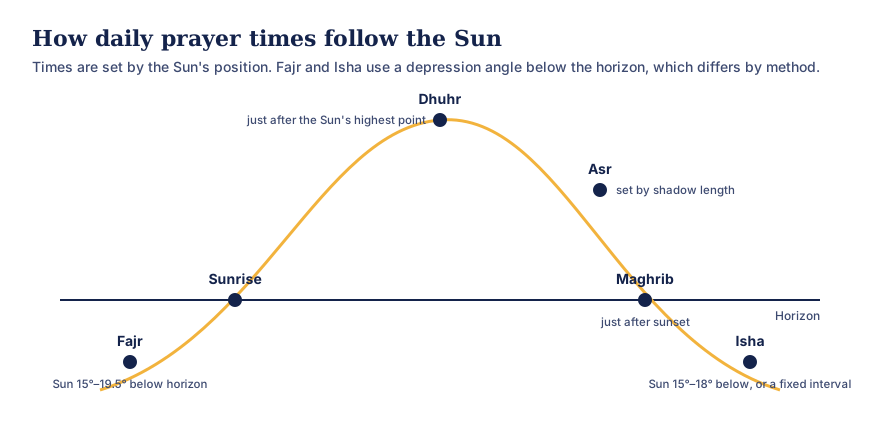
Text version of this diagram
- Fajr: when the Sun is a set angle below the eastern horizon before dawn (commonly between 15° and 19.5°, depending on the method).
- Sunrise: the end of the Fajr window.
- Dhuhr: just after the Sun passes its highest point.
- Asr: when an object’s shadow reaches a set length (the standard rule or the Hanafi rule).
- Maghrib: just after sunset.
- Isha: when the Sun is a set angle below the horizon after dusk (commonly 15° to 18°), or a fixed interval after Maghrib in some methods.
The two rules
At solar noon, every upright object casts its shortest shadow of the day. In India, except near the Tropic of Cancer in midsummer, that noon shadow isn’t zero; it points north. As the afternoon goes on, the shadow lengthens.
Standard rule (mithl awwal, the “first length”). Followed by the Shafi’i, Maliki and Hanbali schools, and by the Ja’fari school in a related form. Asr begins when an object’s shadow equals its own length plus its noon shadow.
Hanafi rule (mithl thani, the “second length”). Followed by the Hanafi school. Asr begins when an object’s shadow equals twice its own length plus its noon shadow.
Since the shadow has to grow longer under the Hanafi rule, Hanafi Asr always begins later.
How far apart are they?
It depends on the latitude and season, but in India the Hanafi Asr usually begins somewhere around 40 minutes to an hour and a quarter after the standard Asr: closer together in summer, when the Sun is high and shadows grow quickly in the afternoon, and further apart in winter.
Many Sunni Muslims in India follow the Hanafi school, so many Indian mosque timetables use Hanafi Asr. Shafi’i communities, including many in Kerala and on the Konkan coast, use the standard Asr. Shia communities follow the Ja’fari convention.
The calculation
The shadow rule can be turned into a Sun angle. If an object of height 1 casts a noon shadow of length s₀, then at Asr its shadow is n + s₀, where n is 1 for the standard rule and 2 for the Hanafi rule. The Sun’s altitude a at that moment satisfies:
cot(a) = n + tan(|latitude − declination|)
where the Sun’s declination is its position north or south of the celestial equator on that date. Once the altitude is known, the same spherical trigonometry used for other prayer times gives the clock time.
You don’t need to do this yourself, but it shows why Asr depends on both your location and the date, and why the gap between the two rules changes through the year.
Which should I use?
Follow the school your family and mosque follow. If you’re unsure, check your local mosque’s timetable: if its Asr is noticeably later than other mosques nearby, it’s probably using the Hanafi rule. Both are established, respected positions, and the difference concerns only when Asr begins; the end of Asr, around sunset, is the same.
Asr and other methods
The Asr rule is separate from the calculation method (Karachi, MWL and so on), which affects only Fajr and Isha. A complete prayer-time setting therefore has two parts: the method for Fajr and Isha, and the juristic rule for Asr. When comparing a calculated time with a mosque’s timetable, check both.
In OIOA
OIOA’s Islamic Home screen calculates prayer times on your phone for your location, with globally accepted methods including Karachi and the Muslim World League. If the Asr time you see doesn’t match the rule your mosque follows, please tell us what we missed. For practice, follow your mosque and scholars.
Common questions
Why is my mosque’s Asr later than the app’s?
The most likely reason is that your mosque uses the Hanafi rule and the app is set to the standard rule, or the other way round. Check the Asr setting first, then the calculation method and your location. Remember also that congregation times are set by the mosque and usually come some minutes after the earliest time.
Is it permissible to pray Asr at the earlier time if I follow the Hanafi school?
That’s a question for your own scholar. Opinions within schools differ on whether, and in what circumstances, one may follow another school’s timing. OIOA only calculates the times; it doesn’t give rulings.
When does Asr end?
All schools agree that Asr continues until sunset, though many scholars regard delaying it until the Sun has turned pale and yellow as disliked except when necessary. The end of Asr is the start of Maghrib.
Why does the gap between the two Asr times change through the year?
The gap depends on how quickly shadows lengthen in the afternoon, which depends on how high the Sun climbs. In summer the noon Sun is high and the afternoon shadow grows quickly, so the two thresholds are reached closer together. In winter the Sun is lower, shadows are already long at noon and grow more slowly in relative terms, so the gap widens.
Does latitude matter?
Yes. Further from the equator, the Sun is lower in the sky for much of the year, noon shadows are longer, and both Asr times shift. That is why Asr in Srinagar and Asr in Kochi differ by more than their longitude alone would suggest.
What about the Ja’fari rule?
In the Ja’fari (Shia Twelver) school, the time for Dhuhr and Asr is understood as shared, with Asr’s particular time beginning after the time needed to pray Dhuhr. Shia timetables commonly show Asr using the shadow rule equal to the object’s length. Please follow your own marja’ and local scholars for the details.
Key terms
- Mithl: a length equal to the object’s height, used to measure shadows.
- Noon shadow (fay’ al-zawal): the shortest shadow of the day, cast at solar noon.
- Declination: how far north or south of the celestial equator the Sun is on a given date.
-
Juristic method: the Asr rule (standard or Hanafi), separate from the Fajr/Isha calculation method.
-
Shafi’i, Maliki, Hanbali, Hanafi: the four main Sunni schools of jurisprudence.
For the other prayers, see how prayer times are calculated; for Fridays, Jumma.