What Jumma is
Jumma (Arabic Jumu’ah, “gathering”) is the Friday congregational prayer. Friday itself is called Yawm al-Jumu’ah, the day of gathering. For those who attend it, the Jumma prayer takes the place of Dhuhr on Fridays. It consists of a khutbah (sermon), usually in two parts, followed by a prayer of two units (rak’ahs) led by the imam in congregation.
Jumma is a communal prayer: it is prayed in a mosque or recognised congregation, not alone. In India, many workplaces and schools make arrangements for Friday afternoons so that people can attend.
When does its time begin?
The time of Jumma is the time of Dhuhr: it begins just after solar noon, when the Sun passes its highest point and begins to decline, and continues until the start of Asr.
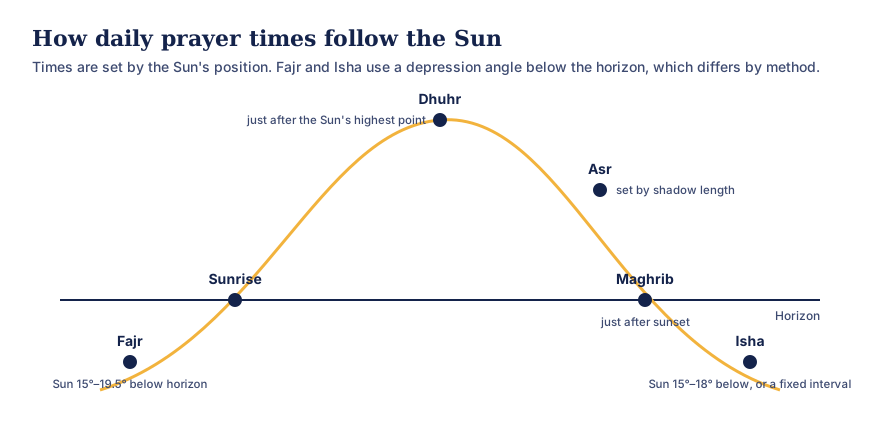
Text version of this diagram
- Fajr: when the Sun is a set angle below the eastern horizon before dawn (commonly between 15° and 19.5°, depending on the method).
- Sunrise: the end of the Fajr window.
- Dhuhr: just after the Sun passes its highest point.
- Asr: when an object’s shadow reaches a set length (the standard rule or the Hanafi rule).
- Maghrib: just after sunset.
- Isha: when the Sun is a set angle below the horizon after dusk (commonly 15° to 18°), or a fixed interval after Maghrib in some methods.
Because solar noon depends on your longitude and the time of year, the start of Jumma’s time differs between cities. Across India, solar noon ranges from before 11:15 IST in the far north-east to around 12:55 IST in the far west, depending on the season. See why sunrise times differ, which explains the same effect for noon.
Khutbah and congregation times
Within the time for Jumma, each mosque sets its own schedule: when the adhan is called, when the khutbah begins and when the congregation prays. In India many mosques hold Jumma between about 12:30 and 2:00 pm, and larger mosques in busy areas sometimes hold more than one congregation.
So a calculated “Jumma time” tells you when the prayer’s time begins. For when to be at the mosque, follow your mosque’s announced timings.
Etiquette and preparation
Traditional recommendations for Friday include:
- Ghusl, a full bath, before going to the mosque.
- Wearing clean, good clothes and, for men, applying perfume.
- Arriving early and listening attentively to the khutbah without talking.
- Reciting Surah al-Kahf on Friday and sending blessings on the Prophet (peace be upon him).
- Making du’a, especially in the last hour before Maghrib on Friday, which many hold to be a time when prayers are accepted.
Practices vary between communities and schools; please follow your own scholars.
Who is required to attend?
According to the major schools, Jumma is obligatory for adult Muslim men who are resident and able to attend, and is not obligatory for women, travellers, the ill and some others, who pray Dhuhr instead; women may attend if they wish, and many mosques have facilities for them. Details vary between schools, so please ask your local scholar.
Planning your Friday
A few practical tips:
- Know your mosque’s khutbah time. Note it in a reminder set to go off with enough time to get there.
- Allow for traffic and parking, which can be heavy near large mosques on Friday afternoons.
- If you’re travelling, use a calculated Dhuhr/Jumma time for where you are, and find out the local mosque’s schedule.
- For meetings at work, it helps colleagues if Friday early afternoons are kept clear.
In OIOA
OIOA’s Islamic Home screen shows Jumma alongside the daily prayer times, calculated on your phone for your location and available offline. Set a reminder before Jumma, and follow your mosque for the khutbah and congregation time.
Common questions
What time is Jumma prayer today?
The time for Jumma begins with Dhuhr, just after solar noon where you are. The congregation is held at the time your mosque announces, usually between about 12:30 and 2:00 pm in India. OIOA’s Islamic Home screen shows Jumma with the day’s prayer times.
How long is the Jumma khutbah?
It varies by mosque, commonly between about 10 and 30 minutes, in two parts with a short sitting between them. In India the khutbah is often delivered partly in Arabic and partly in Urdu or a regional language, and some mosques give a talk in the local language before the khutbah.
What happens if I miss Jumma?
Those who miss the congregation pray Dhuhr instead, in the usual four rak’ahs. For questions about practice, please ask your local scholar.
Is Jumma prayed when travelling?
According to the major schools, travellers are not obliged to attend Jumma, though they may if they wish; otherwise they pray Dhuhr, shortened as travellers’ prayers are. Details differ between schools.
Can Jumma be held in an office or a community hall?
Many communities hold Jumma congregations in halls, offices or other spaces when a mosque isn’t nearby. The conditions for a valid congregation are discussed by scholars of each school; follow your local imam’s guidance.
Why is Friday special?
In Islamic tradition, Friday is the best of the days of the week, the day of gathering, with special recommended acts of worship and a particular hour in which prayers are hoped to be accepted.
Key terms
- Jumu’ah: the Friday congregational prayer; Yawm al-Jumu’ah, Friday.
- Khutbah: the sermon delivered before the Jumma prayer.
- Rak’ah: a unit of prayer; Jumma has two.
- Zawal: the Sun’s passing of the meridian at solar noon, after which Dhuhr and Jumma time begins.
Jumma and the wider community
In many Indian cities, Friday afternoons have a rhythm of their own, as streets near mosques fill and empty around the congregation. Being aware of Jumma times, whether you attend or not, is a small, practical way neighbours and colleagues can be considerate of one another, for example by not scheduling a meeting across the Friday prayer.